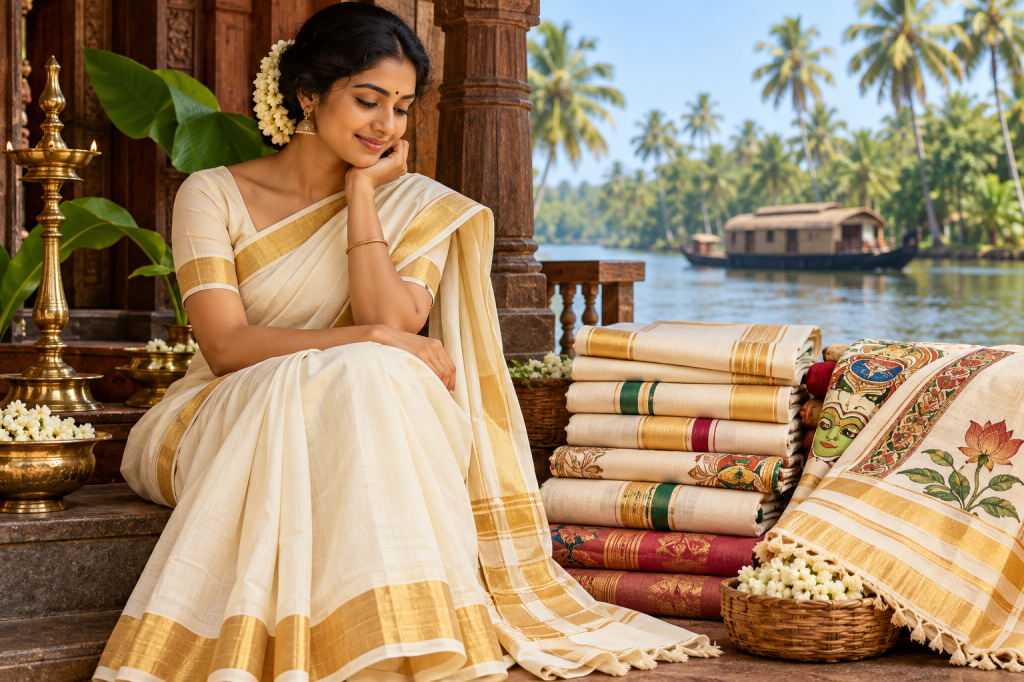
A Complete Guide to the Heritage, Weaves, Kasavu Borders, and Timeless Elegance of Kerala Handlooms
Introduction: The Enduring Charm of Kerala Cotton Sarees
There is something unmistakably graceful about a Kerala cotton saree. Its soft ivory or cream body, beautifully finished border, gentle drape, and understated elegance create a style that feels both traditional and refreshingly modern. Unlike garments that depend on elaborate ornamentation to make an impression, Kerala cotton sarees often achieve their beauty through simplicity, texture, proportion, and the remarkable skill of the hands that make them.
Known for their connection with Kerala’s textile heritage, these sarees represent much more than a particular colour combination or a fashionable way of dressing. They bring together generations of weaving knowledge, regional craftsmanship, distinctive border designs, practical fabric choices, and an aesthetic that continues to inspire contemporary fashion.
The familiar cream saree with a gold-toned border is perhaps the best-known expression of this tradition. Often called a Kerala saree or a Kasavu saree, it has become a recognisable part of the state’s textile identity. Yet the world of Kerala cotton sarees extends far beyond this celebrated combination. Balaramapuram, Chendamangalam, Kuthampully, and Kasaragod each have their own weaving histories and textile characteristics. Mundum Neriyathum offers another perspective on the traditional Kerala drape, while coloured handloom sarees, double-border designs, mural-inspired creations, and Kathakali-themed printed sarees demonstrate how this textile heritage continues to evolve.
These names do not all describe the same kind of thing. Some refer to established weaving centres, some identify a traditional garment or draping arrangement, and others describe the decorative treatment applied to a saree. Understanding these distinctions makes it easier to appreciate the variety within Kerala’s textile landscape.
A saree woven in Balaramapuram, for example, is associated with a particular regional handloom tradition. Kasavu describes a distinctive metallic border or decorative element. Mundum Neriyathum refers to a traditional two-piece form of dress. A mural-painted saree, meanwhile, is identified by its artistic surface decoration rather than necessarily by the place where its fabric was woven.
All these expressions can belong to the wider story of Kerala textiles, but each deserves to be understood on its own terms.
Kerala cotton sarees are also closely connected with the environment in which they developed. Cotton’s familiar qualities—its breathability, softness, and suitability for lightweight weaving—make it a practical choice in a tropical climate. A finely woven cotton saree can be comfortable for long hours, easy to style, and suitable for a variety of occasions. At the same time, the fabric provides an appealing foundation for borders, traditional motifs, contrast selvedges, woven patterns, and metallic accents.
Today, Kerala cotton sarees can be found in traditional handloom collections, contemporary fashion boutiques, specialist textile stores, cooperative outlets, exhibitions, and online shops. Some retain the restrained appearance of classic cream-and-gold designs, while others introduce brighter colours, experimental borders, contemporary prints, and new ways of combining traditional motifs with modern styling.
This guide explores the heritage, regional identities, weaving techniques, materials, draping methods, design variations, care requirements, and current uses of Kerala cotton sarees. It also explains what to look for when choosing a saree, how to distinguish traditional handloom characteristics from decorative styles, and how this enduring textile can find a place in both everyday wardrobes and special-occasion dressing.
The aim is to celebrate Kerala’s textile traditions through a detailed, accessible account of their beauty, craftsmanship, diversity, and continuing relevance.
1. Understanding Kerala Cotton Sarees
1.1 What is a Kerala cotton saree?
A Kerala cotton saree is a saree made wholly or partly from cotton and associated with the textile traditions, design vocabulary, or regional styles of Kerala. The expression is used broadly in everyday conversation, so it can refer to several related but distinct categories.
The classic Kerala saree is generally recognised by its white, off-white, ivory, or cream body, often complemented by a gold-coloured or metallic-looking border. Depending on the weave and the intended design, the body may be plain, subtly textured, or decorated with small motifs. The pallu, or decorative end of the saree, may carry a more prominent border or additional woven details.
Many Kerala sarees are produced by traditional handloom weavers. Their appeal lies in the relationship between the cotton ground, the border, and the overall arrangement of the fabric. Other sarees inspired by Kerala’s visual culture may use printed designs, painted artwork, or contemporary embellishments.
It is therefore useful to distinguish a traditional regional handloom saree from a Kerala-inspired fashion saree. Both can be beautiful and appropriate for different occasions, but they are not automatically identical in their materials, production methods, or regional provenance.
A genuine handloom saree is woven on a loom operated by hand, although the preparation of yarn and other stages may involve different tools and processes. A printed saree may use machine-woven or handwoven fabric that is subsequently decorated. A hand-painted saree may be created by applying artwork to an existing woven textile. Each process produces a different relationship between the fabric and its design.
1.2 The signature cream-and-gold appearance
The combination of a light cotton body and a gold-toned border is one of the most recognisable features of Kerala sarees.
The pale body creates a calm visual field. It allows the border to stand out without making the entire garment appear heavily decorated. The contrast is often gentle rather than dramatic, especially when the border is narrow or the metallic element is used sparingly.
This colour relationship is one reason the saree can be styled in many different ways. A plain cream body works with blouses in white, gold, green, red, blue, black, pink, and numerous other shades. A traditional gold border can connect visually with metallic jewellery, while a coloured blouse can introduce a contemporary accent.
The appearance is not always identical across weaving centres. Some sarees have a subtle cream body and a restrained gold line. Others have broader borders, contrasting coloured edges, or additional motifs. Variations in cotton yarn, weaving structure, finishing, and metallic yarn can also affect how the fabric looks in natural or artificial light.
It is worth remembering that a gold-coloured border does not necessarily consist of solid gold. In traditional textile terminology, kasavu is associated with metallic decorative yarn or a metallic border. Depending on the product, the metallic element may be made from silver-based yarn coated with gold, other metallic-effect yarns, or modern substitutes. Buyers should check the product description rather than assuming that every gold-coloured border has the same composition.
1.3 Cotton, comfort, and the Kerala climate
Cotton has long been valued for its everyday practicality. It can feel pleasant against the skin, allows air to move through the fabric when the weave permits, and is available in a wide range of yarn thicknesses and fabric structures.
These qualities are especially relevant in a warm, humid environment. A lightweight cotton saree can feel less cumbersome than a heavily embellished garment, particularly during extended wear. Its natural-looking surface also suits the understated aesthetic associated with many Kerala handloom designs.
However, not all cotton sarees are equally thin or equally breathable. Fabric weight depends on yarn count, yarn twist, weave density, finishing, and the construction of the border. A closely woven cotton saree may feel more substantial, while a fine, open-textured weave may feel lighter.
The presence of a metallic border can also affect how a saree hangs. A heavier border may help the edge fall neatly, while a lighter border can make the overall drape feel more fluid. These are general tendencies rather than universal rules: the finished result depends on the particular textile.
A thin saree is not automatically better than a thicker one. Fine cotton can be especially elegant, but a medium-weight weave may offer a different balance of structure, coverage, and ease of pleating. The most suitable fabric depends on the wearer’s preferences, the intended occasion, and the way the saree is constructed.
1.4 A textile tradition with many identities
Kerala’s cotton saree heritage is not a single uniform tradition. It includes several weaving clusters, each with its own historical development and established reputation.
Balaramapuram, in Thiruvananthapuram district, is known for fine cotton fabrics and traditional kasavu work. Chendamangalam, in Ernakulam district, has a distinctive handloom heritage. Kuthampully, in Thrissur district, is associated with characteristic saree borders and its own weaving community. Kasaragod, in northern Kerala, represents another regional cotton-saree tradition with influences from the wider coastal region.
These identities are important because they show how a shared preference for cotton and restrained decoration can produce different textile expressions.
Regional variation may be visible in the density of the fabric, the width and construction of the border, the use of coloured yarns, the arrangement of motifs, and the overall character of the finished saree. Such distinctions are best understood as tendencies within established traditions rather than rigid rules that every individual saree must follow.
Kerala cotton sarees also belong to a broader Indian textile landscape in which weaving knowledge has travelled between regions. Weaving communities, markets, patrons, materials, and changing consumer preferences have all contributed to the development of local styles. The result is a rich tradition that combines regional identity with a long history of textile exchange.
2. A Brief History of Kerala’s Cotton Saree Tradition
2.1 The importance of cotton textiles
Cotton has played an important role in the history of clothing across the Indian subcontinent. Its versatility made it suitable for garments ranging from everyday wraps to finely woven fabrics intended for more specialised uses.
Kerala’s position along the southwestern coast of India placed it within networks of trade, travel, and cultural contact. Textile traditions in the region developed in relation to local preferences as well as interactions with neighbouring areas. The history of any individual weaving centre, however, should be considered separately rather than assuming that every Kerala saree emerged at the same time or followed the same path.
Over generations, weavers developed knowledge of yarn preparation, loom operation, border construction, finishing, and fabric handling. These skills were passed through families and communities, creating the specialised expertise that distinguishes established handloom clusters.
The beauty of a finely woven saree is the visible result of this accumulated knowledge. A straight selvedge, balanced border, consistent fabric width, and well-aligned motifs may appear simple, but each depends on careful planning and control throughout the weaving process.
2.2 The development of Balaramapuram weaving
Balaramapuram, in the present-day Thiruvananthapuram district, is one of Kerala’s best-known handloom centres.
According to the Kerala government’s handloom department, the region’s weaving tradition dates back approximately two centuries and is associated with the royal household of Travancore. The account describes the arrival of weaving families from Valliyoor, in present-day Tirunelveli district of Tamil Nadu, during the period of Maharaja Balarama Varma. The weavers were invited to produce fine textiles for the royal household.
The tradition subsequently developed into a recognised centre for fine cotton sarees and other cotton fabrics. Its products became known for their understated appearance, natural cotton colours, and carefully executed decorative borders.
Balaramapuram’s reputation is not based solely on the colour of its sarees. The quality of the cotton ground, the handling of fine yarn, and the integration of metallic decorative elements all contribute to the identity of the textile.
The region’s handloom heritage remains an important part of Kerala’s wider textile story. Traditional designs continue to inspire present-day products, and the familiar cream-and-gold saree remains one of the most recognisable expressions of the cluster.
Balaramapuram sarees and fine cotton fabrics are discussed by the Kerala Handloom Department and Kerala Tourism.
2.3 Chendamangalam and its weaving heritage
Chendamangalam, in Ernakulam district, is another important name in Kerala’s handloom landscape.
The Chendamangalam textile tradition is associated with a long history of fine cotton weaving. Historical accounts connect the development of weaving in the area with the Devanga Chettiar community and the Paliam household in the region. The tradition includes cotton fabrics and later became known for its sarees.
The area’s textile identity is often associated with fine cotton, restrained decoration, and borders that provide definition without overwhelming the body of the fabric. Depending on the design, the saree may combine a pale ground with coloured or metallic accents.
Chendamangalam demonstrates how a regional textile tradition can retain its recognisable character while adapting to changing tastes. Contemporary products may vary in colour, motif, and border treatment, but the handloom identity remains central to the tradition.
For more on the regional history and characteristics of the Chendamangalam saree, see the Chendamangalam saree reference.
2.4 Kuthampully and the development of a distinct saree identity
Kuthampully, in Thrissur district, is widely associated with a distinctive Kerala handloom tradition.
The Kuthampully saree is particularly recognised for its borders. Its identity is connected with the weaving community in the village and with the development of organised handloom activity in the area.
A border can appear to be a small part of a saree, but in a traditional handloom textile it is an important design feature. The border establishes the visual frame of the garment, determines how the edge contrasts with the body, and can influence the way the fabric hangs when worn.
Kuthampully’s established border tradition gives its sarees a recognisable place within Kerala’s textile heritage. The designs can be adapted through changes in colour, width, or decorative detail while continuing to draw on the area’s weaving identity.
The Kuthampully saree reference provides a starting point for exploring the regional tradition and its geographical indication history.
2.5 Kasaragod and northern Kerala’s textile character
Kasaragod, in northern Kerala, has its own cotton-saree tradition.
The Kasaragod saree is associated with weavers of the Saliya community and with the wider textile influences of the Karavali region. This geographical context is significant: northern Kerala has long existed within a cultural landscape that connects the state with neighbouring coastal areas.
As a result, Kasaragod textiles should not automatically be treated as identical to the better-known cream-and-gold sarees of southern Kerala. Regional weaving histories and local design preferences contribute to the character of each tradition.
Kasaragod sarees are generally described as handmade cotton textiles with a durable character. The particular fabric, colour, and border can vary according to the design and producer.
The Kasaragod saree reference outlines its regional identity and connection with the local weaving community.
2.6 Tradition and change
A textile tradition is not frozen at the moment of its historical origin. It continues through the choices made by weavers, designers, retailers, and wearers.
Over time, Kerala cotton sarees have been adapted for different tastes and occasions. The classic cream-and-gold appearance remains important, while coloured borders, contrast selvedges, broader decorative panels, and printed or painted designs provide additional possibilities.
Modern blouses have also changed how traditional sarees are styled. A familiar handloom saree can be paired with a plain blouse for a restrained look, a contrast blouse for a more contemporary appearance, or a blouse that repeats a colour from the border.
New retail channels have widened access to these textiles. Customers can encounter Kerala sarees at local weaving centres, handloom exhibitions, specialist stores, and online retailers. Product descriptions and authenticity labels have consequently become important parts of the buying experience.
The continuing relevance of Kerala cotton sarees comes from this combination of continuity and adaptation. Their characteristic visual language remains recognisable, but the ways in which people select, style, and wear them continue to expand.
3. How Kerala Cotton Sarees Are Made
Understanding how a cotton saree is produced makes it easier to appreciate the skill behind the finished fabric. A saree may look simple when folded on a shop shelf, yet its production involves a sequence of connected stages.
The exact process varies between weaving centres, individual weavers, yarn types, and product designs. The following overview describes common stages in cotton handloom production rather than a single mandatory method followed by every Kerala weaving cluster.
3.1 Selecting the cotton yarn
The process begins with the selection of yarn suitable for the intended fabric.
Cotton yarn varies in thickness, strength, twist, and surface character. Fine yarn can be used to produce a lightweight fabric with a delicate appearance, while a thicker yarn may create a more substantial texture.
Yarn selection influences the appearance and behaviour of the finished saree. It affects the density of the weave, the way the fabric feels in the hand, and the degree to which the saree forms soft folds or more structured pleats.
The yarn must also be suitable for the planned border and motif. A plain cotton body may require a different arrangement of threads from a design that incorporates contrasting colours or metallic decorative yarn.
3.2 Preparing the yarn
Before weaving, yarn must be prepared so that it can be arranged correctly on the loom.
Depending on the production method, this may include winding, measuring, arranging the warp, and preparing the weft. The warp consists of the lengthwise threads stretched on the loom. The weft consists of the threads inserted across the width of the fabric.
The quality of warp preparation is particularly important. The threads must be arranged in the required order and tension so that the fabric can be woven consistently.
Uneven tension can affect the appearance of the cloth, while incorrect thread placement may disrupt a pattern or border. Preparing a long length of warp therefore requires careful measurement and attention to detail.
3.3 Setting up the loom
A traditional handloom allows the weaver to control the movement of warp and weft threads through a series of coordinated actions.
Many handloom sarees are woven on looms that use a mechanism to separate the warp threads and create an opening, or shed, through which the weft passes. The weaver inserts the weft and then brings the newly placed thread into position.
In some Kerala handloom traditions, pit looms and throw-shuttle arrangements are used. Kerala Tourism’s account of Balaramapuram weaving specifically describes traditional throw-shuttle pit looms.
The precise loom configuration is not identical across all producers, and not every saree marketed as a Kerala cotton saree is necessarily woven using the same equipment. Nevertheless, the handloom process allows the maker to exercise direct control over the developing fabric.
3.4 Creating the plain cotton body
Once the loom is prepared, the weaver interlaces the warp and weft to create the fabric.
A plain-weave structure is common in lightweight cotton textiles. In a basic plain weave, each weft thread passes alternately over and under successive warp threads, with the arrangement changing from one row to the next.
This structure produces a balanced fabric in which the warp and weft are closely integrated. The finished surface can appear simple and smooth, allowing the quality of the cotton and the border design to become the main visual features.
However, the phrase “plain cotton saree” does not necessarily indicate that every thread follows one identical arrangement. A saree may include different weave structures or supplementary threads in its border and pallu.
3.5 Weaving the border
The border is one of the most important elements of many Kerala cotton sarees.
Depending on the design, the border may be produced by introducing contrasting yarns, using supplementary decorative threads, or changing the arrangement of threads in a designated section of the fabric.
The process must maintain the intended width and alignment while keeping the body of the saree consistent. When the border includes a metallic effect, the decorative yarn must be handled in a way that allows it to integrate with the cotton structure.
Border construction can be technically demanding because the decorative area must remain balanced with the main fabric. A border that is too heavy for the body may influence the way the saree hangs, while an uneven border can disturb the visual proportions of the finished textile.
The final appearance depends on the design, yarn, loom arrangement, and skill of the weaver.
3.6 Adding motifs and the pallu design
Some sarees have a largely plain body and concentrate their decoration at the pallu. Others introduce small motifs along the body or use a more elaborate border.
Motifs may be incorporated through the weaving process or applied afterwards, depending on the product. Woven motifs are created through the arrangement of threads, while printed motifs are transferred to the fabric’s surface. Painted designs are applied through an artistic process after the fabric has been prepared.
These methods produce different effects. A woven motif is part of the textile structure. A printed motif generally creates a surface pattern. A painted motif may show the individual qualities of the artist’s brushwork.
The pallu is particularly suitable for additional design because it is often visible when the saree is draped over the shoulder. Its decoration can be restrained or elaborate, depending on the intended style.
3.7 Checking and finishing the fabric
After weaving, the saree may undergo inspection and finishing appropriate to the material and production method.
Loose threads may be trimmed, edges checked, and the fabric prepared for presentation. Some textiles receive washing, pressing, or other finishing treatments that affect their feel and appearance.
A finished saree should have an even body, a clearly defined border, and a pallu that complements the overall design. The selvedges—the finished lengthwise edges of the cloth—are also worth examining because they help reveal the consistency of the weaving.
Handloom fabrics can have subtle variations associated with manual production. These variations should be understood in context rather than treated automatically as defects. At the same time, a well-made saree should be structurally sound and suitable for its intended use.
3.8 What makes handloom craftsmanship distinctive?
The identity of a handloom saree is not limited to the fact that it is woven by hand.
The weaver makes decisions throughout the process, from setting the threads to controlling the developing cloth. Pattern placement, border alignment, fabric tension, and the relationship between decorative elements all influence the final result.
In established weaving centres, these decisions are shaped by inherited technical knowledge as well as contemporary experience. Traditional designs provide a starting point, but individual products can vary according to the maker and the specifications of the saree.
For a buyer, understanding this process adds another dimension to the experience of choosing a textile. The saree is not simply a finished garment; it is also the outcome of planning, manual skill, material knowledge, and sustained attention.
4. Cotton, Texture, and Fabric Weight
4.1 Why some Kerala sarees are so fine
Many people associate Kerala cotton sarees with a lightweight, almost airy texture. This quality is particularly noticeable in fine cotton designs with a relatively simple body and a narrow border.
The thinness of a saree is influenced by the yarn and weave rather than by the region’s name alone. Fine yarns can create a lightweight fabric, while a dense arrangement of threads can make even fine cotton feel more substantial.
A saree’s weight also depends on its length and width, the amount of decorative yarn used, and the size of its border. A broad metallic border may make one end of the saree noticeably heavier than the plain body.
Fine cotton can produce elegant folds and a fluid drape. However, its suitability depends on personal preference and the particular garment. Some people enjoy a soft, lightweight saree, while others prefer a firmer cloth that holds pleats more easily.
4.2 Smooth, crisp, soft, and textured finishes
Kerala cotton sarees can feel different even when their colours and borders appear similar.
A finely woven saree may have a smooth surface and a light, flowing drape. A more structured cotton fabric may feel crisp when new and soften with use and washing. A saree with a more visible weave structure can have a slightly textured surface.
Finishing also affects how the fabric feels. A freshly pressed saree may appear sharper than one that has been worn and washed several times. Some cotton fabrics develop a softer hand through regular use, while others retain a more structured character.
The terms “soft,” “crisp,” and “fine” are useful descriptions, but they are not precise technical specifications. When shopping online, it is helpful to look for details about the cotton, fabric weight, weave, and care instructions.
4.3 The relationship between fabric and drape
The drape of a saree is the way the fabric falls, folds, and responds to movement.
Lightweight cotton can create a relaxed, flowing appearance, but very soft fabric may require additional care when arranging pleats. A firmer weave can provide more definition to the front pleats and may stay in place differently.
The border also influences the drape. A distinct edge can provide visual structure, especially when the pallu is placed over the shoulder. A heavy decorative section may fall differently from the lighter body.
These characteristics are not simply matters of appearance. They influence how easy the saree is to wear, how it sits at the waist, and how it responds to walking and sitting.
Trying a saree on, when possible, is one of the most useful ways to assess these qualities. For online purchases, a retailer’s fabric description, dimensions, close-up photographs, and return policy can help establish whether the saree is likely to suit the wearer’s preferences.
5. Kasavu and Zari: Understanding the Signature Border
5.1 What is kasavu?
Kasavu is closely associated with the traditional Kerala saree and its characteristic metallic border.
In everyday usage, people often use the word to describe the gold-toned border itself or, more broadly, the classic cream-and-gold saree. The word is also used in connection with traditional metallic decorative yarn.
The exact composition of the border depends on the textile. Traditional descriptions commonly refer to metallic yarn made with silver coated in gold, while contemporary products may use different metallic-effect materials. The appearance alone is not enough to establish the composition.
This distinction matters when choosing a saree. Two garments may look similar from a distance while differing in the materials used in their borders.
A product description should ideally identify the fabric, the type of metallic yarn or decorative material, and whether the border is woven into the cloth or added through another process.
5.2 What is zari?
Zari is a term widely used in Indian textiles for metallic decorative thread. It may be used to create borders, motifs, patterned panels, and other embellishments.
The composition of zari varies. Depending on the product and tradition, it may involve precious-metal content, metallic strips or coatings, or imitation metallic materials. Therefore, “zari” should not automatically be interpreted as a guarantee of a particular precious-metal composition.
In a Kerala cotton saree, zari provides a contrasting visual element against the cotton ground. It can be woven into a border or used in a more decorative section of the fabric.
The metallic surface catches light differently from cotton, allowing a relatively small border to become visually prominent. This is one reason a simple saree can appear festive without requiring a heavily ornamented body.
5.3 Real metallic yarn and modern alternatives
Traditional metallic yarns and modern metallic-effect yarns may look similar, but their construction, durability, and care requirements can differ.
Some products use traditional zari or kasavu materials, while others use synthetic or imitation metallic yarns. The latter can make a similar visual style available at different price points.
Neither the colour of the border nor the name used in a casual product listing is enough to confirm the precise material. Buyers interested in a traditional specification should ask the seller for details and check whether the information is supported by a reliable product description or authenticity documentation.
Care instructions are particularly important for metallic borders. Some decorative materials may be sensitive to moisture, abrasion, harsh detergents, or prolonged exposure to unsuitable storage conditions.
5.4 Why the border matters so much
In many Kerala cotton sarees, the border is the main decorative feature.
It establishes the edge of the textile, frames the body, and creates a transition between the plain fabric and the pallu. Even a narrow border can provide a strong visual identity when it contrasts with a light cotton ground.
The border also plays an important role in styling. Its colour can be repeated in the blouse, jewellery, or accessories. A gold border can be paired with a blouse in a similar tone for a coordinated appearance or contrasted with a brighter colour for a more contemporary effect.
Border width affects the overall character of the saree. A narrow border tends to produce a restrained look, while a broad border creates a stronger visual frame. Double borders add another layer of detail by using two parallel bands or contrasting border elements.
The placement and construction of the border should be considered alongside the body fabric. A beautiful border is most effective when it complements the proportions, weight, and drape of the saree.
6. Balaramapuram Sarees: Fine Cotton and Traditional Kasavu Craftsmanship
6.1 The identity of Balaramapuram sarees
Balaramapuram sarees are among the most recognised examples of Kerala’s fine cotton handloom tradition.
The weaving centre is located in Thiruvananthapuram district, in the southern part of Kerala. Its reputation is closely associated with fine cotton fabrics, natural cream shades, carefully executed borders, and the use of kasavu or zari in traditional designs.
The characteristic appearance is often understated. Rather than covering the entire saree with elaborate decoration, the design allows the cotton body to remain visually prominent. The border provides a focal point, and the pallu may carry additional decorative detail.
The result is a textile in which the quality of the fabric and the precision of the border are central to its appeal.
6.2 Historical origins
The history of Balaramapuram weaving is commonly traced to the period of the Travancore royal household, approximately two centuries ago.
The Kerala Handloom Department records an account in which weaving families from Valliyoor, in present-day Tamil Nadu, were brought to Balaramapuram during the reign of Maharaja Balarama Varma. They were invited to produce fine textiles for the royal household.
Over time, weaving became established in the region, and Balaramapuram developed a lasting association with fine cotton sarees and other handloom fabrics.
This history illustrates an important feature of Indian textile heritage: regional traditions often develop through the movement of skilled communities, the support of patrons, and the adaptation of existing weaving knowledge to new settings.
The resulting textile identity belongs to Balaramapuram, while its historical development also reflects the wider movement of people and skills across present-day regional boundaries.
6.3 Cotton quality and texture
Balaramapuram sarees are especially associated with fine cotton and a lightweight, refined appearance.
The fabric can have a smooth surface and a soft drape, although the precise feel varies by yarn, weave, and individual product. The natural cream or off-white body allows the border to stand out clearly.
The fabric’s simplicity makes small differences in construction more noticeable. Evenness of weave, the alignment of the border, and the finishing of the edges all contribute to the finished saree’s appearance.
Fine cotton also responds well to understated styling. A plain blouse can allow the textile to remain the main feature, while a coloured blouse introduces contrast without competing with the border.
6.4 Weaving methods
Traditional Balaramapuram production is associated with handloom weaving, including the use of throw-shuttle pit looms described by Kerala Tourism.
In a handloom process, the weaver controls the interlacing of warp and weft to form the cotton body. Decorative elements are incorporated according to the planned design.
The body of the saree may be relatively plain, while the border introduces metallic yarn or contrasting threads. The pallu can carry a stronger decorative arrangement, depending on the particular product.
The exact process varies among designs and producers. Not every saree from the wider region must have an identical weave structure or border composition, so it is best to consider Balaramapuram as a regional handloom identity rather than a single fixed pattern.
6.5 Kasavu borders and the pallu
The cream-and-gold combination is strongly associated with Balaramapuram’s traditional sarees.
The gold-toned border provides a clear visual frame against the pale body. In some designs, the border is relatively narrow and restrained; in others, it is more prominent. The pallu may repeat the border or introduce additional woven decoration.
The beauty of this arrangement comes from proportion. A simple body allows the metallic detail to remain visible without making the garment appear excessively elaborate.
When the saree is worn, the border can appear along the lower edge, around the pleats, and across the shoulder where the pallu falls. These different placements give the same design several visual expressions.
6.6 How Balaramapuram sarees are used today
Balaramapuram sarees are worn for a variety of occasions, including family gatherings, festive events, cultural programmes, formal daytime occasions, and other celebrations.
The classic cream-and-gold version remains a familiar choice, but contemporary offerings may include coloured borders, variations in fabric weight, and changes in the pallu design.
Some people prefer the traditional appearance with a matching or cream blouse. Others choose contrast blouses in green, maroon, red, navy, or brighter contemporary shades.
The saree’s versatility comes from the balance between its plain body and distinctive border. It can be styled in a restrained way or used as the foundation for a more colourful ensemble.
6.7 Where Balaramapuram sarees are available
Balaramapuram sarees may be found through local handloom outlets, cooperative stores, specialist saree retailers, exhibitions, and online sellers that stock Kerala handloom products.
The Kerala Handloom Department and Kerala Tourism provide useful background on the regional tradition. Buyers can also investigate the producer, seller, and product details when selecting an individual saree.
When purchasing online, it is helpful to check whether the listing specifies the actual weaving origin, cotton composition, border material, dimensions, and care instructions. A seller’s use of the word “Balaramapuram” is not by itself proof that a product was woven there.
Where regional authenticity is important, seek clear provenance information and any applicable geographical indication or producer documentation.
6.8 Who might enjoy a Balaramapuram saree?
A Balaramapuram saree may appeal to someone who appreciates fine cotton, a relatively lightweight drape, and understated decorative detail.
It is also a useful option for people who want a traditional textile that can be styled in several ways. The same saree may work with a simple blouse for a quiet, classic appearance or with a contrast blouse for a more contemporary outfit.
For textile enthusiasts, Balaramapuram offers a particularly interesting example of how the quality of the cotton and the execution of the border can create a strong identity without relying on elaborate surface decoration.
7. Chendamangalam Sarees: The Character of a Distinctive Handloom Tradition
7.1 An introduction to Chendamangalam
Chendamangalam is an established handloom centre in Ernakulam district, central Kerala.
The Chendamangalam saree is part of a wider regional textile tradition that includes cotton fabrics and other handloom products. Its identity reflects the history of weaving in the area and the skills developed by the local weaving community.
Although it shares broad visual characteristics with other Kerala cotton sarees, it should not simply be treated as another name for the Balaramapuram saree. Each centre has its own historical associations and established textile identity.
7.2 Historical development
Historical accounts connect Chendamangalam’s weaving tradition with the Devanga Chettiar community, which settled in the area during the sixteenth century. The tradition is also associated with the Paliam household and the historical Cochin region.
Accounts of the area’s early weaving describe fine cotton fabrics, including muslin and dhoti cloth. Over time, the weaving tradition expanded and developed into a broader range of textile products, including sarees.
As with other regional handloom traditions, its history reflects the importance of specialised weaving knowledge and the way local textile production developed through community networks and changing demand.
The Chendamangalam saree reference provides further historical background.
7.3 Cotton texture and visual character
Chendamangalam sarees are associated with cotton handloom production and restrained design.
The exact fabric weight and surface texture vary, but the cotton ground is an important part of the textile’s appeal. The body may be relatively simple, allowing the border and pallu to provide the principal decorative interest.
Depending on the design, coloured borders and woven accents can introduce contrast while preserving a balanced overall appearance.
When assessing a particular saree, it is useful to examine the cotton’s density, the consistency of the weave, and the way the border is integrated into the fabric. These features provide more information about the individual textile than its colour alone.
7.4 Borders, motifs, and construction
Borders play an important role in the visual character of Chendamangalam sarees.
The precise border may vary according to the design, but the relationship between the border and the body is an important feature to observe. A contrasting edge can create definition, while a more restrained border can preserve the quiet appearance of the cotton ground.
Some contemporary versions introduce brighter colours or decorative motifs. Such adaptations allow the regional textile tradition to remain relevant to changing tastes.
It is important, however, to distinguish an established handloom product from a saree that merely borrows a similar colour scheme. A Kerala-inspired design can be attractive without necessarily having been woven in Chendamangalam.
7.5 How Chendamangalam sarees are worn today
Chendamangalam sarees can be styled for family occasions, cultural programmes, formal daytime gatherings, and everyday wear, depending on the fabric and design.
A simple cotton saree can be paired with a plain blouse to create a classic look. If the border contains a distinct colour, the blouse can repeat that shade or introduce a complementary contrast.
For a contemporary appearance, the saree can be paired with a neatly tailored blouse, understated jewellery, and simple footwear. For a more traditional look, a coordinated blouse and restrained accessories allow the handloom textile to remain the focus.
The best styling approach depends on the particular saree rather than on the regional name alone.
7.6 Present-day availability
Chendamangalam handloom products can be sought through regional textile outlets, handloom exhibitions, specialist saree shops, and online retailers that identify the source of their products.
Availability changes according to the producer, design, and stock cycle. A specific border or colour may not be available throughout the year.
When shopping, ask whether the saree was woven in Chendamangalam, whether the fabric is cotton, and how the border and motifs were produced. Where authenticity is important, check any applicable geographical indication information and the credentials of the seller or producer.
7.7 Why Chendamangalam matters
Chendamangalam contributes to the diversity of Kerala’s textile heritage by preserving a regional weaving identity within the wider cotton-saree tradition.
Its story reminds us that traditional textiles are not defined only by their appearance. Their provenance, the skills of their makers, and the history of their production are equally important.
For someone building an appreciation of Kerala handlooms, a Chendamangalam saree offers an opportunity to explore a distinct regional tradition rather than viewing every cream cotton saree as interchangeable.
8. Kuthampully Sarees: Borders, Precision, and Regional Identity
8.1 The Kuthampully weaving centre
Kuthampully, in Thrissur district, is one of Kerala’s recognised handloom centres.
The Kuthampully saree has an established identity associated with its borders and the local weaving tradition. Its history is connected with a weaving community whose skills developed into a distinctive regional textile practice.
Kuthampully is particularly useful to consider when exploring how a design feature as seemingly simple as a border can become the defining characteristic of a saree.
8.2 Historical background
The Kuthampully saree is associated with the weaving community in the village and with organised handloom production in the region.
A handloom cooperative society was registered in 1972, according to the commonly cited historical account of the Kuthampully saree. The saree later received geographical indication recognition in 2011.
The cooperative and GI history are relevant because they help identify the product as a regional textile tradition rather than a general decorative style.
A geographical indication identifies goods associated with a particular geographical origin and qualities or reputation linked to that origin. It does not mean that every saree with a similar appearance has the same provenance. Buyers should still verify the producer and product details.
8.3 Border design as a signature feature
The border is central to the identity of Kuthampully sarees.
A well-defined border gives the textile its visual frame. It can be used to create contrast, establish a traditional appearance, or introduce a brighter design element.
Depending on the product, the border may be gold-toned, coloured, or constructed with multiple bands. The body can remain relatively plain, creating a balanced contrast between the cotton ground and the decorative edge.
When the saree is draped, the border appears in several places. It outlines the lower edge, helps define the pleats, and provides a visible accent where the pallu crosses the shoulder.
This repeated appearance is one reason the border’s alignment and finishing are important. The design must remain visually consistent along the length of the textile.
8.4 Cotton, weave, and texture
Kuthampully sarees belong to Kerala’s handloom textile landscape, but the exact texture varies by product.
Cotton sarees may be lightweight or moderately substantial depending on the yarn and weave. A fine cotton body creates a softer drape, while a firmer weave can help maintain more structured pleats.
The border may also affect the overall weight. A more elaborate edge can provide additional structure, while a narrow border can preserve a lighter appearance.
A buyer should therefore assess the particular saree rather than assuming that all Kuthampully products have the same thickness, softness, or draping behaviour.
8.5 Contemporary interpretations
Traditional border designs can provide a foundation for contemporary variations.
Modern Kuthampully-inspired sarees may feature changes in border colour, width, or motif placement. Some designs preserve a restrained cream-and-gold palette, while others use stronger contrasts.
The body may remain plain, or it may incorporate subtle decorative elements. The pallu can repeat the border or introduce a more elaborate arrangement.
Such variation demonstrates how regional handloom traditions can develop without abandoning the visual features that make them recognisable.
When a product is described as “Kuthampully-inspired,” the phrase may indicate a design influence rather than an actual weaving origin. The distinction is worth checking when buying a saree for its regional provenance.
8.6 Styling a Kuthampully saree
A Kuthampully saree can be styled in ways that emphasise its border.
A plain blouse in cream or white keeps the overall appearance restrained. A gold-toned blouse can coordinate with a metallic border, while a contrast blouse can highlight a coloured edge.
If the border is broad, a simple blouse may help maintain balance. If the border is narrow, a stronger blouse colour can introduce a more noticeable accent without competing with the saree.
Accessories can be selected to complement the design rather than reproduce every colour. Simple earrings, a modest necklace, or a coordinated handbag can complete the outfit.
The aim is not to follow a single fixed styling rule but to let the saree’s proportions and decorative details guide the final combination.
8.7 Availability today
Kuthampully sarees are available through regional handloom sellers, specialist retailers, exhibitions, and online stores that stock Kerala textiles.
Designs, colours, and fabric specifications vary between producers. Buyers should examine the product description carefully and ask about the actual weaving location, cotton composition, border construction, and any applicable GI documentation.
The Kuthampully saree reference is a useful starting point for learning about the tradition and its recognition.
8.8 The continuing value of Kuthampully
Kuthampully’s contribution to Kerala’s handloom heritage demonstrates how a regional textile identity can be built around craftsmanship and a distinctive design vocabulary.
The saree’s border is not simply an ornament attached to the fabric. It is part of the textile’s construction and visual structure. Its careful execution links the finished garment to the knowledge of the weaver and the established practices of the weaving centre.
For people who enjoy traditional cotton sarees with a clearly defined edge, Kuthampully offers an especially interesting regional tradition to explore.
9. Kasaragod Sarees: Northern Kerala’s Cotton Weaving Tradition
9.1 An introduction to Kasaragod sarees
Kasaragod sarees represent an important part of Kerala’s northern textile landscape.
Kasaragod district lies in northern Kerala, within a wider coastal region that has long shared cultural and commercial connections with neighbouring areas. Its saree tradition reflects this regional context.
The Kasaragod saree is associated with the Saliya weaving community. It is generally described as a handmade cotton textile, with an identity distinct from the familiar cream-and-gold Kerala saree commonly associated with the southern part of the state.
This distinction is important because the expression “Kerala saree” can sometimes be used so broadly that regional differences disappear from view.
9.2 Historical and regional influences
The Kasaragod weaving tradition developed within the social and cultural setting of northern Kerala.
The wider Karavali region, which extends along the southwestern coast, has its own textile and clothing traditions. Regional proximity and long-standing contact have helped create a diverse cultural landscape in which different weaving practices coexist and influence one another.
It is not necessary to assume that all these traditions are identical to recognise their connections. Kasaragod’s textile identity remains grounded in its own weaving community and regional history.
The Kasaragod saree reference provides further information about its origin and the community associated with its production.
9.3 Fabric character and durability
Kasaragod sarees are associated with handmade cotton fabrics and a durable character.
As with other cotton handlooms, the exact texture depends on yarn thickness, weave density, finishing, and the design of the individual saree.
Some cotton fabrics have a firmer hand and hold their shape well, while others feel softer and drape more fluidly. The border and decorative elements may also affect the fabric’s weight and movement.
A buyer should examine the textile directly whenever possible. The way a saree folds, the consistency of its weave, and the quality of its selvedges all provide useful information about the particular product.
9.4 Colour and border possibilities
Kasaragod sarees should not be understood solely through the cream-and-gold palette associated with the classic Kerala saree.
Regional handloom products can vary in colour, border treatment, and decorative arrangement. A pale cotton ground may be paired with a contrasting edge, while other designs may place greater emphasis on coloured yarns or a more substantial woven structure.
The exact design available depends on the producer and collection. It is better to consult individual product specifications than to assume that every Kasaragod saree follows one fixed pattern.
9.5 How Kasaragod sarees are worn
A Kasaragod cotton saree can be styled for everyday use, family occasions, cultural gatherings, and other settings according to its weight and decorative character.
A simple blouse can emphasise the fabric itself. A contrast blouse may pick up the border colour or introduce a complementary shade.
The styling approach can be similar to that used for other cotton sarees, but the final appearance should respond to the individual textile. A stronger border may work well with a plain blouse, while a more restrained design may allow greater freedom in blouse colour and accessories.
9.6 Where to find Kasaragod sarees
Kasaragod sarees may be sought through local handloom outlets, regional textile sellers, exhibitions, and online retailers specialising in Kerala handloom products.
The availability of a particular design can vary, and online listings may use regional names in different ways. Ask whether the saree was actually woven in Kasaragod, which cotton and border materials are used, and whether the producer can provide information about its origin.
Where regional authenticity is important, check the seller’s details and any relevant provenance documentation.
9.7 Why Kasaragod deserves attention
Kasaragod adds geographical and cultural depth to the story of Kerala cotton sarees.
It reminds us that the state’s textile heritage extends beyond a single colour palette or a single weaving cluster. Regional communities have developed their own practices, and these differences enrich the broader handloom landscape.
Exploring Kasaragod alongside Balaramapuram, Chendamangalam, and Kuthampully offers a more complete understanding of Kerala’s cotton-saree traditions.
10. Kasavu Sarees: The Classic Kerala Cotton Look
10.1 Understanding the term
Kasavu saree is one of the most familiar expressions associated with Kerala’s traditional cotton clothing.
In common usage, the term often describes a light-coloured saree with a gold-toned or metallic border. The word is also associated with the metallic decorative element itself.
This means that “Kasavu saree” is primarily a description of a recognisable textile style, whereas Balaramapuram, Chendamangalam, Kuthampully, and Kasaragod refer to regional weaving identities.
A saree can belong to a particular handloom tradition and incorporate kasavu. Conversely, a commercially produced saree may imitate the cream-and-gold appearance without sharing the same weaving origin or materials.
For a careful buyer, the difference between design, material, and provenance is worth understanding.
10.2 The classic colour palette
The traditional kasavu appearance is built around a light cotton ground and a metallic-looking border.
The body may be described as white, cream, ivory, or off-white. These shades are not always identical, and differences in cotton yarn and finishing can affect the final appearance.
The border may be gold-toned, silver-toned, or combined with other colours, depending on the product. Traditional designs often keep the body relatively plain so that the border becomes the principal decorative element.
This restrained colour palette creates a versatile foundation for styling. The blouse can match the body, repeat the metallic accent, or introduce a contrasting colour.
10.3 How the border is created
In a traditional woven saree, the border is integrated into the textile through the weaving process.
The arrangement depends on the design and loom setup. Contrasting threads or supplementary decorative yarns can be used to form the border, while the main body retains its cotton structure.
The weaver must maintain the border’s intended width and alignment as the fabric develops. This requires careful control of the yarns and the relationship between the border and the body.
Other sarees may use metallic-effect decoration applied through a different production method. The finished appearance can be similar, but the construction is not necessarily the same.
When a buyer wants a woven kasavu border, it is useful to ask the seller whether the metallic element is woven into the cloth and what material it contains.
10.4 The beauty of restraint
One of the distinctive features of the classic kasavu saree is the balance between the plain body and the decorative edge.
The design does not need a large number of motifs to create visual interest. The light cotton provides a calm background, and the metallic border creates a clear frame.
This restraint makes the saree easy to adapt to different personal styles. It can be worn with a simple blouse and minimal accessories or styled with more elaborate jewellery for a special occasion.
The saree’s simplicity also makes the details of its construction more visible. The evenness of the cotton, the alignment of the border, and the finish of the pallu all contribute to its final appearance.
10.5 How kasavu sarees are worn today
Kasavu sarees are worn in a wide variety of settings, including family celebrations, festive gatherings, cultural events, formal daytime occasions, and contemporary social functions.
Some wearers prefer a traditional blouse in cream, white, or gold. Others pair the saree with a bright colour to create a modern contrast.
Blouse design can also alter the overall impression. A simple short-sleeved blouse creates a restrained appearance, while a blouse with a different neckline, sleeve length, or fabric introduces a contemporary element.
The saree itself remains the visual foundation. Because the body is relatively simple, the choice of blouse can significantly influence the overall style.
10.6 How to choose a kasavu saree
When choosing a kasavu saree, consider the cotton quality, fabric weight, border width, metallic material, and intended occasion.
A lightweight saree may be appropriate for long hours of wear, while a more substantial fabric may suit someone who prefers structured pleats.
A narrow border gives a restrained appearance, while a broad border creates a stronger visual frame. The pallu should complement the border and feel proportionate to the body of the saree.
If traditional craftsmanship is important, check whether the saree is handwoven, where it was made, and how the kasavu element was produced. The word “kasavu” alone does not establish all these details.
11. Mundum Neriyathum: Kerala’s Traditional Two-Piece Draping Form
11.1 What is Mundum Neriyathum?
Mundum Neriyathum is a traditional Kerala garment consisting of two separate pieces of cloth arranged to create a coordinated drape.
It is often discussed alongside the Kerala saree because of its related visual language: light-coloured fabric, contrasting or metallic borders, and an emphasis on graceful simplicity.
However, it is not simply another name for a single-piece saree. Its two-piece construction makes it distinct, and its draping arrangement differs from the continuous length of fabric used in a conventional saree.
The terminology can vary in everyday usage, but the central distinction is the use of a lower cloth and a separate upper cloth.
11.2 The two components
The mundu is the lower piece, generally wrapped around the waist and arranged to cover the lower body. The neriyathu is the upper piece, which can be draped over the upper body and shoulder.
The two pieces may be coordinated through their colour, border, and decorative details. In traditional styles, the pale body and contrasting border create a unified appearance.
Because the pieces are separate, the wearer can arrange them according to the preferred style. The upper cloth can be placed in different ways, while the lower cloth is secured around the waist.
The exact draping practice varies by personal preference and context. It is best understood as a family of related arrangements rather than one immutable set of folds.
11.3 Cotton, kasavu, and construction
Mundum Neriyathum commonly uses cotton fabric, often with borders that echo the visual character of Kerala’s traditional textiles.
The fabric may be plain or lightly decorated, and the border may introduce a metallic or coloured accent. As with sarees, the exact material and construction vary by product.
The two-piece arrangement creates a different visual rhythm from a conventional saree. The lower piece forms a broad horizontal field, while the upper cloth adds another layer of colour and border detail.
This makes the coordinated relationship between the two pieces especially important. Matching or complementary borders help the outfit appear cohesive.
11.4 The relationship between Mundum Neriyathum and the Kerala saree
Mundum Neriyathum and the Kerala saree share elements of a broader textile aesthetic, but they should not be treated as identical garments.
The Kerala saree is generally one continuous length of cloth. Mundum Neriyathum consists of two pieces, each with its own role in the drape.
This difference affects how the garment is worn, how its borders appear, and how the pieces move during everyday activities.
Both forms illustrate how the same broad design principles—light cotton, restrained colour, and carefully arranged borders—can produce different clothing traditions.
11.5 Contemporary uses
Mundum Neriyathum continues to appear in traditional clothing collections and contemporary styling.
Some wearers prefer a classic cream-and-gold combination. Others choose coloured borders or variations that coordinate with modern blouses and accessories.
Its two-piece construction also allows flexibility in the way the upper cloth is arranged. The result can be kept traditional or adapted to individual comfort and style preferences.
When buying a set, it is useful to check whether both pieces are included, whether their borders match, and whether the fabric and dimensions suit the intended drape.
11.6 Styling suggestions
A coordinated blouse can create a cohesive look, especially when its colour relates to the border. A contrast blouse can introduce a more contemporary accent.
Accessories can be kept simple so that the arrangement of the two cloth pieces remains the focus. A coordinated set can also be styled with a blouse in a shade drawn from the border or decorative details.
The most important consideration is the relationship between the two fabrics. Their colour, border, and overall proportions should work together to create a balanced appearance.
11.7 Why it belongs in a guide to Kerala cotton textiles
Mundum Neriyathum demonstrates that Kerala’s textile heritage cannot be understood through the saree alone.
The two-piece garment shares the understated visual language of many Kerala cotton textiles while retaining a distinct construction and draping tradition.
Including it in a discussion of Kerala sarees provides useful context, particularly for readers who want to understand the difference between a regional textile style and a specific garment form.
12. Double Border Kasavu Sarees: A Traditional Look with Added Definition
12.1 What is a double-border kasavu saree?
A double-border kasavu saree is a design in which the border incorporates two distinct bands or two parallel decorative elements rather than a single uninterrupted band.
The term describes a design feature rather than a separate geographical weaving tradition. A double-border saree may be produced by different makers and can be associated with different handloom or commercial textile collections.
The two bands may both be gold-toned, or they may combine a metallic border with a coloured stripe. Their width and spacing can vary according to the design.
The double-border treatment gives the saree a more defined edge while preserving the visual simplicity of a light-coloured cotton body.
12.2 How the double border changes the appearance
A single border provides one clear line along the edge of the saree. A double border introduces an additional band, creating a layered effect.
The two bands may be close together, separated by a narrow strip of the body colour, or arranged with contrasting colours. Each arrangement changes the visual character of the textile.
When the saree is draped, the double border may be visible along the lower edge and the pallu. The repeated lines can make the edge more prominent, especially when the saree is paired with a plain blouse.
A double border does not necessarily mean that the saree is heavier or more elaborate in construction. That depends on the materials and the way the bands are woven or applied.
12.3 Weaving and construction
In a handwoven double-border saree, the two bands can be incorporated through the arrangement of the warp and weft, supplementary yarns, or other design-specific weaving methods.
The precise technique depends on the loom and pattern. A woven border is integrated into the textile structure, while an applied or printed border is created through a different process.
The distinction matters because the construction affects the way the border feels, wears, and hangs.
For a traditional handloom version, the border should be assessed for consistent width, clear alignment, and a balanced transition into the cotton body. The two bands should work together rather than appear visually disconnected.
12.4 Colour combinations
The classic double-border kasavu saree often uses gold-toned elements against a cream or ivory body.
Contemporary variations may introduce coloured stripes in green, red, maroon, blue, black, or other shades. These colours can create a stronger contrast while retaining the traditional light-coloured ground.
A coloured blouse can repeat one of the border shades, while a neutral blouse allows the border to remain the main accent.
The range of colour combinations means that the double-border style can be adapted to different personal preferences without changing the basic design principle.
12.5 Styling a double-border saree
A double-border saree already has a more defined edge, so a simple blouse often creates a balanced overall appearance.
A blouse that matches the body colour produces a restrained look. A blouse in a colour taken from the border can create a coordinated ensemble, while a contrasting shade makes the outfit feel more contemporary.
Accessories can be selected according to the prominence of the border. A narrow double border may work well with more decorative jewellery, while a broad, strongly contrasting border may be sufficient visual detail on its own.
The aim is to create harmony between the saree, blouse, and accessories rather than make every element equally prominent.
12.6 Occasions and present-day availability
Double-border kasavu sarees are suitable for many of the same settings as other cotton sarees, including family occasions, cultural programmes, celebrations, and formal daytime gatherings.
Their availability depends on the particular producer and collection. They may be found through handloom stores, saree boutiques, online sellers, and retailers specialising in Kerala-inspired designs.
If the buyer is looking for a genuine regional handloom product, the double-border description should be considered separately from the weaving origin. Ask where the saree was made and whether the border is woven or applied.
12.7 How to assess a double border
Look at the width, spacing, and consistency of both bands.
The border should feel proportionate to the body of the saree, and the pallu should relate visually to the edge design. The cotton body should also be suitable for the desired drape.
A good double-border design is not necessarily the widest or most elaborate. Its appeal lies in the relationship between the two bands and the overall textile.
13. Kerala Coloured Handloom Sarees: Beyond Cream and Gold
13.1 Expanding the traditional palette
Although the cream-and-gold saree is widely recognised as a Kerala classic, coloured handloom sarees form an important part of the broader textile landscape.
These sarees use coloured cotton yarns, contrast borders, patterned sections, or other design elements to create a wider range of appearances.
Some retain a light-coloured body with a coloured border. Others use a more prominent base colour, with the border providing a contrasting frame.
The expression “Kerala coloured handloom saree” describes a broad category rather than a single regional weaving tradition. The actual weaving origin and construction depend on the particular product.
13.2 How coloured borders are produced
A coloured border may be created by incorporating contrasting yarns into the weave.
The weaver arranges the yarns according to the design so that the border remains consistent along the edge. Depending on the pattern, the body may remain plain, or it may contain small motifs or additional colour details.
Some contemporary sarees combine coloured borders with kasavu or metallic-effect accents. Others use entirely coloured borders without metallic decoration.
These options allow the saree to maintain the basic structure of a traditional cotton textile while exploring a wider colour palette.
13.3 Common colour directions
Coloured Kerala-inspired handloom sarees can feature a broad range of shades.
- Green: A green border against an ivory body creates a fresh, balanced appearance.
- Maroon: Maroon provides a rich contrast and works well with a cream or off-white ground.
- Red: Red introduces a strong accent, especially when used in a defined border.
- Blue: Blue can create a crisp, contemporary contrast with a pale cotton body.
- Black: A black border produces a more graphic appearance.
- Pink: Pink adds a softer colour accent and can work with a light neutral body.
- Purple: Purple provides a distinctive alternative to more familiar border colours.
- Multicoloured combinations: Multiple shades can be used in the border or pallu to create a more playful design.
These are general styling possibilities rather than rules tied to particular regional weaving centres. Actual colour availability depends on the producer and collection.
13.4 Texture and weaving
The texture of a coloured handloom saree depends on the cotton yarn, weave, finishing, and construction.
A saree with a plain body and coloured border may feel similar to a classic cream-and-gold version made from comparable yarn. A more complex design with additional woven motifs can have a different surface character.
Colour alone does not determine whether a saree is handwoven. The production method must be established through product information or reliable provenance.
When assessing a coloured saree, look at the clarity of the border, the consistency of the body, and the way the colours meet. The textile should appear balanced, with the decorative sections working in harmony with the fabric.
13.5 Styling coloured handloom sarees
A coloured border creates an opportunity to coordinate the blouse without matching every detail.
One approach is to select a blouse in the same shade as the border. This creates continuity and allows the saree to look coordinated.
Another approach is to choose a complementary or contrasting colour. A cream saree with a blue border, for example, can be paired with a plain blue blouse or a neutral blouse that keeps the outfit restrained.
A third option is to introduce texture through the blouse rather than additional colour. A simple blouse in a fabric with a different surface can provide contrast while leaving the saree’s design intact.
Accessories should be chosen according to the overall effect. A colourful saree may need fewer additional accents, while a restrained design can accommodate more experimentation.
13.6 Everyday wear and special occasions
Coloured cotton handloom sarees can be suitable for everyday use, office settings where sarees are worn, cultural gatherings, family events, and informal celebrations.
The most appropriate design depends on the fabric weight, colour intensity, and amount of decoration. A lightweight saree with a narrow border may suit long hours of wear, while a more elaborate design may be chosen for a special occasion.
The versatility of coloured handlooms lies in their ability to retain the familiar cotton drape while moving beyond the traditional cream-and-gold palette.
13.7 Availability and buying considerations
Coloured Kerala handloom sarees can be found through regional handloom sellers, boutiques, exhibitions, and online retailers.
Because the category is broad, buyers should identify what matters most: actual regional provenance, a particular cotton texture, a specific border style, or simply a design inspired by Kerala’s textile aesthetic.
If the saree is advertised as a product from Balaramapuram, Chendamangalam, Kuthampully, or Kasaragod, check that the stated origin is supported by the seller’s information.
A coloured saree can be a beautiful expression of Kerala-inspired style even when it does not belong to a named GI-recognised weaving tradition. The important point is to describe it accurately.
14. Kerala Mural-Painted Sarees: Cotton as a Canvas for Art
14.1 What is a Kerala mural-painted saree?
A Kerala mural-painted saree is a saree decorated with artwork inspired by Kerala’s mural-painting tradition.
Unlike a saree defined primarily by its weaving centre or border construction, this category is identified by its surface artwork. The fabric may be cotton or another textile, and the method of decoration depends on the artist and producer.
A mural-inspired saree may feature traditional visual motifs, stylised figures, floral elements, ornamental patterns, or compositions that draw on the visual language of Kerala mural art.
The phrase “mural-painted” should not automatically be taken to mean that every design is created using identical materials or techniques. Some are individually hand-painted, while others may use printed reproductions or mixed decorative methods.
For buyers interested in an original painted piece, the production method should be confirmed with the seller.
14.2 Kerala mural art as a design influence
Kerala mural painting is known for its distinctive visual vocabulary, including stylised figures, carefully arranged forms, and richly composed ornamental details.
When adapted to clothing, these influences can create a different aesthetic from the restrained cream-and-gold handloom saree.
A mural-inspired design may use a plain cotton body as a background for a decorative panel. The artwork can be concentrated on the pallu, placed along a border, or arranged in selected areas of the body.
This placement matters because the saree is a moving garment. The artist or designer must consider how the artwork will appear when the cloth is folded, draped, and viewed from different angles.
14.3 How a painted saree is made
The process generally begins with a suitable fabric, which is prepared according to the needs of the chosen painting medium.
The artist then plans the composition and applies the design to the fabric. Depending on the materials, this may involve sketching, outlining, filling areas with colour, and completing fine details.
The painting medium and finishing method should be compatible with the textile. The way the saree is washed and stored will depend on the specific materials used.
A hand-painted saree differs from a printed one because the artwork is created directly on the fabric by an artist. A printed reproduction may be produced using a transfer or printing process. Both can carry mural-inspired imagery, but the production methods are different.
The term “hand-painted” should therefore be used accurately rather than applied to every saree featuring a mural-style print.
14.4 Cotton and the painted surface
Cotton can provide a suitable surface for artistic decoration, but the result depends on the weave, the absorbency of the fabric, and the painting materials.
A smooth, closely woven cotton surface may support fine lines and detailed artwork, while a more textured fabric can influence the appearance of the painted design.
The artist must also consider the way the saree will fold. A large painted composition may be most visible on the pallu, where it can be arranged to appear as a single decorative panel.
The painted section may alter the feel of the fabric slightly, depending on the amount and type of material applied. Buyers who prioritise a very soft, fluid cotton drape should ask about the finish and handling of the artwork.
14.5 The role of the pallu
The pallu offers a natural place for mural-inspired artwork because it is often displayed over the shoulder.
A painted panel can become the focal point of the saree, while the body remains relatively plain. This arrangement allows the artwork to stand out without making the entire garment visually crowded.
Some designs may place smaller motifs along the border or body, creating a connection between the painted panel and the rest of the fabric.
The best placement depends on the composition and intended drape. A design should be assessed not only when the saree is spread flat but also in the way it is likely to appear when worn.
14.6 Styling a mural-painted saree
A mural-painted saree generally benefits from styling that allows the artwork to remain visible.
A plain blouse in a shade drawn from the painting can create a coordinated appearance. A neutral blouse may provide a quieter background, while a coloured blouse can emphasise one part of the design.
Accessories can be selected to complement the overall colour palette. There is no need to reproduce every colour from the artwork in the rest of the outfit.
Because the pallu may carry the principal decorative feature, it is useful to drape it in a way that displays the painting rather than folding the entire composition out of view.
14.7 Occasions and availability
Mural-painted sarees can be chosen for cultural events, art-related gatherings, celebrations, and occasions where an artistic textile makes a distinctive statement.
Availability depends on whether the buyer is looking for an individually hand-painted piece, a printed design, or a saree that combines painting with handloom fabric.
Specialist boutiques, artisan sellers, craft exhibitions, and online stores may offer different versions. Product descriptions should identify the fabric, painting or printing method, and care requirements.
If the saree is advertised as a hand-painted work, ask whether the design is painted individually, whether the artist or studio is identified, and how the painted section should be maintained.
14.8 Why mural-painted sarees broaden the Kerala textile story
Mural-painted sarees show how a traditional textile can become a canvas for visual art.
They do not replace the importance of regional handloom weaving. Instead, they demonstrate a different relationship between fabric and design.
A handwoven saree derives much of its identity from the interlacing of threads, the construction of the border, and the work of the weaver. A painted saree introduces an additional artistic process, allowing the surface of the fabric to carry a detailed composition.
For people who enjoy clothing that connects textiles with art, this category offers a distinctive way to explore Kerala’s visual heritage.
15. Kathakali-Printed Sarees: Bringing Performance Art into Contemporary Textiles
15.1 What is a Kathakali-printed saree?
A Kathakali-printed saree is a saree featuring printed designs inspired by Kathakali, Kerala’s well-known classical dance-drama tradition.
The design may incorporate stylised facial imagery, costume-inspired details, decorative patterns, or other visual elements associated with Kathakali’s distinctive stage appearance.
This is a decorative category rather than a separate regional weaving tradition. A Kathakali print can be applied to cotton or another fabric, and the base textile may be handwoven or machine-made.
It is important to distinguish a printed design from a hand-painted one. A printed Kathakali saree reproduces its motifs through a printing process, while a hand-painted version involves the direct application of artwork by an artist.
15.2 Kathakali as a visual influence
Kathakali is recognised for its elaborate costume design, expressive facial presentation, and highly stylised visual language.
These qualities provide a strong source of inspiration for textile designers. The imagery can be simplified, repeated, or arranged into a pattern suitable for the dimensions of a saree.
A designer might use a single prominent motif on the pallu, a sequence of smaller faces along the border, or a more elaborate arrangement across the body.
The resulting textile can have a playful, artistic, or statement-making character, depending on the scale and colour of the print.
The design should be understood as a contemporary interpretation of a performance-art tradition rather than as a substitute for the original art form.
15.3 Printing methods and cotton fabric
A printed saree is produced by transferring a design to the fabric’s surface through a suitable printing process.
The exact method varies by manufacturer. The design may be printed onto a prepared cotton fabric, and the finished saree may then receive additional processing or finishing.
The clarity of the print depends on the fabric, printing method, colour application, and finishing quality. A smooth cotton surface may display fine details differently from a more textured fabric.
Printed motifs are not the same as woven motifs. In a woven design, the pattern is formed through the arrangement of threads. In a printed design, the pattern is applied to the fabric’s surface.
Both methods can produce attractive textiles, but the distinction is important when describing a product’s construction.
15.4 Design placement
Kathakali imagery can be used in several ways.
A single large motif on the pallu creates a focal point. Repeated small motifs can form a patterned border. A more elaborate design may distribute the imagery across the body.
The scale of the motif influences how the saree looks when draped. A design that appears striking when the fabric is fully spread may become partially hidden by pleats or folds.
For this reason, it is useful to examine photographs of the saree both flat and draped, especially when purchasing online.
15.5 Styling Kathakali-printed sarees
A Kathakali-printed saree can be styled with a plain blouse that allows the print to remain the central feature.
A blouse in one of the print’s colours can create a coordinated appearance. A neutral blouse can provide a simpler contrast, especially if the saree uses several strong colours.
Accessories can be kept understated when the print is large or colourful. If the design is small and restrained, there may be more room to experiment with complementary accessories.
The overall effect depends on the scale of the artwork, the colour palette, and the amount of decoration elsewhere in the outfit.
15.6 Present-day uses and availability
Kathakali-printed sarees may appeal to people who enjoy artistic clothing, contemporary ethnic fashion, and textiles that reference Kerala’s performance traditions.
They can be worn at cultural gatherings, creative events, informal celebrations, and other settings where a distinctive print is appropriate.
Availability depends on the seller and design. Online retailers, boutiques, craft outlets, and textile exhibitions may carry different versions.
When shopping, check the base fabric, print method, dimensions, and care instructions. If the saree is described as handloom cotton, verify that the base textile is actually handwoven. The presence of a Kerala-inspired print does not establish the origin of the fabric.
15.7 Printed sarees and regional textile heritage
Kathakali-printed sarees illustrate the way contemporary textile design can draw on Kerala’s cultural imagery.
Their significance lies in the creative adaptation of familiar visual references to a modern garment. At the same time, they should be described accurately as printed or decorated sarees rather than automatically grouped with named regional handloom products.
This distinction helps readers appreciate both the enduring value of traditional weaving and the creative possibilities of contemporary textile design.
16. Other Kerala-Inspired Cotton Sarees and Design Variations
16.1 Plain cotton sarees with traditional borders
A plain cotton saree with a simple border is one of the most versatile expressions of Kerala-inspired dressing.
The body may be white, cream, ivory, or another light shade. The border can be gold-toned, coloured, or designed with a subtle woven pattern.
The appeal comes from proportion rather than complexity. A plain body provides a calm background, while the border adds definition.
These sarees can be appropriate for everyday wear, office settings, family occasions, and more formal daytime events, depending on their fabric and finishing.
16.2 Coloured-body sarees with contrast borders
Another variation uses a coloured cotton body paired with a contrasting border.
The colour may cover the full body or appear in selected sections. A contrasting edge creates a visual frame, while the pallu may repeat the border colour or introduce additional motifs.
This category is broad and can include both traditional handloom products and contemporary designs. The weaving origin should be established separately from the colour scheme.
16.3 Temple-inspired geometric borders
Some sarees use geometric or architectural-looking motifs inspired by traditional Indian textile design.
These may appear as repeated triangles, stepped forms, lines, checks, or other structured patterns. The exact motif and its provenance depend on the design.
Such borders can give a cotton saree a more graphic appearance while retaining a simple body.
It is best to describe these designs by their actual visual characteristics unless the maker provides a reliable source for a more specific traditional name.
16.4 Sarees with small woven motifs
A saree may include small motifs across the body while retaining a relatively restrained overall appearance.
The motifs can be distributed at intervals, concentrated near the border, or arranged in the pallu. Their scale influences the visual balance of the textile.
Woven motifs are created through the arrangement of threads. Printed motifs, by contrast, are applied to the fabric’s surface. A close examination of the product description helps establish which method has been used.
16.5 Contemporary fusion designs
Contemporary Kerala-inspired sarees may combine traditional cotton fabrics with newer colour palettes, printed panels, contrast blouses, or unusual border arrangements.
Some preserve the familiar cream-and-gold appearance while changing the blouse styling. Others use a more experimental body colour or combine several decorative approaches.
These products can be appealing to wearers who want a connection with Kerala’s textile aesthetic while expressing an individual style.
However, a fusion design should not automatically be described as a traditional regional handloom saree. Its actual construction and provenance should be identified separately.
16.6 Handloom cotton sarees without kasavu
Not every Kerala handloom saree needs a metallic border.
Some products rely on coloured cotton yarns, woven patterns, or simple contrasting edges to create their identity.
These sarees broaden the understanding of Kerala handlooms beyond the classic cream-and-gold combination. They also demonstrate that the quality of weaving can be appreciated independently of metallic decoration.
16.7 The value of accurate naming
The variety of Kerala-inspired sarees makes accurate naming especially important.
A regional name identifies a connection with a particular weaving centre. A term such as kasavu describes a decorative feature. Mundum Neriyathum identifies a two-piece garment form. Mural-painted and Kathakali-printed describe particular approaches to surface design.
These categories can overlap, but they should not be treated as interchangeable.
A Balaramapuram saree may feature kasavu. A contemporary cotton saree may be decorated with Kathakali imagery. A cream-and-gold saree may be produced outside the traditional weaving centres. The design alone does not establish the manufacturing origin.
Clear descriptions help consumers understand what they are buying and give appropriate recognition to the people and places associated with the textile.
17. How to Drape a Kerala Cotton Saree
17.1 Understanding the basic structure
A conventional saree is a long length of fabric arranged around the body. Although draping styles vary, most include a secured section around the waist, a series of front pleats, and a pallu arranged over the shoulder or upper body.
Kerala cotton sarees are often worn in a familiar modern saree drape, but their lightweight fabric and defined borders can influence the final appearance.
The following guide describes a common approach. It is not the only traditional or contemporary way to wear a Kerala saree.
17.2 Preparing the saree and outfit
Before draping, check that the saree is clean, the border is arranged correctly, and the blouse fits comfortably.
A suitable underskirt or petticoat can help secure the fabric, depending on the chosen drape and personal preference. The blouse should allow comfortable movement of the shoulders and arms.
If the saree is lightweight, it may be helpful to prepare the pleats carefully before securing them. If the border is prominent, plan how it will appear along the lower edge and on the pallu.
17.3 Securing the first wrap
Begin by placing one end of the saree at the waist and tucking it securely into the underskirt or waistband.
Wrap the fabric around the waist, keeping the lower edge at a comfortable and consistent height. The exact number of turns depends on the saree’s length and the desired drape.
The fabric should feel secure without being so tight that it restricts movement.
17.4 Forming the front pleats
Gather the remaining fabric into a series of vertical pleats.
Try to keep the pleats reasonably even in width, particularly if the saree has a visible border. Consistent pleats help the border appear orderly and create a balanced front arrangement.
Tuck the pleated section into the waistband and check that it stays in place when standing and walking.
Lightweight cotton may need a little attention to keep the pleats aligned. A firmer fabric may hold its shape more readily, although the exact behaviour depends on the weave and finishing.
17.5 Arranging the pallu
The remaining length of the saree is arranged over the shoulder as the pallu.
It can be allowed to fall freely or arranged into pleats, depending on the desired style. A free-flowing pallu creates a relaxed appearance, while a pleated pallu gives a more structured look.
If the saree has a decorative border or painted panel, arrange the pallu so that the design remains visible.
The pallu should be comfortable and secure enough for ordinary movement. A pin may be used where appropriate, taking care not to damage delicate yarns or painted sections.
17.6 Checking the final drape
Once the saree is arranged, check the height of the lower edge, the balance of the pleats, and the position of the pallu.
The border should sit in a way that complements the overall arrangement. A broad border may be more prominent along the lower edge, while a narrow border creates a subtler outline.
Walk, sit, and move the arms to ensure that the drape remains comfortable.
The most successful drape is one that allows the wearer to move naturally while presenting the saree’s fabric and design clearly.
17.7 Styling the Kerala saree in different ways
A Kerala cotton saree can look different depending on how the pallu is arranged and what blouse is worn with it.
A simple shoulder drape emphasises the fabric’s fluidity. A pleated pallu creates a more structured appearance. A contrast blouse can modernise a traditional saree without changing the textile itself.
The draping style can also be adjusted to suit the occasion. A simple, practical arrangement may be suitable for everyday wear, while a more carefully structured drape can be chosen for formal gatherings.
The key is to work with the fabric rather than force it into a style that does not suit its weight or texture.
18. Choosing the Right Blouse for a Kerala Cotton Saree
18.1 The classic matching blouse
A blouse in cream, white, or a similar shade creates a coordinated look with a traditional Kerala saree.
This combination allows the border to remain the main decorative feature. It is particularly suitable for someone who appreciates a restrained, traditional appearance.
The blouse can be simple or include small details such as piping, a contrasting edge, or subtle texture.
18.2 Gold and metallic shades
A gold-toned blouse can complement a kasavu border and create a coordinated festive outfit.
The exact shade should be chosen carefully because gold colours vary from muted champagne to bright metallic tones. A blouse that is too different in colour or surface finish may create an unintended contrast.
A matte gold fabric can produce a softer effect, while a more reflective material makes the outfit appear more decorative.
18.3 Contrast colours
A contrast blouse is one of the easiest ways to give a traditional Kerala cotton saree a contemporary appearance.
Green, maroon, red, blue, black, pink, and purple can all work, depending on the shade of the saree and the border.
The blouse does not have to match the border exactly. A complementary colour can provide visual interest while keeping the outfit balanced.
18.4 Plain versus patterned blouses
A plain blouse generally works well with a saree that has a prominent border, painted panel, or printed motif.
A patterned blouse may be suitable when the saree itself is very simple. The patterns should complement rather than compete with one another.
When both the saree and blouse contain elaborate decoration, it can be helpful to repeat one colour or motif so that the outfit feels connected.
18.5 Sleeve and neckline choices
Blouse design can influence the overall impression of the saree without changing the textile.
Short sleeves, longer sleeves, different neckline shapes, and tailored fits can all create different looks. The choice should be guided by personal comfort, the occasion, and the style the wearer prefers.
A simple blouse allows the saree’s traditional details to remain visible. A more contemporary cut can give the same handloom textile a fresh interpretation.
18.6 Coordinating accessories
Accessories can be selected to echo the saree’s border, colour, or general level of decoration.
A traditional cream-and-gold saree may work with gold-toned jewellery, while a coloured-border saree can be paired with accessories that repeat one of its shades.
The goal is not to match every item precisely. A small number of coordinated details often creates a more balanced appearance than an outfit in which every element competes for attention.
19. When to Wear Kerala Cotton Sarees
19.1 Everyday dressing
A simple cotton saree can be suitable for everyday wear, particularly when the fabric is lightweight and the border is not excessively elaborate.
The plain body makes the saree easy to pair with different blouses. Its appearance can remain understated, and the fabric can be chosen according to personal comfort.
Care requirements vary by product, so everyday use should be considered alongside the durability of the yarn and any decorative elements.
19.2 Office and professional settings
Kerala cotton sarees can be styled for professional settings where sarees are appropriate.
A plain body, a restrained border, and a coordinated blouse create a polished appearance without requiring elaborate accessories.
The choice of fabric weight is important for comfort over long hours. A saree that sits well at the waist and holds its pleats comfortably may be easier to wear throughout the day.
19.3 Family gatherings
Family gatherings provide an opportunity to wear traditional textiles in a relaxed setting.
A classic kasavu saree can be styled simply, while a coloured-border version can introduce a more personal touch.
The choice can depend on the formality of the occasion, the weather, and the wearer’s preferred level of decoration.
19.4 Festive and cultural occasions
Traditional Kerala cotton sarees are often chosen for festive gatherings and cultural programmes because of their recognisable visual character.
The cream-and-gold palette provides a classic option, while coloured borders and contemporary designs allow for greater variety.
A more elaborate blouse or coordinated accessories can create a festive appearance without changing the essential character of the saree.
19.5 Weddings and formal celebrations
A cotton kasavu saree may be suitable for certain wedding-related events or formal celebrations, depending on the setting and the wearer’s preferences.
Some people prefer a restrained cotton textile, while others choose a more elaborate saree for a particular occasion.
The decision should take into account the formality of the event, the fabric, the border material, and the desired overall look.
19.6 Travel and cultural experiences
A lightweight cotton saree can be an appealing option for travel or cultural outings where comfortable traditional clothing is preferred.
The suitability depends on the fabric weight, the ease of draping, and the amount of care the textile requires.
For travel, a saree with a simpler border and manageable fabric may be easier to fold and pack than a heavily decorated garment.
19.7 Contemporary events
Kerala cotton sarees can also be styled for contemporary gatherings, art events, creative functions, and informal celebrations.
Coloured handlooms, double-border sarees, mural-painted designs, and Kathakali prints offer different ways to create a distinctive appearance.
These categories demonstrate that a traditional textile can be adapted to modern styling without losing its connection with Kerala-inspired design.
20. How to Identify a Quality Kerala Cotton Saree
20.1 Examine the fabric
Start by looking at the cotton body.
The fabric should suit the intended use and feel consistent with the product description. Check whether it is lightweight or substantial, smooth or textured, and soft or crisp.
If buying in person, handle the fabric gently and observe how it folds. If buying online, look for detailed product photographs and clear descriptions of the material.
20.2 Inspect the weave
Look closely at the fabric’s structure.
A consistent weave generally gives the saree an even appearance. Small variations can occur in handloom textiles, but the fabric should still be structurally sound.
Examine the body and the border separately because their construction may differ. If the product is advertised as handwoven, the seller should be able to explain the weaving origin or provide relevant information.
20.3 Check the border
The border is often the most visible design feature of a Kerala cotton saree.
Look for consistent width, alignment, and finishing. If the border includes two bands, check that they appear balanced. If it includes metallic yarn, ask about the material and construction.
The border should complement the body rather than feel visually or structurally disconnected from it.
20.4 Examine the selvedges
The selvedges are the finished lengthwise edges of the fabric.
A neat selvedge contributes to the overall finish of the saree. It is worth checking whether the edges are consistent and free from obvious structural problems.
The appearance of a selvedge alone does not conclusively establish the weaving method, but it is one of several details that can help assess the textile.
20.5 Read the product description carefully
A reliable product description should provide useful information about the fabric and its construction.
Look for details such as:
- Cotton composition.
- Handloom or powerloom production.
- Actual weaving location.
- Border and zari or kasavu material.
- Saree length and width.
- Blouse-piece inclusion, if applicable.
- Care instructions.
- Seller or producer information.
- Relevant authenticity or GI documentation, where applicable.
If the listing simply says “Kerala saree,” it may be describing a visual style rather than confirming a regional handloom origin.
20.6 Understand geographical indication labels
A geographical indication, often abbreviated as GI, identifies goods associated with a particular geographical origin and recognised qualities or reputation.
Some Kerala handloom traditions have GI recognition. This can help buyers distinguish a named regional product from a general imitation of its appearance.
However, a GI name in an advertisement should not be treated as sufficient proof on its own. Where authenticity matters, examine the producer information and any supporting documentation.
The purpose of checking provenance is not to make shopping complicated. It is to help the buyer understand the textile’s origin and make an informed choice.
20.7 Compare similar-looking sarees fairly
Two sarees may look nearly identical while differing in yarn quality, fabric weight, border composition, and production method.
One may be a traditional handwoven product; another may be a machine-woven saree inspired by the same colour scheme. Both can have a place in the market, but they should be described accurately.
A fair comparison considers what the buyer values: regional craftsmanship, a particular fabric feel, the design, ease of maintenance, or a preferred price range.
21. Buying Kerala Cotton Sarees Today
21.1 Shopping at a handloom centre
Buying from a regional handloom centre can provide an opportunity to learn about the textile directly from local sellers and producers.
Customers may be able to compare different cotton textures, border designs, and weaving styles in person. They can also ask questions about the fabric, production method, and origin.
Availability varies by location and producer. A particular design may need to be ordered or may be available only in a limited collection.
21.2 Cooperative and specialist outlets
Handloom cooperatives and specialist textile stores can be useful places to look for regional products.
Their value depends on the quality of their product information and the range they stock. Buyers should still check the details of an individual saree rather than assuming that every product in a store has the same origin or construction.
A clear description of the weaving centre, cotton composition, and border material is helpful when choosing a traditional handloom product.
21.3 Online shopping
Online stores make Kerala cotton sarees accessible to customers who do not live near a weaving centre.
Photographs can show the overall colour, border width, pallu design, and drape. Product descriptions may also provide information about fabric composition, dimensions, and care.
The limitations are equally important to understand. Screen settings can affect how colours appear, and photographs may not reveal the exact texture or weight of the fabric.
Before purchasing, read the specifications, check the seller’s policies, and look for close-up photographs of the weave and border.
21.4 What to ask an online seller
A short list of questions can help clarify the product.
- Is the saree made from cotton, and is the composition specified?
- Is it handwoven or machine-woven?
- Where was it woven?
- Is the border woven into the fabric or applied afterwards?
- What material is used for the kasavu or zari effect?
- What are the saree’s length and width?
- Is a blouse piece included?
- What are the washing and storage recommendations?
- Is any regional authenticity or GI documentation available?
The seller’s ability to provide clear answers is useful when comparing products.
21.5 Choosing according to intended use
The best saree for one person may not be the best choice for another.
Someone seeking a lightweight everyday textile may prefer a fine cotton weave and a simple border. A person who wants a more prominent traditional look may prefer a broader border or more elaborate pallu.
Someone interested in regional heritage may prioritise a verified weaving origin. Another buyer may care most about colour, ease of maintenance, or compatibility with an existing wardrobe.
Identifying the purpose of the purchase makes it easier to choose among the many available styles.
22. Caring for Kerala Cotton Sarees
22.1 Why care matters
Cotton sarees can provide long service when handled according to the needs of the fabric and its decorative elements.
However, care requirements vary. A plain cotton saree may tolerate different washing methods from a fine handloom textile with a metallic border or hand-painted artwork.
The product’s care label or the maker’s instructions should take priority over general advice.
22.2 Washing plain cotton sarees
For a plain cotton saree, follow the washing instructions provided by the manufacturer.
If handwashing is permitted, gentle handling and a suitable mild detergent may help maintain the fabric. Avoid unnecessary twisting or harsh rubbing, particularly around the border and selvedges.
Some cotton textiles may release colour during washing, especially if they contain strongly coloured yarns. Follow any instructions about separating colours or using a particular washing method.
22.3 Caring for kasavu and zari borders
Metallic or metallic-effect borders may require additional care.
The composition of the decorative yarn affects how it responds to moisture, detergent, friction, and storage. Some borders may be more sensitive than the cotton body.
Avoid assuming that every metallic border can be washed in the same way. Check the care instructions and seek professional cleaning advice if the material is delicate or its composition is uncertain.
22.4 Caring for painted and printed sarees
Painted and printed sarees require care appropriate to their decorative process.
A hand-painted design may use materials that respond differently to water or detergent from a machine-printed design. The artist or seller should provide guidance on washing and ironing.
Avoid rubbing directly over a painted section unless the care instructions specifically permit it. When ironing is allowed, follow the recommended temperature and any advice about protecting the artwork.
22.5 Drying and ironing
Cotton sarees should be dried and ironed according to the manufacturer’s instructions.
Excessive heat can affect some decorative materials, and direct exposure to strong sunlight may influence certain dyes or finishes over time.
If the saree contains a delicate metallic border or painted panel, pay particular attention to the recommended ironing temperature and whether the decorative area should be protected.
22.6 Folding and storing
Fold the saree neatly and store it in a clean, dry place.
Avoid placing heavy objects on delicate decorative areas for long periods. If the saree contains a metallic border, it may be helpful to refold it occasionally so that the same section does not remain sharply creased for an extended time.
Painted or embellished sarees may need additional protection from abrasion.
22.7 Maintaining the drape
Regular use and washing can change the feel of cotton. Some fabrics become softer, while others retain more of their original structure.
A neatly folded saree is easier to prepare for wear. When arranging the pleats, avoid pulling the fabric unnecessarily around the border.
With suitable care, a cotton saree can remain a useful part of the wardrobe for many occasions, and its familiar appearance can continue to be enjoyed over time.
23. Kerala Cotton Sarees and Contemporary Fashion
23.1 Traditional textiles in modern wardrobes
Kerala cotton sarees have a natural place in contemporary fashion because their simple structure allows many styling possibilities.
A traditional saree can be paired with a modern blouse, contemporary accessories, or a different draping arrangement. The textile itself does not need to change for the overall appearance to feel fresh.
This flexibility makes cotton sarees relevant to people with different personal styles, from those who prefer a classic look to those who enjoy experimentation.
23.2 The contrast-blouse approach
One of the most straightforward ways to modernise a classic Kerala saree is through the blouse.
A cream saree with a gold border can be paired with a bright green, blue, maroon, or black blouse. The contrast creates a more contemporary appearance while leaving the saree’s essential design intact.
The blouse can also be chosen to repeat a small detail from the border or pallu.
23.3 Minimalist styling
Minimalist styling emphasises the saree’s fabric and construction.
A plain blouse, restrained jewellery, and simple accessories can create a polished look. This approach works particularly well with a saree whose beauty comes from the cotton texture and a carefully executed border.
Minimalist styling is not limited to traditional outfits. It is also a contemporary way of presenting a textile without adding unnecessary visual complexity.
23.4 Artistic and statement designs
Mural-painted and Kathakali-printed sarees provide a different route into contemporary styling.
Because these designs can carry prominent artwork, the blouse and accessories may be kept simple to allow the printed or painted section to remain the focal point.
A carefully chosen colour from the artwork can help connect the blouse with the saree. The result can be distinctive without requiring additional ornamentation.
23.5 Reinterpreting the pallu
The pallu can change the appearance of a saree even when the fabric and blouse remain the same.
A free-flowing pallu creates movement and shows more of the fabric’s surface. A pleated pallu creates a more structured appearance. A painted or printed pallu may be arranged to display a particular motif.
The best choice depends on the fabric’s weight, the design, and the wearer’s comfort.
23.6 The role of individual style
Traditional clothing does not need to be worn in only one way.
Some people prefer to follow familiar styling conventions, while others enjoy pairing a classic saree with contemporary accessories or a differently tailored blouse.
Both approaches can appreciate the textile’s heritage. The important thing is to understand the saree’s construction and design so that the styling supports rather than obscures its distinctive features.
24. Frequently Asked Questions About Kerala Cotton Sarees
24.1 What is a Kerala cotton saree?
A Kerala cotton saree is a cotton saree associated with Kerala’s textile traditions or inspired by their distinctive designs. The classic version commonly has a white, ivory, or cream body with a gold-toned or metallic border, although many other colours and decorative styles are available.
24.2 Is a Kerala saree the same as a kasavu saree?
The terms overlap in everyday usage, but they are not always identical. “Kerala saree” is a broad expression, while “kasavu saree” usually refers to the familiar light-coloured saree with a metallic or gold-toned border.
The exact construction and origin of an individual product should be checked separately.
24.3 What is the difference between Balaramapuram and Kuthampully sarees?
Balaramapuram and Kuthampully are distinct regional handloom identities.
Balaramapuram is particularly associated with fine cotton fabrics and traditional kasavu work. Kuthampully is known for its distinctive border tradition and regional weaving identity.
Their products can share broad visual similarities, but the regional history and specific construction of an individual saree may differ.
24.4 What makes Chendamangalam sarees distinctive?
Chendamangalam has an established handloom heritage associated with fine cotton weaving and its own regional history.
The sarees belong to the wider Chendamangalam textile tradition. Their fabric and decorative details vary by product, so the best way to understand a particular saree is to examine its origin and construction.
24.5 What is a Kasaragod saree?
A Kasaragod saree is a regional cotton-saree tradition associated with Kasaragod district in northern Kerala and the local Saliya weaving community.
It forms part of Kerala’s wider handloom heritage and should not automatically be treated as identical to the classic cream-and-gold sarees associated with southern weaving centres.
24.6 What does kasavu mean?
Kasavu is associated with the metallic decorative yarn or border used in traditional Kerala textiles. In common usage, it also refers to the gold-toned border and the classic saree style built around it.
The actual composition varies by product, so the word alone does not guarantee a particular precious-metal content.
24.7 Is zari always made from gold?
No. Zari can be made using different metallic materials and constructions. Traditional descriptions may refer to silver-based thread coated with gold, while other products use imitation or metallic-effect materials.
Buyers should check the product specifications if the precise composition matters.
24.8 Why are many Kerala cotton sarees lightweight?
The weight depends on the cotton yarn, weave density, finishing, and border construction. Fine yarns and relatively lightweight fabric structures can produce a fluid drape, while thicker yarns or denser weaving can create a more substantial saree.
Not every Kerala cotton saree is equally thin.
24.9 Are all Kerala sarees handwoven?
No. Traditional Kerala handloom sarees are handwoven, but the wider market also includes machine-woven and printed products inspired by Kerala’s textile aesthetic.
Check the product description and weaving origin if handloom production is important to you.
24.10 Is a mural-painted saree the same as a printed saree?
No. A hand-painted saree has artwork applied directly by an artist. A printed saree carries a design transferred through a printing process.
A mural-inspired saree may be painted or printed, so the production method should be confirmed with the seller.
24.11 Is a Kathakali saree a separate weaving tradition?
A Kathakali-printed saree is generally identified by its decorative imagery rather than by a separate weaving centre.
The fabric may be cotton or another textile, and it may be handwoven or machine-made. The presence of Kathakali imagery does not establish the saree’s weaving origin.
24.12 What is a double-border kasavu saree?
A double-border kasavu saree has two distinct bands or parallel decorative elements along its border.
The bands may be gold-toned, coloured, or combined. The term describes a design feature, not necessarily a particular regional weaving tradition.
24.13 Is Mundum Neriyathum a saree?
Mundum Neriyathum is a traditional two-piece garment form. It is related to the broader visual language of Kerala textiles but differs from a conventional single-piece saree in its construction and draping arrangement.
24.14 Can Kerala cotton sarees be worn for formal occasions?
Yes, depending on the saree, the occasion, and the wearer’s preferences. A traditional kasavu saree can create a polished appearance, while coloured handlooms and artistic designs provide additional options.
24.15 Which blouse colours work with a cream-and-gold saree?
Cream, white, gold, green, maroon, red, blue, black, pink, and other colours can work, depending on the desired appearance.
A matching blouse creates a restrained look, while a contrast blouse introduces a more contemporary accent.
24.16 How can I check whether a saree is genuinely from a named weaving centre?
Check the producer and seller information, the stated weaving location, and any relevant authenticity or GI documentation. The visual appearance alone cannot establish regional provenance.
24.17 Where can I buy Kerala cotton sarees?
They can be found through regional handloom centres, cooperative outlets, specialist saree retailers, exhibitions, boutiques, and online sellers. Availability varies by producer, design, and season.
24.18 How should I wash a kasavu saree?
Follow the care instructions supplied with the product. The appropriate method depends on the cotton, the metallic border, and any additional decoration.
A saree with delicate zari or a painted panel may require more specialised care than a plain cotton saree.
24.19 Do all Kerala cotton sarees have gold borders?
No. The cream-and-gold design is widely recognised, but Kerala handloom and Kerala-inspired cotton sarees also include coloured borders, plain edges, woven motifs, and other decorative treatments.
24.20 What is the difference between a regional handloom saree and a Kerala-inspired saree?
A regional handloom saree is connected with a particular weaving tradition or production origin. A Kerala-inspired saree may borrow the colour palette, border design, or decorative imagery without being woven in one of Kerala’s traditional handloom centres.
Both categories can be attractive, but their construction and provenance should be described accurately.
25. Celebrating the Craftsmanship Behind Kerala Cotton Sarees
Kerala cotton sarees are an example of how a textile can create a strong identity through relatively simple design elements.
The pale cotton body, the carefully constructed border, the proportion of the pallu, and the quality of the weave work together to create a recognisable appearance. Yet behind this simplicity lies a considerable amount of knowledge about yarn, loom operation, fabric construction, and finishing.
The regional traditions of Balaramapuram, Chendamangalam, Kuthampully, and Kasaragod show that Kerala’s handloom heritage is not limited to one standard design. Each centre contributes its own historical context and textile identity.
Kasavu adds another dimension to this story by demonstrating how metallic decorative yarn can transform a plain cotton ground into a distinctive textile. Double-border designs build on that visual language, while coloured handlooms show how traditional cotton fabrics can accommodate a broader palette.
Mundum Neriyathum expands the discussion from fabric to garment construction and draping. Mural-painted and Kathakali-printed sarees introduce a different relationship between textile and design, connecting contemporary clothing with Kerala’s visual and performance traditions.
These categories are related, but they are not interchangeable. Understanding their differences helps buyers appreciate the individual qualities of each product and recognise the work involved in its creation.
The continued use of Kerala cotton sarees also demonstrates their adaptability. A traditional handloom textile can be worn with a classic blouse or a contemporary design. A simple border can be styled for everyday use or a special occasion. A coloured saree can offer a fresh interpretation without abandoning the practical qualities of cotton.
For those who value textiles, the experience of choosing a Kerala cotton saree can involve more than selecting a colour. It can mean exploring the origin of the fabric, understanding the material used in the border, learning about a weaving centre, and discovering the relationship between the saree’s construction and its drape.
Such knowledge adds meaning to the garment without making the experience complicated. It encourages a more informed appreciation of the people, places, and skills that contribute to the finished textile.
Conclusion: Kerala Cotton Sarees as a Living Textile Heritage
Kerala cotton sarees occupy a distinctive place in India’s textile landscape because they bring together practical fabric, refined design, regional craftsmanship, and a visual identity that remains recognisable across generations.
The familiar cream-and-gold kasavu saree is an important part of this story, but it is only one expression of a much broader tradition. Balaramapuram is associated with fine cotton and traditional metallic borders. Chendamangalam contributes its own handloom history. Kuthampully is recognised for its distinctive border tradition, while Kasaragod represents the textile identity of northern Kerala.
Mundum Neriyathum shows how related fabric traditions can take a different garment form. Double-border kasavu sarees add visual definition, and coloured handloom sarees extend the traditional palette. Mural-painted and Kathakali-printed sarees demonstrate how Kerala-inspired design can connect textiles with art and contemporary fashion.
The differences between these categories matter. A weaving centre identifies a regional tradition, kasavu describes a decorative feature, Mundum Neriyathum identifies a two-piece garment form, and painted or printed sarees are distinguished by their surface decoration. Recognising these distinctions makes the textile landscape richer and easier to understand.
For today’s wearer, Kerala cotton sarees offer a combination of comfort, versatility, and character. They can be styled simply or elaborately, worn in traditional ways or interpreted through contemporary fashion, and selected according to personal preferences for fabric weight, border design, and colour.
For the textile enthusiast, they offer a closer look at the relationship between cotton yarn, weaving technique, metallic decoration, and regional identity. For someone choosing a saree as a gift or adding one to a personal wardrobe, they provide an opportunity to appreciate craftsmanship as well as appearance.
Above all, Kerala cotton sarees demonstrate that elegance does not always depend on complexity. A well-made cotton fabric, a thoughtfully proportioned border, and the skilled work of a weaver can create a textile with enduring appeal.
As weaving traditions continue to develop and new designs enter the market, Kerala cotton sarees remain connected to their heritage while finding fresh expressions in modern life. Their story is one of continuity, creativity, and craftsmanship—a story woven into the fabric itself.
Editorial source notes and further reading
The following references provide background for the regional histories, textile characteristics, and design categories discussed in this article. Individual product specifications and present-day availability should be confirmed with the relevant producer or seller.
- Kerala Handloom Department — Balaramapuram Sarees and Fine Cotton Fabrics: handloom.kerala.gov.in
- Kerala Tourism — Balaramapuram: The Tradition of Exquisite Handloom Sarees and Cotton Fabrics: keralatourism.org
- Kerala Sari: Wikipedia
- Chendamangalam Saree: Wikipedia
- Kuthampully Saree: Wikipedia
- Kasaragod Saree: Wikipedia
- Why Is the Cotton Kasavu Saree Used So Much in Kerala and Why Is It So Thin?: Kerala Saree
- Kerala Sarees: A Complete Guide to the Rich Textile Heritage: Ressa
- Traditional Kerala Sarees and Textiles Guide: Spend Time Kerala
- The Real Story Behind India’s Iconic State Sarees: Save Handloom
- What Saree Is Famous in Kerala?: Ethniwear
- A Sincere Elegance of Kerala Saree Costumes and Couture: Utsavpedia
- Balaramapuram Sarees and Fine Cotton Fabrics: GI Kerala
- Kerala Kasavu Saree: History, Types, Styling Tips and Where to Buy: Fibre2Fashion
- Mundum Neriyathum: Wikiwand
- Balaramapuram Handlooms: Wikipedia
- Kerala Sari: Wikiwand


Leave a Reply