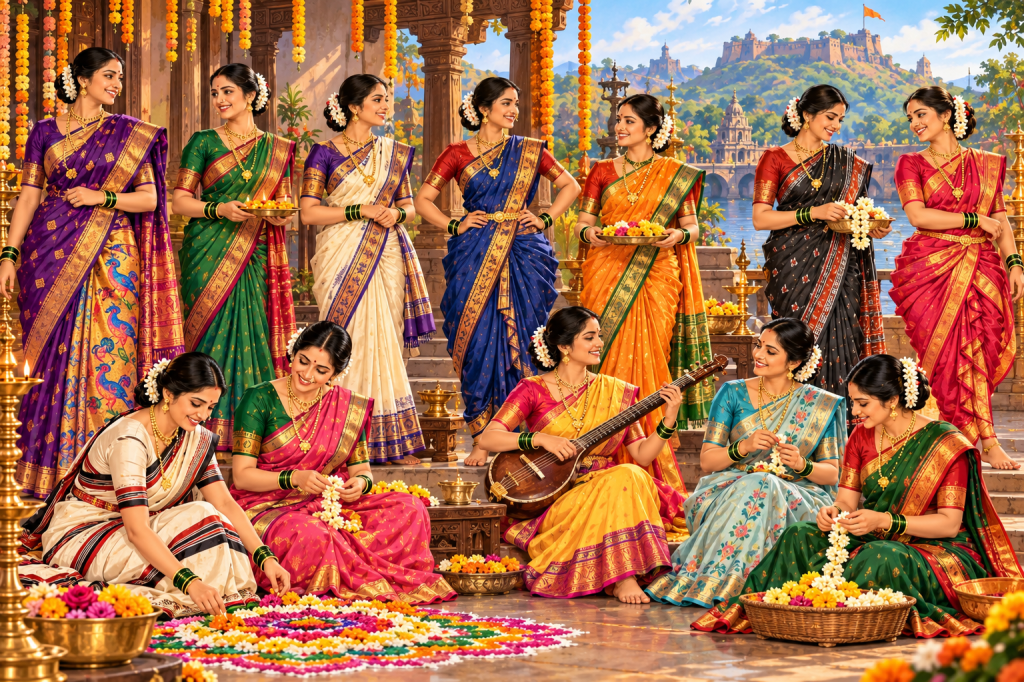
MAHARASHTRA • HANDLOOM • TEXTILE HERITAGE
A detailed guide to regional textiles, weaving traditions, embroidery and draping
A Detailed Guide to Regional Textiles, Weaving Traditions, Embroidery and Draping
Introduction: A textile heritage woven from many traditions
Maharashtra’s saree heritage is not one single style, weave or silhouette. It is a broad and evolving collection of textile traditions shaped by regional materials, skilled artisans, trade routes, community practices and changing tastes. From the luminous silk and elaborate woven motifs of Paithani to the practical elegance of cotton sarees, from figured Deccan textiles to contemporary sarees decorated with Warli-inspired art, the state’s textile landscape offers many ways to understand the relationship between clothing, craft and place.
Some names in this landscape identify a recognised regional saree tradition. Others refer to fabrics that can be used for sarees or blouses, a way of arranging colour, an embroidery technique, an art form applied to cloth, or a town whose textile industry supplies many different products. These distinctions matter. A printed saree inspired by Paithani motifs may be attractive, but it is not made in the same way as a handwoven Paithani. A saree sold in Pune or Jalgaon may have been woven elsewhere. A fabric with two contrasting colours may be called Ganga Jamuna in the market, although the exact construction can differ from one product to another.
This guide therefore celebrates the richness of Maharashtra’s sarees while distinguishing documented traditions from broad commercial descriptions. It explores each requested category through its regional context, materials, texture, construction, current use and availability. It also explains Nauvari draping styles, embroidery traditions that can be applied to sarees, the knowledge involved in weaving, and the roles of textile centres such as Nagpur, Jalgaon, Ichalkaranji and Solapur.
Traditional does not mean unchanging. Fibres, dyes, looms, blouse styles, colours and distribution channels have evolved over time. Today, handloom sarees coexist with power-loom textiles, printed fabrics, blended yarns and contemporary designs. These products serve different purposes, and accurate descriptions help buyers appreciate them on their own terms.
Part I — The principal sarees and textile traditions
1. Paithani: Silk, Zari and the Art of the Woven Padar
Origin and regional identity
Paithani is one of Maharashtra’s best-known saree traditions. Its name is associated with Paithan, a historic town in the Chhatrapati Sambhajinagar region, and the tradition is also strongly connected with Yeola in Nashik district, an important centre of Paithani production today. Paithani has a long history and has been valued for its silk, metallic-thread ornamentation and distinctive woven motifs.
The saree is especially associated with ceremonial dressing, weddings, festivals and family occasions. Its reputation comes not only from its lustre but also from the way its motifs are constructed within the fabric. A traditional woven motif is created through the interlacing of threads, rather than simply printed onto the surface.
Fibre, weave and texture
Traditional Paithani is generally made from silk, with zari used in the border and padar. The exact fibres and metallic threads can vary between products, so a buyer should check the description of an individual saree. Silk gives the cloth a smooth surface and lustre, while the woven motifs and border add structure and visual richness.
Paithani is admired for its contrast between the body and the decorative end-piece, or padar. The body may be relatively plain, dotted with small motifs, or patterned more densely. The border can feature geometric forms, vines or other repeated designs. The padar often carries the most elaborate visual work.
How Paithani is made
The process begins with yarn selection and preparation. The weaver plans the colours, border and padar design, then prepares the warp—the threads arranged lengthwise on the loom. The weft threads are inserted across the warp to form the fabric.
Motifs can require careful handling of coloured threads so that different shapes appear in the intended places. The more elaborate the pattern, the more coordination is needed between the design plan and the weaving process. The weaver must maintain tension, pattern alignment and the correct relationship between the body, border and padar.
The time needed varies substantially according to the motif density, zari work, loom setup and skill of the artisan. It is therefore misleading to assign one production duration to every Paithani. A simple design and a densely patterned ceremonial saree represent different levels of work.
Motifs and colours
Peacocks, parrots, lotus forms, vines and geometric patterns are among the motifs associated with Paithani. Peacock designs are particularly familiar, although not every Paithani uses the same motif. Traditional colour combinations can be vivid and contrasting, while contemporary products may use softer or less conventional shades.
Colour is part of the design rather than a separate decoration. In woven motifs, coloured threads create the figure, and the pattern must remain legible as the saree is folded and draped.
Current use and availability
Paithani remains a prominent choice for weddings, festivals and other special occasions. It is available through specialist handloom stores, weaving-centre retailers, exhibitions and online sellers. Yeola is a major contemporary production centre, while the historical association with Paithan remains important to the saree’s identity.
Products marketed as “Paithani-inspired” or “Paithani-style” may use printed, embroidered or machine-woven motifs. They may be useful alternatives, but they should not automatically be described as equivalent to a traditional handwoven Paithani. Buyers who value provenance should ask where the saree was woven, what fibres are used and how the motifs were made.
2. Mashru: A Distinctive Silk-and-Cotton Textile
What Mashru is
Mashru is a historic textile tradition found across parts of western India and the Deccan. It is known for constructions that combine silk and cotton, traditionally producing a smooth, lustrous face and a cotton-rich reverse. The word and the fabric’s history are connected with a wider cultural and commercial world; Mashru should not be described as exclusively Maharashtrian.
Mashru has been used for garments and other textile products, and it may be encountered in contemporary saree collections. Its significance lies in the distinctive construction and feel of the cloth, rather than in one standardised saree pattern.
Weave and texture
Traditional Mashru constructions often use a satin-like face that emphasises the silk yarn, with cotton contributing to the reverse. This produces a textile that looks different on its two sides. The face may feel smooth and lustrous, while the reverse has a different texture because of the way the yarns are arranged.
The exact fibre composition and weave vary. Modern products may use different blends or imitate the appearance of historic Mashru. The name alone does not prove that a particular item uses the traditional construction.
How it is made
The weaver plans the warp and weft so that the intended yarns dominate the appropriate surface. The process requires control of the interlacing sequence, tension and density. Once woven, the fabric may be dyed or finished to achieve the desired colour and handle.
Mashru’s characteristic surface is a result of its structure. It is not simply a cotton cloth with a silk coating. When assessing a product, the buyer should ask for the fibre composition and construction details rather than rely on shine alone.
Current use and availability
Mashru appears in discussions of Deccan textile history and may be found through specialist textile sellers, craft collections and contemporary designers. Its use in sarees depends on the particular product and producer. It can also be used for garments and accessories.
For a Maharashtra-focused article, Mashru is best presented as part of the wider Deccan textile heritage that has interacted with Maharashtra’s textile culture. That framing recognises its relevance without claiming an exclusive local origin.
3. Himroo: Figured Weaving from the Deccan
Origin and identity
Himroo is associated particularly with Aurangabad, now officially known as Chhatrapati Sambhajinagar. It is a figured textile tradition whose history reflects the wider Deccan’s courtly, commercial and craft connections. Himroo has been used for shawls, wraps, furnishing fabrics and other products; it is not exclusively a saree type.
Its inclusion in a guide to Maharashtra’s sarees is important because it illustrates the region’s broader weaving expertise and the way traditional fabrics can influence contemporary garments.
Materials, surface and pattern
Himroo has traditionally been made using combinations of silk and cotton, although the composition of contemporary products varies. The fabric is known for a patterned surface created by the arrangement of threads. Motifs may be floral, geometric or inspired by other decorative vocabularies.
The texture depends on the yarns and weave. Compared with a plain cotton fabric, Himroo may have a more complex surface and a richer visual effect. The pattern is constructed in the fabric rather than simply applied as a print.
How Himroo is woven
The design is planned before the loom is prepared. Warp and weft arrangements determine how the patterned areas appear. The weaver must coordinate the sequence of threads and maintain consistent tension so that the motifs develop clearly.
The precise method varies with the loom, materials and design. It is not appropriate to assume that every contemporary textile sold as Himroo uses one identical traditional structure. A product-specific description should identify the fibres and construction where known.
Current use and availability
Himroo is associated with Chhatrapati Sambhajinagar and can be encountered through local craft sellers, textile outlets and specialist collections. Contemporary uses may include shawls, wraps, furnishing textiles and fashion products. Some designers adapt Himroo-inspired patterns for sarees or other garments.
When the fabric is used in a saree, the seller should clarify whether the saree itself is woven as Himroo or whether it merely uses a related motif or surface effect. This distinction allows the textile’s identity to be described accurately.
4. Narayan Pethi / Narayanpet Saree: A Neighbouring Deccan Tradition
Name and regional association
Narayanpet sarees are primarily associated with Narayanpet in present-day Telangana. They are relevant to Maharashtra because of the close cultural and commercial connections across the Deccan, and because these sarees are sold and worn in Maharashtra. The spelling “Narayan Pethi” sometimes appears in commercial usage, but Narayanpet is the more widely recognised place-name for the saree tradition.
It is important to identify the regional association accurately rather than classify the saree as exclusively Maharashtrian.
Weave, texture and design
Narayanpet sarees are commonly associated with cotton and silk varieties, contrasting borders, checks or stripes in some designs, and traditional motifs. The details vary by fibre, producer and intended market. Some sarees have a relatively light, practical character, while silk versions can be more formal.
The border often plays a prominent role in the overall design. Body and border colours may contrast, giving the saree a clear visual frame.
Production
The fabric is woven on a loom after the yarns have been selected, prepared and arranged. The colour sequence determines checks, stripes and border patterns. The precise production method and fibre content depend on the particular saree and workshop.
A contemporary product may use a power loom, a handloom or a combination of processes across its supply chain. The name alone does not establish the method.
Current use and availability
Narayanpet sarees are worn for everyday use, work, festivals and family occasions, depending on their material and ornamentation. They are available in their region of origin and through textile retailers in Maharashtra and elsewhere.
They are a useful example of how neighbouring textile traditions form part of the wardrobes and markets of Maharashtra without necessarily originating within the state’s current boundaries.
5. Ganga Jamuna Saree: The Appeal of Two Colours
Understanding the name
“Ganga Jamuna” is used in textile contexts for designs that emphasise two contrasting colours, often in the body and border. In some descriptions, the name is associated with a more specific double-cloth construction. Commercial use is not always consistent, so it is important to examine the particular product rather than assume that every Ganga Jamuna saree is woven in the same way.
The name evokes two distinct streams coming together, making it a memorable description for a textile built around colour contrast. It is encountered in Deccan and Maharashtra textile markets, although the exact origin and construction should be verified for individual products.
Weave and appearance
A simple two-colour saree may have a body in one shade and a border in another. More complex double-cloth structures use two layers of fabric woven together in a planned relationship. The layers may connect at selected points or sections, allowing different colours or patterns to appear on opposite faces.
Not every contrasting border is double cloth. The distinction is technical: double cloth involves two woven layers, whereas a standard border may be made within a single cloth structure.
How it is made
The weaver selects the yarn colours and plans their arrangement. In a basic contrast design, the loom setup must preserve the colour division between the body and border. In a double-cloth structure, the warp and weft systems must be coordinated so that the layers connect where required and remain separate where intended.
The fabric is checked after weaving for alignment, consistency and drape. Colour contrast is the defining visual feature, but the actual construction determines how the textile behaves.
Current use and availability
Ganga Jamuna-style sarees can be found through regional textile shops, handloom outlets and broader retail channels. Contemporary products may vary in fibre, loom type and construction. The style works well for people who like a clear contrast without necessarily wanting an elaborate all-over motif.
Buyers interested in traditional construction should ask whether the item is genuinely double cloth or simply a saree with contrasting body and border.
6. Vidarbha Block Prints: Pattern Applied to Cloth
Regional context
Vidarbha, in eastern Maharashtra, has a varied textile and craft landscape. Block-printed fabrics associated with the region form part of the wider tradition of decorating cloth through repeated motifs. The specific designs, dyes and production methods can differ between localities and workshops.
Block printing is a surface-decoration technique, not a weave. The base fabric is made first, and a design is then transferred onto it using carved blocks and colour.
How block printing works
The artisan prepares a block with a raised design. Dye or printing paste is applied to the block, which is pressed against the fabric in a controlled way. Repeating the process creates a pattern. Multicoloured designs may require separate blocks or separate passes for different colours.
Alignment is important. The artisan must position each impression so the repeat remains even. Small variations may occur in hand printing, while mechanised printing can produce more uniform results.
The base cloth can be cotton or another suitable fabric. Dye, paste and finishing methods depend on the design and production system.
Texture and appearance
Block printing usually adds colour to the surface without creating the same structure as a woven motif. The fabric’s feel is therefore largely determined by the base cloth and any finishing applied afterward.
Patterns may be geometric, floral or inspired by regional decorative forms. A printed saree can be visually intricate while remaining relatively light and flexible.
Current use and availability
Block-printed sarees can be worn for everyday activities, work, casual gatherings and cultural occasions. They are available through regional craft sellers, exhibitions and contemporary textile retailers.
Because printing can be done on different fabrics, the words “Vidarbha print” alone do not establish the fibre or production method. A useful description identifies the base fabric, printing process and place of production where known.
7. Khana: Geometric Fabric for Blouses and More
What Khana is
Khana is a traditional patterned fabric associated with parts of southern Maharashtra and neighbouring northern Karnataka. It is especially well known as blouse material, often paired with sarees whose colours or motifs complement its geometric design. It is therefore better described as a textile tradition used with sarees than as a single standardised saree category.
Weave and texture
Khana is recognised for its small-scale geometric patterning. The designs may use checks, diamonds or repeated shapes arranged in a compact grid. The fabric’s texture and weight depend on its fibres and weaving method.
The pattern is typically part of the woven structure rather than simply printed onto the surface. The geometry gives Khana a distinctive visual character and makes it useful as a contrast to plain or lightly patterned sarees.
Production
The weaver plans the colour arrangement and pattern repeat, prepares the warp and sets up the loom. The coloured warp and weft must intersect in the intended sequence to create the geometric design. Consistency is important because the small repeat makes uneven spacing easy to notice.
Contemporary Khana products may differ in fibre content, loom type and finish. A seller’s description should distinguish traditional woven Khana from printed fabric that merely imitates its pattern.
Current use and styling
Khana is often used for blouses, where its geometry can complement a plain cotton or silk saree. It can also be incorporated into contemporary garments and accessories. A blouse made from Khana may pick up the border colour of a Paithani-inspired saree or create contrast with a simpler cotton saree.
The fabric’s importance lies in how it completes an ensemble. It demonstrates that saree traditions include not only the six- or nine-yard garment, but also the coordinated textiles used alongside it.
8. Ganeshpur Kosa Silk: Understanding the Local Reference
Kosa and tussar silk
Kosa is commonly associated with tussar silk, a silk type known for its textured surface and natural-looking lustre. Kosa is linked with wider central and eastern Indian silk traditions, and silk yarn or finished fabric may move between regions before it becomes a saree.
“Ganeshpur Kosa silk” is a more specific local or commercial designation than the broad term Kosa. The exact location, production community and construction associated with that name should be verified through a local producer or reliable documentation. It should not be treated as a universally standardised category without that evidence.
Texture and appearance
Kosa/tussar silk often has a slightly grainier or more textured character than smooth mulberry silk. The surface may show natural variations in lustre, and the fabric can feel substantial while remaining suitable for elegant draping. The final texture depends on the yarn, weave and finishing.
Sarees may be left in natural-looking shades or dyed in a wide palette. Some use understated borders, while others incorporate checks, stripes or woven motifs.
How it is made
The process includes obtaining and preparing silk yarn, planning the colour and pattern, setting the warp and weaving the fabric. The yarn’s properties influence loom handling and the finished drape. After weaving, the fabric is inspected and finished.
Kosa production may involve multiple locations and specialists. A saree sold in Maharashtra might use silk sourced elsewhere and be woven or finished locally. The actual production chain should be established before assigning a specific local origin.
Current use and availability
Kosa sarees are used for festivals, formal occasions and everyday dressing depending on their weight and design. They are available through silk retailers, handloom outlets and online sellers. Buyers should check the fibre label and the stated production location, especially when a product uses a more specific place-based name.
9. Nagpur Cotton Sarees: Practical Weaves and Local Textile Knowledge
Regional context
Nagpur has a history of textile production and trading, including cotton fabrics. The city’s wider textile landscape includes weaving communities, workshops, retailers and distribution networks. “Nagpur cotton saree” is best understood as a broad market and regional association rather than one single, universally standardised weave.
Weave and texture
Cotton sarees associated with Nagpur can vary from light, practical fabrics to more substantial weaves. Checks, stripes, plain bodies and contrasting borders may all be encountered, depending on the producer. Texture depends on yarn count, weave density, finishing and whether the fabric is handwoven or machine-woven.
Cotton’s breathability and familiar handling make it useful for regular wear. The saree’s comfort, however, depends on the fabric weight and finish rather than the fibre name alone.
How the fabric is produced
The yarn is prepared and arranged as warp and weft. The loom interlaces the threads to create the cloth, with colour sequences determining checks or stripes. The border may be integrated into the weaving plan or added through a separate process, depending on the product.
Nagpur’s textile economy has included both traditional craft activity and changing forms of production. Not every saree sold there is handloom, and not every cotton saree associated with the city has the same origin.
Mominpura and the weaving community
Mominpura is associated with Nagpur’s wider weaving history and Momin artisan communities. The history of such neighbourhoods highlights the importance of skilled people, family knowledge and specialised work in the development of textile centres.
Weaving involves more than operating a loom. It requires selecting yarn, planning patterns, setting tension, maintaining consistency and identifying defects. The exact products made by individual workshops change over time, so it is important not to assume that every household or business in a historic weaving neighbourhood still makes the same textile.
Current use and availability
Cotton sarees are useful for everyday wear, work and informal gatherings. They are sold through local markets and retailers and may be distributed to other parts of Maharashtra. A buyer should ask about fibre content, production method and origin if those details are important.
10. Karvat Kati Saree: The Saw-Edged Border of Vidarbha
Origin and identity
Karvat Kati is associated with parts of Vidarbha, including areas around Bhandara, Nagpur, Chandrapur and Gadchiroli. The name is commonly linked to the distinctive saw-edged or serrated border, which gives the saree a recognisable outline.
The border is the defining feature, but the saree’s overall character also depends on body colour, motif, fibre and weaving method. The exact details vary among producers and products.
Weave and appearance
Karvat Kati sarees may use cotton or other fibres, depending on the product. The body can be relatively simple, allowing the angular border to stand out. The saw-tooth effect may be created through the weaving arrangement rather than applied as a separate printed design.
The contrast between the border and body helps define the saree when it is folded or draped. The motif is decorative but also structural in the sense that it is formed as part of the textile pattern.
How it is made
The design must be planned so that the serrated border repeats consistently along the length. The loom is prepared with the required colour and pattern arrangement. The weaver maintains the sequence while producing the body and border, checking that the edges remain clear and balanced.
The precise technique depends on the loom and the design. A product advertised as Karvat Kati may need further verification if it is printed or machine-produced to imitate the characteristic border.
Current use and availability
Karvat Kati is a useful example of a regional saree whose identity comes from a specific design feature. It can be worn for everyday and cultural occasions, depending on the fibre and finish. Availability may be more specialised than that of mass-market cotton sarees, so buyers may need to look through regional handloom outlets, craft exhibitions or sellers familiar with Vidarbha textiles.
11. Munga and Ghicha Silk: Related but Distinct Silk Terms
Understanding the terms
Muga and Ghicha are terms from the wider Indian silk landscape, and their use in saree descriptions needs care. Muga silk is particularly associated with Assam and is known for its naturally golden appearance. Ghicha generally refers to a type of silk yarn associated with certain stages or methods of silk processing, often used to create a textured, irregular surface. These terms should not be treated as a single Maharashtra-origin saree tradition.
Sarees using these silks may be sold in Maharashtra, and regional designers may incorporate them into garments. Their inclusion is relevant to the variety of silk products available in the state’s markets, but the fibre’s origin should be described accurately.
Texture and appearance
Muga silk is known for its warm golden tone and distinctive lustre. Ghicha silk can have a more textured, slubby character because of the nature of the yarn. Actual appearance depends on the yarn source, weave, dyeing and finishing.
A saree may use one of these yarns in the body, border or pallu, or it may combine fibres. The product label should clarify whether the fabric is pure silk or a blend.
Production and availability
Silk yarn is prepared and woven according to the desired structure. Textured yarns may require careful handling to achieve a consistent fabric without losing their natural character. Sarees may be woven in the region where the yarn is sourced or in another textile centre.
Consumers should check the fibre content and place of weaving. The presence of a particular silk yarn does not automatically make the saree a traditional Maharashtra-origin textile.
12. Solapur Top Padar Saree: The Importance of the Decorative End
Solapur’s textile context
Solapur is widely associated with cotton weaving and textile manufacturing, especially chadars and towels, alongside other fabric products. Sarees described as Solapur Top Padar may be found in regional and commercial usage, but the exact definition is not consistently standardised across all references. It is best treated as a product description that should be confirmed with the specific maker or seller.
The padar as a design feature
The padar is the end section of a saree that is often displayed over the shoulder. A “top padar” description generally draws attention to the decorative end-piece or its placement and design. The padar may contrast with the body through colour, stripes, motifs or a denser weave.
The effect depends on how the padar falls when worn. A striking padar can give a simple body a formal appearance without requiring dense decoration across the whole saree.
Production and current use
The saree’s construction depends on the specific product. It may be cotton or another fibre and may be handwoven or machine-woven. A clear description should state the fibre, loom method and what the seller means by “Top Padar.”
Such sarees can be suitable for regular wear or cultural occasions, depending on the weight and ornamentation. Their availability may be strongest through local textile markets and sellers familiar with Solapur products.
13. Solapur Cotton Sarees: Practicality and Textile Industry
Regional identity
Solapur is one of Maharashtra’s notable textile centres, with a strong reputation for cotton products. Its industrial history includes household textiles, and the broader weaving ecosystem contributes to the region’s fabric trade. Solapur cotton sarees should be understood within this larger context rather than assumed to be one single weave.
Weave and texture
Cotton sarees can range from light, plain fabrics to designs with checks, stripes and decorative borders. The feel depends on yarn thickness, weave density and finishing. Some are intended for everyday wear, while others use stronger colour contrasts or patterned sections for a more dressed-up look.
Production
Cotton yarn is prepared and woven on the appropriate loom. Patterns can be created by changing the colour sequence of warp and weft threads, using woven motifs, or adding printing and finishing at later stages. Production methods vary between manufacturers.
Solapur’s wider textile industry includes different scales and technologies. A saree sold under a Solapur association may be handwoven, power-woven or sourced through a local distributor; the seller should clarify which applies.
Current use and availability
Cotton sarees remain useful for regular wear because they can be comfortable and adaptable. Solapur’s textile networks also make a range of cotton products available to buyers and retailers. For a traditional handloom purchase, the buyer should ask for the actual production location and method.
14. Warli Art Sarees: Folk Art on a Contemporary Garment
Warli art and its origins
Warli art is associated with Warli Adivasi communities in Maharashtra, particularly in parts of the state’s western and northern regions. Its visual vocabulary includes simple geometric forms—circles, triangles and lines—used to depict people, animals, activities and community life. Warli is an art tradition, not a weave.
A Warli art saree uses this visual language on fabric. The base may be cotton, silk or another textile, and the art may be printed, painted, embroidered or applied through another technique.
Motifs and visual character
Warli compositions may depict dancing figures, farming, animals, trees, houses and scenes of shared activity. The forms are often arranged rhythmically, creating a sense of movement. Traditional Warli painting is associated with particular materials and surfaces, while contemporary textile adaptations may use a wider range of colours and techniques.
The precise cultural context matters. Not every geometric figure on a garment is Warli, and a design inspired by Warli should not automatically be presented as a community-made work.
How a Warli saree is made
The base fabric is selected first. If the design is printed, the motif is transferred using a printing process. If it is painted by hand, the artist applies the design directly to the fabric or to a prepared surface. Embroidered interpretations use thread to build the figures.
The method affects the texture, durability and appearance. Printed designs tend to be flatter; hand painting may show individual brushwork; embroidery adds a tactile surface. Care instructions should match the technique used.
Current use and availability
Warli-inspired sarees are worn at cultural gatherings, exhibitions, festivals and as contemporary statement pieces. They are sold by craft organisations, designers, online shops and textile retailers. Buyers who want to support traditional artisans should ask who created the design, where the work was carried out and whether the item is hand-painted, printed or embroidered.
15. Pune Sarees: A Market and Dressing Tradition, Not One Fixed Weave
Understanding the term
Pune is a major cultural and commercial centre in Maharashtra, with a long history of saree retail, tailoring, ceremonial dressing and textile trade. “Pune saree” is not one universally standardised weave comparable to Paithani. The term can refer broadly to sarees sold in Pune, local preferences in styling, or particular products described by retailers.
This distinction is important because the city’s shops offer sarees from many regions, including Paithani, cotton sarees, silk varieties, printed fabrics and products from outside Maharashtra.
Materials and designs
The variety available in Pune includes cotton, silk, blends and synthetic fabrics. Some sarees feature traditional Maharashtrian borders and motifs; others follow broader contemporary fashion trends. The body, border and pallu may be simple or richly decorated.
Pune’s role is therefore best described through its textile market and dressing culture rather than a single defining weave.
Current use and availability
Pune offers sarees for weddings, festivals, professional dressing and everyday use through specialist stores, local markets, exhibitions and online sellers. Buyers should identify the actual saree tradition and production location rather than assume that a product sold in Pune originated there.
Part II — Nauvari Sarees and the Art of Draping
16. What Makes the Nauvari Distinctive?
Nauvari refers to the nine-yard saree and to a family of draping practices associated with Maharashtra. The longer length allows the cloth to be arranged around the waist and legs in ways that differ from the common five- to six-yard saree drape. The precise arrangement varies by region, community, occasion and personal practice.
The Nauvari is not one fixed costume. Brahmani, Peshwai, Koli and kashta-style arrangements are often discussed as distinct styles, but names and techniques can overlap in contemporary usage. There is no single universal sequence that every wearer in a community follows. The instructions below describe commonly presented approaches and should be understood as practical guides rather than exclusive definitions.
A traditional Nauvari ensemble may be paired with a blouse, jewellery and accessories suited to the occasion. The saree’s border and pallu remain important visual elements, but the drape itself is central to its appearance.
17. Before Draping: Length, Preparation and Safety
A nine-yard saree is long enough to require deliberate preparation. The exact length, width, fabric weight and border placement affect the final result. Cotton and lighter silk blends may be easier for a beginner to manage than a very heavy saree with a dense zari border.
Before starting:
- Choose a clean, stable surface with enough room to move.
- Wear a fitted petticoat or other suitable base garment if the chosen style uses one.
- Keep safety pins ready, but use them sparingly and place them where they will not damage delicate fabric.
- Identify the pallu and the preferred display of the border before making the first tuck.
- Ensure the fabric is not so long at the ankles that it creates a tripping hazard.
- If the style is unfamiliar, practise with a helper before wearing it for a long event.
Traditional drapes can be secured in different ways. Some rely on tucks and the arrangement of fabric; others use discreet pins. The aim is a secure, comfortable drape that allows natural movement.
18. Kashta Nauvari: The Trouser-Like Leg Arrangement
Characteristic appearance
The kashta style is often recognised by the way the central length of the saree is brought between the legs and tucked at the back, creating a divided, trouser-like lower silhouette. It allows the wearer to walk more freely than a conventional skirt-like drape when tied securely. The name is often associated with the rear tuck or the way the fabric is gathered.
Practical draping sequence
- Start at the waist. Hold one end of the saree and tuck it securely into the waistband, leaving enough length for the pallu and upper-body drape.
- Wrap around the waist. Bring the fabric around the body, keeping the lower edge level. Avoid twisting the border.
- Make the front pleats. Gather a set of even pleats at the front and tuck them into the waistband. Adjust their width so they lie flat and do not pull to one side.
- Create the central leg section. Take the required length from between the legs and guide it toward the back. Keep the cloth smooth and ensure it is not twisted.
- Secure the back tuck. Tuck the fabric firmly at the rear waistband. Check that the cloth has enough ease for walking and bending.
- Arrange the remaining length. Depending on the version being followed, the remaining fabric may be wrapped around the waist or arranged to form the upper drape.
- Drape the pallu. Bring the pallu over the shoulder in the chosen direction, displaying the border or motif.
- Check movement. Walk a few steps, sit carefully and raise the arms. Adjust any tight or loose sections before finishing.
How it differs from a conventional drape
The key difference is the central fabric passing between the legs and being secured at the back. The front pleats and pallu can vary. The resulting silhouette depends on the wearer’s chosen method and the fabric’s weight.
19. Brahmani Nauvari: A Refined, Structured Drape
General character
Brahmani Nauvari is often presented as a more structured and carefully arranged style, with attention to neat front pleats, the pallu and the overall balance of the saree. The name is associated with a particular dressing tradition, but contemporary descriptions can vary. It is safest to treat it as a commonly recognised style rather than a single immutable pattern.
Practical draping sequence
- Establish the waist tuck. Begin by tucking one end into the waistband and wrap the fabric around the waist, keeping the border even.
- Form neat front pleats. Make even pleats and tuck them securely at the centre or slightly to one side, depending on the version being followed.
- Arrange the lower drape. If following a version with a kashta-style leg arrangement, bring the appropriate section between the legs and secure it at the back. Other contemporary versions may arrange the lower cloth differently.
- Smooth the side folds. Check that the fabric lies evenly around the hips and that the border remains visible.
- Bring the pallu across the torso. Arrange it over the shoulder in a way that complements the front pleats and the saree’s decorative end.
- Secure the shoulder section. Use a discreet pin if needed, taking care not to catch delicate zari or damage the fabric.
- Balance the overall silhouette. Check the front, sides and back in a mirror. Adjust the pallu and pleats so the saree is comfortable and symmetrical.
How it differs from other Nauvari styles
The Brahmani description generally emphasises a tidy, composed arrangement. The distinction from a Peshwai or Koli style may lie in the way the pallu, pleats and lower section are arranged, but regional practices overlap. It is advisable to learn a specific family or community method from a knowledgeable practitioner when historical accuracy is important.
20. Peshwai Nauvari: A Ceremonial and Historical Styling
General character
Peshwai Nauvari is associated in contemporary dressing with the historical and courtly visual culture linked to the Peshwa period. The term is often used for a more formal presentation of the Nauvari, with an emphasis on a coordinated ensemble and a carefully arranged drape. It should not be assumed that all historical wearers used one identical method.
Practical draping sequence
- Choose the intended display. Decide which border and padar should be visible. For a ceremonial look, the pallu may be arranged to show its most decorative section.
- Make the initial waist tuck. Tuck one end securely and wrap the saree around the waist without twisting the border.
- Create the front pleats. Gather even pleats and position them neatly. Keep enough length available for the rear or leg arrangement if the chosen version includes it.
- Arrange the kashta section if used. Pass the appropriate cloth between the legs and tuck it at the back. Ensure the fabric is secure but not restrictive.
- Wrap and smooth the remaining fabric. Arrange the cloth around the waist and hips, maintaining an even line.
- Drape the pallu. Bring it over the shoulder or across the torso according to the selected Peshwai-inspired version. Arrange the pleats of the pallu so the border is visible.
- Coordinate the ensemble. Add the blouse and accessories that suit the occasion. The saree should remain secure when the wearer walks and turns.
- Perform a movement check. Make sure the front pleats, rear tuck and pallu remain in place.
How it differs from Brahmani and kashta styles
“Peshwai” often describes the overall historical or ceremonial styling as much as a single technical sequence. A kashta arrangement may form part of a Peshwai-inspired look, while Brahmani styling may also use a structured lower drape. The clearest distinction is therefore often the full presentation rather than a single universal knot or tuck.
21. Koli Nauvari: A Community-Associated Draping Tradition
Cultural context
Koli communities have a long association with Maharashtra’s coastal life, and clothing practices reflect local work, movement and community identity. Koli-style saree draping is often described as practical and secure, with the fabric arranged to allow movement. Exact styles differ across communities and local settings, so it is best not to present one contemporary demonstration as the only authentic Koli method.
Practical draping sequence
- Prepare the base. Wear a suitable base garment and identify the saree’s border and pallu.
- Secure the starting end. Tuck the end into the waistband and wrap the saree around the waist.
- Make front pleats. Gather manageable pleats and tuck them in securely, avoiding excess bulk.
- Arrange the lower section. In a version with a kashta-like arrangement, pass the cloth between the legs and secure it at the back. Keep enough ease for comfortable movement.
- Check the waist and sides. Smooth the fabric so it does not bunch or loosen when walking.
- Drape the upper section. Bring the remaining cloth across the torso and over the shoulder in the style being followed.
- Secure the pallu. Position it so it remains stable while allowing free movement.
- Test the drape. Walk, turn and sit carefully. Adjust the tucks so the garment remains secure.
How it differs from other styles
Koli-inspired draping is often discussed in relation to movement and practical wear. Its precise form varies, and the distinction may include how the fabric is divided around the legs, how the pallu is secured and how the waist is wrapped. Community-specific instruction is the best source for a precise local version.
22. Comparing the Four Nauvari Styles
| Style | Commonly emphasised feature | Lower drape | Pallu and overall presentation |
| Kashta | The central fabric passes between the legs and is tucked at the back | Divided, trouser-like appearance | Can vary; often focused on a secure and practical arrangement |
| Brahmani | Neat, structured pleats and a balanced silhouette | May include a kashta-style arrangement, depending on the version | Often presented as composed and carefully arranged |
| Peshwai | Ceremonial or historical styling associated with the Peshwa-era visual tradition | May use a kashta arrangement | Emphasis on coordinated, formal presentation |
| Koli | Practical draping associated with Koli community traditions | Often arranged for freedom of movement; local forms vary | Can be secured to suit the particular community style and activity |
These categories are useful guides, but the names are not always used consistently in modern fashion descriptions. For exact community-specific draping, seek instruction from a knowledgeable practitioner who can demonstrate the version relevant to the occasion or tradition.
Part III — Embroidery, Weaving Skills and Textile Industries
23. Kasuti Embroidery: Geometric Stitchwork for Sarees and Blouses
Kasuti is a traditional embroidery technique associated primarily with Karnataka, especially Dharwad and parts of northern Karnataka. It is relevant to Maharashtra because of long-standing cultural and commercial connections across the state border, and because Kasuti-inspired work is used in contemporary sarees and blouses sold in Maharashtra. It should not be described as originally or exclusively Maharashtrian.
Kasuti is admired for geometric patterns and carefully counted stitches. Motifs may include temple-like forms, chariots, lamps, flowers, birds and other regional decorative forms. Rather than applying a printed image, the artisan builds the design through stitches.
Traditional counted-thread work requires attention to the fabric’s grid. The artisan counts threads, maintains stitch direction and controls tension so that the pattern remains balanced. A small error can disrupt a symmetrical design.
The fabric is woven first and embroidered afterward. Kasuti may be placed on the pallu, border, body or blouse. A plain cotton saree can use embroidery as its main decorative feature, while a richly woven silk saree may benefit from smaller motifs that do not compete with the original design.
Contemporary Kasuti-inspired blouses and sarees may use new colours and layouts. Buyers who value the craft should ask whether the work is hand-embroidered, where it was made and whether the product is genuinely connected to the relevant artisan tradition.
24. Banjara Tribal Embroidery: Colour, Mirrors and Decorative Stitching
Banjara embroidery is associated with Banjara communities and related traditions of decorative needlework in several parts of India. Styles vary by region and community; there is no single design that represents every Banjara group. The embroidery is often recognised for colourful threads, geometric arrangements, appliqué and, in some traditions, mirrors or reflective elements.
The work may use cotton or silk thread, metallic yarn and small mirrors. Chain stitch, running stitch, cross-like arrangements and appliqué may be combined according to the design. Mirrors are secured with stitches around their edges, while surrounding embroidery adds colour and decorative structure.
On sarees, Banjara-inspired work may appear on the pallu, border or blouse. A blouse with embroidered sleeves or a decorative back panel can complement a plain cotton saree. A pallu can carry a larger composition, while a border can use repeated motifs. Heavy embellishment affects the fabric’s weight and drape, so placement and stitch security matter.
In contemporary fashion, “Banjara-inspired” is sometimes used for designs that borrow the visual vocabulary of the tradition. It is useful to distinguish such inspiration from work made by Banjara artisans or from a documented community-specific technique. Accurate attribution respects the people and knowledge associated with the craft.
25. How Embroidery and Weaving Work Together
Weaving and embroidery are different processes. In weaving, the pattern is created by interlacing warp and weft threads, making the design part of the cloth’s structure. In embroidery, stitches are added after the fabric has been formed. Printing transfers colour onto the surface through a different process.
This distinction matters when describing a Paithani motif, an embroidered peacock and a printed peacock. All may be attractive, but they are not made in the same way. A traditional woven Paithani motif is constructed through coloured threads; an embroidered figure is formed with stitches; a printed figure is applied using colour.
Embroidery works particularly well on plain cotton sarees, where the stitches can become the main decoration. On a richly woven saree, smaller motifs may offer a better balance. The pallu can accommodate a larger design, the border can carry a repeated pattern and the blouse can introduce embroidery without covering the saree’s principal features.
26. Mominpura, Nagpur: Weaving Communities and Local Knowledge
Mominpura is associated with Nagpur’s wider weaving history and Momin artisan communities. Momin weavers have been involved in textile production in different parts of India, and their contribution forms part of Maharashtra’s broader history of cotton weaving and related textile activity.
Traditional weaving communities often organised work around households and small workshops. Depending on the setting, a master weaver might manage loom production and train apprentices, while other workers prepared yarn, wound bobbins or finished fabric. Current work varies between families and businesses, and not every household in a historically associated neighbourhood necessarily continues the same craft.
Weaving requires practical knowledge of yarn selection, warp preparation, tension, pattern repeats and quality control. A checked cotton fabric depends on a planned colour sequence. A border needs a repeat that remains consistent along the cloth. The artisan must also recognise irregularities such as broken threads, distorted motifs or changes in width.
A textile centre’s products may evolve as markets change. Some workshops continue traditional handloom work, while others take part in mechanised production or related textile activities. The important point is to describe the actual production method rather than assume every product associated with a historic weaving neighbourhood is handwoven.
27. Kosa Weaving: From Silk Preparation to Finished Cloth
Kosa is commonly associated with tussar silk, whose textured surface and natural-looking lustre differ from the smoother character of many mulberry silks. Kosa production belongs to a wider central and eastern Indian silk network. Maharashtra’s connection should be understood within that network, since raw silk, yarn, weaving and finishing may take place in different locations.
The process begins with suitable silk material being processed into yarn. Depending on the fibre and production system, this can involve reeling, spinning or other preparation. The yarn is assessed for thickness, strength and consistency because these properties affect how it behaves on the loom.
The design is planned before weaving. A simple Kosa saree may rely on the natural texture of the silk with a restrained border; another may use stripes, checks or repeated motifs. The warp is arranged on the loom and the weft inserted to form the fabric. The weaver maintains tension and pattern alignment, especially where the body and border use different colours or structures.
After weaving, the fabric is inspected and finished. Finishing can influence softness, stiffness and drape, so it should suit the fibre. The final product may emphasise natural texture or incorporate colour and surface treatment. A useful description of a Kosa saree should identify the type of silk, weave and finishing where that information is available.
28. Paithani Weaving: The Organisation of a Specialist Craft
Paithani production involves a sequence of specialised tasks. Silk and zari must be sourced, colours selected, the warp prepared and the loom set up. The padar and border need careful planning because their designs must work within the structure of the cloth.
A master weaver must understand both the intended design and the practical operation of the loom. The work involves planning coloured threads, maintaining tension, recognising defects and ensuring that motifs develop correctly. Training may progress from simpler weaving tasks to more complex pattern work.
The wider production network can include silk suppliers, dyers, zari producers, traders and other workers. Some activities may take place locally; others may be supplied by businesses elsewhere. The organisation of production has changed over time, but the specialist knowledge of the weaving centre remains important.
The time required to weave a Paithani depends on the complexity of the design, border width, zari density, number of motifs, loom and experience of the weaver. A simple body may be quicker to produce than a densely patterned padar. There is no single universal production duration for every Paithani, so product-specific information is more reliable than a blanket claim.
29. Ganga Jamuna Weaving: Colour Planning and Double-Cloth Principles
A Ganga Jamuna-style saree begins with a plan for the relationship between two colours. One colour may appear in the body and another in the border, or a more complex structure may show contrasting colours on different faces.
Double cloth is a weaving structure in which two fabric layers are woven together and connected at selected points or areas. It can create different colours or patterns on the two faces. However, not every two-colour saree is double cloth: a contrasting border may be woven within a single fabric structure.
Where double cloth is used, the loom must be set up to coordinate the two layers, connecting them where required and keeping them separate where the design calls for it. In simpler contrast designs, the task may mainly involve maintaining the intended border and body colours.
Contemporary Ganga Jamuna-style products may use different fibres, loom types and constructions. Some retain a double-cloth structure, while others reproduce the visual effect through simpler weaving. The style’s appeal lies in the clarity of its colour contrast, but the construction should be described accurately.
30. Jalgaon: A Textile and Distribution Centre
Jalgaon is an important commercial and industrial centre in northern Maharashtra. Its textile-related activity should not be reduced to one particular saree name. Products may pass through the area at different stages of the supply chain, including yarn procurement, fabric production, processing, finishing, wholesale trading and retail distribution.
A textile economy includes yarn merchants, dyeing units, weaving workshops, processing facilities, finishers, wholesalers and retailers. One business may produce fabric, another may dye or finish it, and a trading business may distribute it to shops in other cities. Such connections can make a location commercially important even when it is not known for one historic handloom saree.
Textile markets may offer cotton, silk and blended sarees, printed fabrics, dress materials and contemporary fashion products. Some draw on traditional Maharashtrian motifs; others follow broader fashion trends. A saree sold in Jalgaon may have been woven elsewhere, so the seller’s location should not be mistaken for the place of production.
Some textiles associated with Jalgaon may not belong to a widely documented traditional category. Modern cotton sarees, blended fabrics, machine-woven designs and locally developed patterns can still be part of the region’s current industry. They should be described accurately rather than assigned an unsupported historical lineage.
Jalgaon’s significance lies in the way it connects production, commerce and distribution. The story of a saree continues after weaving: the cloth must be processed, marketed, transported and made available to the people who will wear it.
31. Ichalkaranji: A Major Textile Hub in Southern Maharashtra
Ichalkaranji, in Kolhapur district, is widely recognised as one of Maharashtra’s major textile centres. Its industrial identity is associated with weaving, fabric production and related businesses. It is important not because every product has one unique traditional name, but because the city supports a wide range of textile activity, including mechanised weaving.
A large textile centre depends on many interconnected operations. Yarn must be sourced and prepared, looms maintained, fabrics woven, and products dyed, printed or finished as needed. Manufacturers require suppliers, traders, customers and transport networks. Different businesses may specialise in particular fabrics or stages of production.
Handloom and power-loom production should be distinguished. A handloom relies on the weaver’s operation to insert the weft and create the fabric; a power loom uses mechanical power for key weaving operations. Both can produce attractive textiles, but the production processes differ. A textile centre may support several kinds of production at the same time.
The city’s industrial environment can supply cotton, synthetic and blended fabrics, printed textiles and other products for different market segments. The exact assortment changes with demand and manufacturing capacity. It is therefore more accurate to describe Ichalkaranji as a major textile manufacturing and trading centre than to assign all its sarees to one traditional weave.
Ichalkaranji demonstrates that Maharashtra’s textile heritage includes industrial expertise as well as traditional craft. Its significance lies in the people and businesses that develop fabrics, operate machinery, train workers, supply materials and respond to changing consumer needs.
32. How Traditional Sarees Move from Loom to Consumer
A saree’s journey often begins before weaving. The producer must obtain yarn, select colours and plan the design. The cloth is then woven or printed, inspected, finished and prepared for sale. Depending on the product, additional stages may include embroidery, embellishment, washing, pressing or other finishing operations.
The finished saree may pass through a master weaver, cooperative, wholesaler, retailer or online seller. A small artisan workshop may manage several stages internally, while a larger supply chain may involve separate businesses. The number of stages varies according to the product and the organisation of the industry.
Wholesalers connect producers with shops and other buyers. Retailers help customers compare materials, designs and prices. A regional textile centre may supply products to markets far beyond its own district. The retailer’s location does not necessarily identify where the fabric was woven.
Cooperatives and artisan organisations can bring weavers together, coordinate production and provide marketing channels. Their roles vary but may include raw materials, shared facilities, training, product development or sales. Consumers can ask organisations and sellers for information about the fabric’s origin and construction.
Online retail has made regional textiles available to customers who live far from weaving centres. This expands access, but product descriptions become especially important. Photographs may not reveal exact texture, fibre composition or construction, and colours can appear differently on screens. Buyers should look for clear details about materials, dimensions, production method, care instructions and return policies.
Provenance means the documented history of a product’s origin and production. For a traditional saree, useful provenance may identify the weaving centre, artisan or workshop, fibre source and method of manufacture. Clear provenance helps distinguish a traditional product from one that borrows its motifs.
33. Recognising Handwoven and Machine-Woven Sarees
Handwoven and machine-woven sarees can share colours, motifs and overall appearance. The key difference is how the cloth is produced. A handloom is operated through the weaver’s movements, while a power loom uses mechanised weaving equipment. Both methods can produce complex patterns, so a rich motif does not by itself prove that a saree is handwoven.
Start with the seller’s description. Look for the fibre composition, weaving method, production location and any relevant certification or documentation. “Silk,” “handloom” and “traditional design” refer to different attributes. A silk saree may be power-woven; a cotton saree may be handwoven; a handloom saree may be printed or embroidered after weaving.
Close inspection may provide clues. Some handwoven textiles show slight variations in motifs, colour placement or thread tension, while mechanically produced fabric may have highly uniform repeats. But skilled handloom work can be very consistent, and machines can reproduce intricate designs. Visual inspection alone is not conclusive.
The fibre label matters. Mulberry silk, tussar silk and Muga silk have different characteristics, while artificial silk and synthetic fibres may imitate a silk-like sheen. A zari-like border may use different metallic or metallic-effect threads; appearance alone does not prove the presence of precious metal.
Price is not proof of authenticity. Prices reflect materials, labour, design, finishing, brand positioning and distribution costs. Compare products using their stated materials, construction, provenance and workmanship.
Useful questions include: Where was the saree woven? Which fibres are used in the body, border and pallu? Is it handwoven, power-woven, printed or embroidered? What type of zari or metallic thread is used? Is the product associated with a registered geographical indication? How should it be stored and cleaned?
Part IV — Styling, Care and Contemporary Use
34. Other Textile Traditions Worth Knowing
Yeola’s contribution to Paithani
Yeola in Nashik district is an important centre for Paithani production. Its role has helped make the saree available to a wider market. Paithani production is not limited to one town; different workshops, weaving communities and market arrangements contribute to the tradition. A careful description identifies the actual weaving centre rather than assuming all Paithanis are woven in the same location.
Solapur chadars and cotton weaving
Solapur is especially well known for cotton chadars, which are bedcovers rather than sarees. Their importance lies in the region’s cotton-weaving expertise and industrial history. The production of chadars, towels and related products demonstrates how a textile centre can develop skills for a broad range of goods. Techniques used for household textiles should not automatically be equated with saree weaving, but they provide context for Solapur’s textile economy.
Ghongadi
Ghongadi is a traditional woollen blanket associated with pastoral communities in parts of Maharashtra. It is not a saree, but it illustrates the diversity of textile materials used in the state. Wool behaves differently from cotton and silk and requires its own processing and weaving knowledge.
Dhurrie weaving
Dhurries are flat-woven textiles used as floor coverings, mats and household products. Their structure differs from saree cloth, but they provide another example of Maharashtra’s varied weaving expertise. The same broad principles of warp and weft can be adapted to different purposes.
Contemporary sarees inspired by traditional motifs
Modern designers adapt regional motifs to new fabrics and silhouettes. A peacock associated with Paithani may appear in an embroidered blouse; a geometric motif inspired by Khana may be printed on cotton; Warli imagery may be transferred to a contemporary silk saree. These adaptations can help traditional design remain visible, provided inspiration is distinguished from the original production technique.
35. The Colour Language of Maharashtrian Sarees
Colour is among the first things noticed in a saree, but it also shapes the garment’s structure and balance. Body colour, border colour and pallu colour affect how the saree looks when folded and draped. The same fabric can appear different depending on the blouse, jewellery, lighting and arrangement of pleats.
Contrasting colours are effective when the border is a major feature. Deep green with magenta, purple with gold, or blue with green can create distinct effects. Ganga Jamuna-style designs show how two colours can become the central feature without requiring many motifs.
Coordinated colours create a more restrained appearance. A pale green body with a deeper green border, shades of pink and purple, or natural-looking silk with a simple border can allow texture to remain prominent. Kosa and other textured silks can work especially well because the surface itself provides visual interest.
In woven motifs, colour is part of the construction. The weaver decides where each coloured thread appears and how the colours interact across the design. In a printed saree, the motif is transferred onto the surface. Colour alone therefore cannot identify a textile tradition; the production method matters too.
Contemporary sarees use pastels, softer shades and new combinations alongside familiar palettes. A modern Paithani may use an unusual body shade while retaining traditional motifs and weaving features. This balance between continuity and change helps regional textiles remain relevant to modern wardrobes.
36. The Role of the Blouse
The blouse can complement a saree, introduce a contrasting colour or provide additional decoration. A blouse that matches the body creates a harmonious appearance and allows a richly patterned border or pallu to remain the focus. A blouse matching the border creates a visual connection between the upper body and the saree’s lower drape.
Khana is useful for blouses because its geometric patterns add texture. A plain saree can be paired with a Khana blouse, or a saree with a geometric border can be coordinated with a related motif. The scale of the patterns matters: a densely patterned blouse may compete with a richly ornamented saree, while a smaller motif can complement it.
Kasuti-inspired or Banjara-inspired embroidery can decorate blouse panels, sleeves and necklines. Counted-thread embroidery creates a structured geometric effect, while colourful embroidery with mirrors or appliqué can be more layered. If the saree already has elaborate woven motifs, a restrained blouse may provide balance.
The blouse also affects the appearance of a Nauvari. Sleeve length, neckline and colour influence the overall silhouette. A blouse can repeat the saree’s border colour or include traditional decorative details, while a simpler blouse may suit everyday use.
37. Jewellery and Accessories
Jewellery should complement the saree’s design and the occasion. A richly woven Paithani can be paired with traditional gold-toned jewellery or accessories that harmonise with its colours. Because the border and padar already provide substantial visual detail, accessories need not compete with the fabric.
Cotton sarees can work with simpler accessories. Earrings, bangles or a necklace can make the outfit more formal, while minimal jewellery suits everyday wear. For Nauvari dressing, the arrangement of the drape is itself a major visual feature, so jewellery should not obscure the border, pallu or front pleats.
Modern saree styling often combines traditional textiles with contemporary jewellery, footwear and blouses. This can work especially well with cotton sarees, printed sarees and restrained designs. A heavily patterned textile may need fewer accessories, while a simpler fabric can accommodate a more decorative ensemble.
38. Sarees for Different Occasions
Weddings
Paithani is a recognisable choice for Maharashtrian bridal and wedding-related dressing. Its silk, zari and elaborate padar create a formal appearance. Other silk sarees and contemporary interpretations may also be selected. A Nauvari may be worn for a traditional ceremony or cultural performance, while another drape may suit a different event.
Festivals and family celebrations
Festive dressing often allows rich colours and decorative borders. A Paithani, a silk saree with a contrasting border or a printed saree with a distinctive pallu can suit different occasions. A saree does not need to be heavily ornamented to feel festive; colour, texture and a well-arranged drape can create a complete look.
Everyday wear
Cotton sarees associated with Nagpur, Solapur and other regional markets can be useful for daily dressing. Fabric weight, ease of washing and comfort matter for repeated wear. A simple blouse and minimal accessories can keep the outfit practical while retaining a traditional appearance.
Cultural programmes
Nauvari sarees are frequently used in dance, theatre, historical presentations and cultural events. The draping style can help establish the character of a performance, while the border and pallu contribute to the visual effect. Warli-inspired sarees may also appear at exhibitions or cultural gatherings where folk art and contemporary clothing intersect.
Work and daytime occasions
A cotton saree or a relatively restrained silk saree can suit work and daytime events. The fabric should be comfortable and manageable, and the drape should remain secure through movement. Subtle colours, a simple border and minimal accessories can create a polished appearance.
39. Caring for Maharashtrian Sarees
Silk sarees
Protect silk from unnecessary abrasion, moisture and harsh cleaning agents. Follow the manufacturer’s instructions, especially for sarees with zari, delicate dyes or intricate motifs. Professional cleaning may be appropriate for valuable or complex pieces. Store the saree in a clean, dry environment and avoid prolonged direct sunlight.
Cotton sarees
Cotton is often more straightforward to care for than heavily ornamented silk, but dye stability and finishing still matter. Follow the care label, separate colours when needed and avoid harsh treatment. Some cotton fabrics can shrink or change texture if washed or dried improperly.
Tussar and Kosa silk
Tussar and Kosa fabrics have distinctive textures that can be affected by inappropriate washing or pressing. Care should reflect the actual construction. A silk-cotton blend may require different treatment from a saree woven entirely from silk. For elaborate borders or metallic threads, professional advice is preferable to experimenting with household cleaning methods.
Embroidered sarees
Embroidery can snag or loosen. Store the saree so embroidered areas do not rub against rough surfaces. Avoid pulling loose threads. If a stitch needs repair, it is better to mend it carefully than to tug at it or cut it without understanding the motif.
Printed sarees
Printed fabrics require care appropriate to the fibre and colourant. Some prints are sensitive to harsh detergents, prolonged soaking or excessive friction. Follow the care label rather than assuming all printed sarees can be washed in the same way.
Storing heirloom sarees
A saree intended for long-term storage should be clean and completely dry. Use a breathable cover and keep it in a cool, dry place. Avoid leaving heavy folds under constant pressure, particularly where metallic threads or delicate motifs are concentrated. For valuable heirloom pieces, seek advice from a textile conservator or specialist familiar with historic fabrics.
40. Buying a Traditional Maharashtrian Saree
Start with the purpose. A wedding or major celebration may call for a richly ornamented Paithani or another silk saree. Everyday use may favour cotton. A Nauvari may suit a cultural event, while a printed saree can offer a lighter, casual option. Intended use affects preferred weight, colour, border and care requirements.
Identify the textile category. Paithani is a recognised regional silk-saree tradition. Himroo is a figured textile tradition used for several products. Khana is especially associated with patterned blouse fabric. Ganga Jamuna may refer to a two-colour arrangement or a more specific construction. Warli identifies an art tradition that can be applied to fabric, while Kasuti and Banjara identify embroidery traditions. Nauvari refers to a saree length and a family of draping styles.
Check the fibre composition. Mulberry silk is generally smooth and lustrous; tussar has a different, often more textured surface; cotton ranges from fine and light to firm and substantial. Blended fabrics combine different properties. If several fibres are used, the seller should state their composition clearly.
Ask where the saree was woven. A Paithani-inspired saree may be woven outside Paithan or Yeola; a saree sold in Pune may originate elsewhere; a product purchased in Jalgaon may have been manufactured in another region. If provenance matters, ask for the weaving centre and relevant documentation.
Understand the production method. Ask whether the saree is handwoven, power-woven, printed, embroidered or made using a combination of processes. These terms describe different attributes. A handwoven saree can be printed or embroidered after weaving, while a machine-woven saree can use traditional motifs.
Examine the border and pallu. In Paithani, the padar may contain intricate woven motifs. In Karvat Kati, the saw-edged border is a defining feature. In many cotton sarees, the border creates contrast with the body. Look at the motif repeat, alignment and relationship between the border and the rest of the fabric.
Consider weight and drape. A saree that looks attractive on a hanger may feel different when worn. Heavy silk and zari can create substantial folds, while lightweight cotton may drape more softly. For a Nauvari, the length and flexibility of the cloth are especially important.
Look for clear care instructions and compare like with like. A silk saree should be compared with similar silk, ornamentation and production methods. A handwoven saree with intricate motifs cannot be compared directly with a printed synthetic fabric simply because the colours are similar. Consider materials, craftsmanship, provenance and intended use together.
41. Geographical Indications and Regional Recognition
A geographical indication, or GI, is a form of intellectual property used to identify goods whose qualities, reputation or other characteristics are linked to a particular geographical origin under the applicable legal framework. In textiles, a GI can help identify a product associated with a recognised region and production tradition.
Paithani sarees and fabrics are listed in India’s geographical-indication documentation. This recognition reflects the importance of the product’s regional identity and its relationship with a recognised production tradition. For buyers, a GI is a reason to examine provenance carefully, but it does not replace checking the actual fibre, weaving method and seller documentation.
Not every traditional textile name has the same legal status. Some regional textiles have registered GIs, while others are recognised through historical use, community practice or commercial terminology without the same status. Anyone making a legal or commercial claim should consult the current register and product specification.
Accurate naming benefits readers, consumers and artisans. A saree inspired by Paithani may still be attractive, but its description should clarify whether it is a traditional handwoven Paithani, a machine-woven imitation or a contemporary design influenced by Paithani motifs. The same principle applies to other regional names.
42. Maharashtra’s Sarees and the Future of Traditional Dressing
Traditional does not mean unchanging. Fibres, dyes, looms, blouse styles, colours and distribution channels have evolved over time. New materials and manufacturing methods introduce possibilities, while traditional motifs continue to influence contemporary design. A textile may appear as an elaborate ceremonial saree, a simpler everyday version, a printed adaptation or a garment inspired by the original.
Designers can introduce regional textiles to new audiences through colour, scale and styling. A traditional border may be paired with a contemporary blouse; a geometric motif may inspire a modern print; Warli imagery can appear on new fabrics; and Paithani-inspired colours can be used in contemporary garments. The most useful adaptations identify their sources accurately and distinguish the original technique from the new interpretation.
Sarees remain relevant because they can be worn for different purposes. Cotton can be comfortable for regular use; silk may be reserved for celebrations; Nauvari creates a distinctive traditional silhouette; and printed sarees can offer a lighter option. There is no single correct way to participate in Maharashtrian saree culture.
Textile knowledge is preserved through artisan training, family heirlooms, research, museums, cultural organisations and informed consumers. Documentation can record local terminology, loom parts, yarn preparation, motif names, weaving sequences and workshop histories. It can also distinguish widely accepted facts from oral histories and interpretations, especially when related techniques are shared across communities.
43. Conclusion: A Heritage of Many Textures
Maharashtra’s saree heritage is remarkable because it does not depend on a single textile, weaving centre or way of dressing. Paithani stands out for silk, zari and intricate padar motifs. Himroo represents the figured textile culture of the Deccan. Mashru demonstrates a distinctive relationship between silk and cotton. Khana adds geometric patterning, Ganga Jamuna highlights colour contrast, and Vidarbha block printing shows how designs can be applied to cloth rather than woven into it.
Kosa silk brings texture and natural lustre into the picture, while Nagpur’s cotton traditions demonstrate the importance of practical fabrics. Karvat Kati is recognised for its saw-edged border. Solapur’s cotton industry illustrates the link between local design preferences and manufacturing expertise. Warli art sarees connect clothing with a living artistic tradition, and Pune, Jalgaon and Ichalkaranji show how traditional textiles participate in contemporary retail and industrial markets.
Nauvari adds another dimension because it is not defined solely by fabric. Its identity is expressed through draping. Brahmani and Peshwai styles emphasise particular arrangements of pleats and pallu; Koli-inspired dressing reflects community-specific traditions; and kashta demonstrates how a long piece of cloth can be secured around the legs while retaining the form of a saree.
Embroidery traditions such as Kasuti and Banjara-inspired needlework further expand the possibilities. They can transform plain fabric, complement a woven border or create a decorative blouse. Their origins and techniques differ from those of Maharashtra’s principal handloom traditions, but their use in contemporary clothing demonstrates how regional textile cultures interact.
The stories of Mominpura’s weaving communities, Paithan’s Paithani production, Kosa’s wider silk network, and the textile industries of Jalgaon, Ichalkaranji and Solapur remind us that a saree belongs to a much larger production network. Yarn preparation, dyeing, weaving, printing, embroidery, finishing, trade and distribution all contribute to the finished garment.
A place known for selling sarees is not necessarily the place where they were woven, and a saree inspired by a historic motif is not automatically produced using the original technique. Clear descriptions preserve the identity of each craft while allowing contemporary designers to explore new possibilities.
Maharashtra’s sarees continue to evolve because they remain relevant to real lives. Some are treasured for weddings and major celebrations. Others are worn for everyday activities, work, cultural programmes or family gatherings. Some preserve familiar regional designs, while others adapt those designs to modern colours and materials.
The enduring appeal of these textiles lies in the relationship between beauty and knowledge. A border may be the defining feature of a regional weave. A peacock in a traditional Paithani can be the result of painstakingly coordinated coloured threads. A Nauvari is not just a long saree; it is a carefully arranged garment whose folds reflect the skill of the person draping it.
To appreciate Maharashtra’s textile heritage is to appreciate the people who select the yarn, prepare the loom, construct the pattern, apply the embroidery, finish the cloth and carry the finished saree into everyday life. These sarees are not relics of a finished past. They are part of an ongoing cultural story in which traditional craftsmanship, contemporary fashion and regional identity continue to meet.
44. Quick Reference: The Fifteen Categories
| Saree or textile | Principal association | Defining characteristic | Important distinction |
| Paithani | Paithan and Yeola | Silk, zari and intricate woven padar | Recognised regional saree tradition |
| Mashru | Wider western Indian and Deccan textile history | Satin-like face; traditional silk-cotton constructions | Broader fabric tradition, not exclusively Maharashtrian |
| Himroo | Chhatrapati Sambhajinagar | Figured weaving and decorative motifs | Textile tradition used for several products |
| Narayan Pethi / Narayanpet | Narayanpet and the wider Deccan | Contrasting borders and traditional patterns | Primarily associated with present-day Telangana |
| Ganga Jamuna | Deccan textile markets | Two-colour contrast | Name may describe different constructions |
| Vidarbha block prints | Vidarbha | Repeated motifs applied with printing blocks | Printing tradition, not a unique weave |
| Khana | Southern Maharashtra and northern Karnataka | Geometric figured fabric | Particularly associated with blouse material |
| Ganeshpur Kosa silk | Local Kosa/tussar references in the Vidarbha context | Textured silk and natural-looking lustre | Specific local production details need verification |
| Nagpur cotton saree | Nagpur and surrounding textile markets | Cotton, checks, stripes and borders | Product origin and weaving method can vary |
| Karvat Kati | Parts of Vidarbha | Saw-edged border | Distinctive regional saree tradition |
| Munga and Ghicha | Wider Indian silk traditions | Distinct silk types and yarn characteristics | Not one uniform Maharashtra-origin saree |
| Solapur Top Padar | Solapur-associated textile descriptions | Emphasis on decorative padar | Exact commercial definition may vary |
| Solapur cotton saree | Solapur and its textile market | Cotton and practical woven designs | Distinguish from other Solapur cotton products |
| Warli art saree | Warli art tradition in Maharashtra | Geometric figures and community-life imagery | Defined by applied artwork, not a particular weave |
| Pune saree | Pune’s clothing culture and retail market | Broad range of Maharashtrian saree styles | Not one universally standardised weave |
This table is a guide to terminology, not a claim that every name represents an identical production method or a separately registered handloom tradition.
45. References and Further Reading
The following sources provide starting points for exploring Maharashtra’s textiles in greater depth. Sources vary in purpose and depth. Specialist and official documentation is particularly useful for historical context and production techniques; commercial textile guides can help explain how sarees are presented in today’s market, but precise claims should be checked against specialist or official sources.
- Sahapedia — An Introduction to the Handlooms of Maharashtra
- Sahapedia — Paithani Saree of Maharashtra
- Sahapedia — Paithani Saree: Woven Histories of Maharashtra
- Government of India, Office of the Development Commissioner (Handicrafts) — GI compendium
Click to access 20170506115215GI_BOOK_FINAL_ilovepdf_compressed.PDF
- Government of Maharashtra — District handicraft information for Chhatrapati Sambhajinagar
- Textile Export — Traditional Sarees of Maharashtra
- Ressa — Maharashtra Sarees: A Complete Guide to the Rich Textile Heritage
- Textile Value Chain — Traditional Textiles of Maharashtra
- Save Handlooms — Handlooms in Maharashtra (PDF)
Click to access Handlooms%20in%20Maharashtra.pdf
- Wikipedia — Paithani
- Wikipedia — Himroo
- MeMeraki — The Handicraft Map of Maharashtra
- Culture and Heritage — Maharashtra State Handloom Corporation and traditional textiles
- Organiser — Exploring India’s Traditional Textiles and Regional Clothing Heritage
- Only Paithani — Fabrics of Maharashtra and Paithani
Note on terminology and verification
Some categories—particularly Pune saree, Solapur Top Padar, Ganeshpur Kosa and the commercial uses of Ganga Jamuna—do not have one consistently documented definition across general references. Their exact construction and local association should be verified through product-specific or archival sources. Similarly, Nauvari styles have local and contemporary variations; the draping sequences in this guide are practical explanations of commonly described arrangements, not claims that one method is the only authentic version for every community.
Closing note
Maharashtra’s sarees tell a story of creativity expressed through cloth. They show how silk can become an elaborate woven picture, how cotton can become an elegant everyday garment, how contrasting colours can define a textile, and how one length of fabric can be draped in distinctive ways. Their traditions are sustained by artisans, designers, textile industries, researchers, retailers and the people who wear these sarees today.
Maharashtra’s sarees are more than garments: they are expressions of regional craftsmanship, cultural memory, design ingenuity and a living tradition that continues to find new ways to be worn, appreciated and passed on.


Leave a Reply