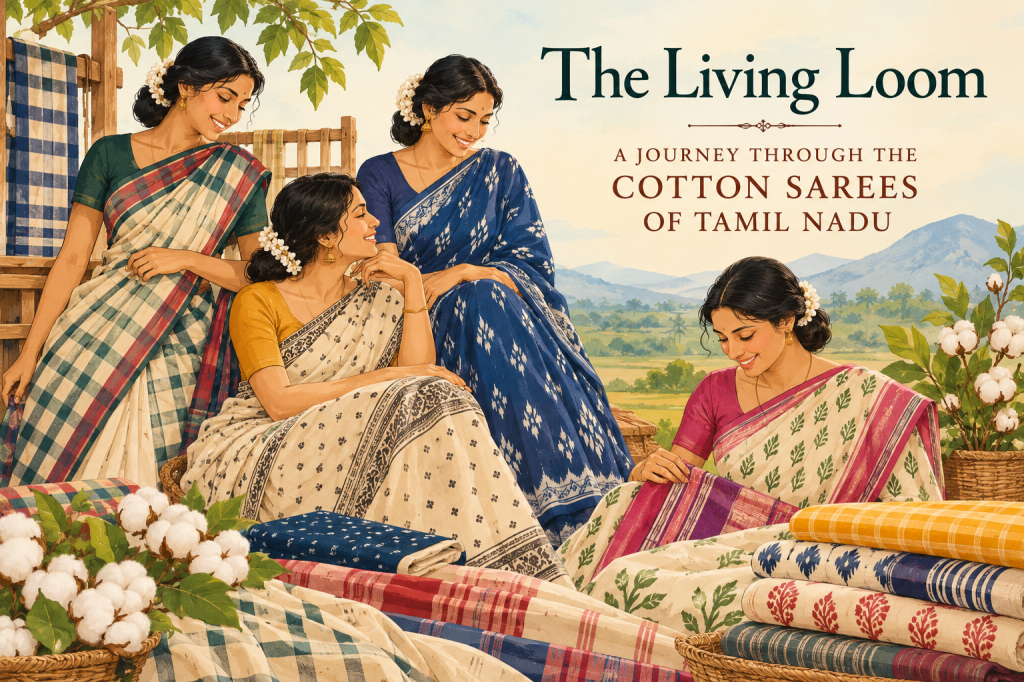
In the long, sunlit corridors of Tamil Nadu’s handloom tradition, cotton occupies a place of quiet yet enduring glory. Unlike the ceremonial weight of silk, cotton has always been the fabric of daily life—soft against the skin, responsive to the region’s heat and humidity, and capable of carrying intricate designs that last for years. Across villages and small towns, generations of weavers have transformed simple cotton yarn into sarees that reflect local landscapes, community histories, and evolving tastes. From the bold geometric checks of the Chettinad region to the delicate hand-tied dots of Madurai and the dense, durable weaves of Coimbatore’s villages, these cotton sarees continue to demonstrate how traditional practices adapt while retaining their essential character.
Tamil Nadu’s tropical climate has shaped its textile preferences for centuries. Cotton’s natural absorbency and breathability make it ideal for the long, warm days that define much of the year. Over time, weavers refined techniques on pit looms and frame looms, incorporating resist dyeing, hand-block printing, jacquard mechanisms, and carefully planned warp structures. Many of these varieties now carry Geographical Indication recognition, which affirms their connection to specific places and communities. Today, the sarees remain relevant both as everyday wear and as expressions of regional identity. Their evolution has been practical: yarn counts have been adjusted for comfort, lengths have been standardised for modern draping, and colour palettes have expanded, yet the core skills of the loom remain central.
This article explores that tradition in detail. It begins with the markets and related textile practices that support the craft, then examines individual varieties one by one. Each section describes historical roots, weaving processes, distinctive features, contemporary presence, and practical notes on wearing and caring for the fabric. The aim is to convey both the technical mastery involved and the continuing appeal of these cotton drapes.
Textile Markets and Related Traditions
Tamil Nadu’s textile markets function as vital meeting points where yarn, finished cloth, and knowledge circulate. The Erode Textile Market, particularly the large weekly gathering associated with the Gani Market area near Panneerselvam Park, has long been one of the state’s most active centres. Traders and weavers converge regularly, with intensive sessions drawing participants from across Tamil Nadu and from neighbouring states such as Kerala, Karnataka, Andhra Pradesh, and Telangana. Cotton sarees, dhotis, and related garments form a substantial portion of the trade. The market operates through a combination of daily shops and concentrated weekly activity, allowing both retail buyers and wholesale merchants to examine a wide range of pure cotton, printed, and handloom pieces. Its location between major spinning and weaving centres has helped it grow into a practical hub where seasonal demand for breathable fabrics is readily met. Over recent decades the market has continued to serve as a distribution point for both traditional and contemporary cotton varieties, supporting the flow of goods from local clusters to wider audiences.
Other markets have expanded significantly in the same period. Coimbatore’s wholesale and retail networks have grown alongside the region’s spinning mills and handloom clusters, facilitating the distribution of Kovai Kora blends and pure cottons. Madurai’s markets channel the Sungudi tradition and support surrounding organic cotton production. Salem and Virudhunagar have developed specialised nodes for handloom cottons, block-printed pieces, and powerloom-supported fabrics. Trichy-area markets sustain clusters such as Manamedu. These centres have benefited from cooperative societies, improved dyeing infrastructure, and broader distribution channels, making regional weaves more accessible while preserving their handmade qualities.
Madras checks form another distinctive strand of the region’s cotton history. This lightweight, yarn-dyed plaid originated along the Coromandel coast and takes its name from the historic port of Madras, now Chennai. Handwoven on pit looms with vegetable dyes in combinations of red, indigo, yellow, and green, the fabric features irregular checks that create a breathable cloth suited to humid conditions. Coastal communities historically used it as lungis. The cloth was exported extensively and became known as Real Madras Handkerchief or Bleeding Madras because the natural dyes softened and shifted slightly with washing. Weaving centres extended along the coast and into nearby areas. Authentic handwoven versions continue in limited production today, valued for their subtle irregularities and the way colours deepen with use. The pattern itself has travelled widely into contemporary fashion while remaining rooted in its South Indian origins.
Toda embroidery, practised by the Toda community of the Nilgiris, offers a complementary textile tradition. Locally called pukhoor, meaning “flower,” this counted-thread embroidery is worked exclusively by Toda women on coarse white or off-white cotton using red and black threads. Geometric motifs inspired by buffalo horns, mountains, celestial bodies, and sacred forms are stitched with such precision that the finished fabric can appear woven. Both sides of the cloth are usable. Traditional pieces appear on ceremonial shawls and cloaks. The craft holds Geographical Indication recognition, linking it specifically to the Nilgiri plateau. Practised in small settlements, it continues as a living expression of cultural identity, with designs remaining strictly geometric.
Kanchi Cotton
Kanchi cotton sarees emerge from the broader weaving heritage of the Kanchipuram region, focusing on pure cotton rather than the more widely known silk. Villages such as Vadamanapakkam have been important centres for this variety. The sarees are typically woven with 80s count cotton yarn in both warp and weft. Designers and weavers adapt motifs familiar from temple-border traditions—rudraksham beads, annam (swan), mayil (peacock), and mango forms—into the border and pallu, often accompanied by bright colour combinations and clean linear elements. The resulting fabric is lightweight yet structured enough to hold a graceful drape.
Historically, cotton versions of Kanchipuram-style designs offered an accessible way to carry the visual language of the region’s weaves. Weavers continue the practice on handlooms, adjusting proportions and colour choices to suit contemporary preferences while retaining the essential motifs. The process requires careful tension control so that fine cotton yarns produce crisp motifs without compromising the fabric’s breathability. Today, Kanchi cotton sarees are appreciated for daily and semi-formal wear. Their cotton base keeps them comfortable through warm days, and the woven motifs add quiet elegance that pairs well with both traditional and modern blouses.
Care is straightforward. Gentle hand-washing or a mild detergent cycle, followed by drying in the shade, preserves colour and structure. Ironing while the fabric is slightly damp restores a smooth finish. With regular use the cotton softens further. The skill involved lies in maintaining evenness across the fine yarns so that borders and motifs remain distinct yet the overall cloth remains pliable and wearable.
Chettinad and Chettinadu Kandangi
The Chettinad region, centred on Karaikudi in Sivaganga district, is home to the Kandangi saree, a robust cotton drape with a history spanning more than 150 years. Early versions were woven in silk; later the preference shifted to cotton for greater comfort in the arid climate. Kandangi sarees are defined by large-scale checks or stripes across the body, paired with wide contrasting borders that frequently incorporate temple motifs. Traditional colour palettes draw on mustard, brick red, black, and other earthy tones once obtained from vegetable dyes such as madder and turmeric. The fabric is usually made with coarser yarn, often around 40s count, which softens with use while retaining structure and longevity.
Weaving takes place on frame or pit looms fitted with fly shuttles. Warp lengths sufficient for several sarees are prepared at once, and the characteristic large checks arise from the precise coordination of coloured warp and weft threads. Historically the saree measured about 91 centimetres in width—narrower than today’s standard—so that anklets remained visible when the cloth was draped with pleats at the back. Contemporary pieces often follow standard dimensions while preserving the bold visual impact. The Nagarathar (Chettiar) community patronised the weave, and many weavers trace their ancestry to the Saurashtra region.
Today Kandangi sarees remain popular for their durability and striking appearance. They drape well for everyday wear and for gatherings. The fabric’s firm texture holds its shape yet becomes more supple over time. Care involves gentle washing, avoiding harsh chemicals, and shade drying to maintain colour and texture. The weaver’s skill is evident in the evenness of the large checks and the seamless integration of the wide border—work that requires careful planning of the warp before a single weft is thrown. Contemporary adaptations sometimes incorporate lighter yarns or refined colour combinations while keeping the essential checked structure that defines the style.
Virudhunagar and Aruppukottai
Virudhunagar district has long been recognised for cotton cultivation on its karisal soils and for the weaving that follows. Saree production concentrates in the eastern parts of the district, while bandage weaving is more prominent toward Rajapalayam. Clusters around Aruppukottai support both handloom and powerloom activity. Weavers historically included communities that migrated from the Saurashtra region of Gujarat, bringing established cotton-working skills that adapted to local yarns and preferences.
Production begins with fine white cotton yarn that is dyed in bright hues before being wound and prepared as the warp. On handlooms, artisans use coordinated arm and leg movements to create plant-inspired booti designs and other motifs. The process is collaborative, yet the weaver’s precise control over thousands of feet of movement per saree ensures the final fabric’s quality. Handloom pieces are especially valued for their hand-feel and longevity. Each saree requires careful calculation of yarn length and tension so that the woven patterns emerge evenly.
Contemporary production continues in the district, with cooperatives and individual weavers supplying markets across the state. The sarees offer practical elegance suited to warm weather. Their cotton construction keeps them comfortable through long days. Care is straightforward: mild washing preserves the cotton’s softness and allows the fabric to become more supple with use. The craftsmanship remains rooted in the careful dyeing and the rhythmic, skilled operation of the loom that turns yarn into wearable cloth. Over recent decades, both handloom and supported production have adapted designs to contemporary preferences while retaining the region’s characteristic plant-inspired motifs and durable structure.
Madurai Sungudi
Madurai Sungudi is among the most distinctive cotton sarees of Tamil Nadu and received Geographical Indication recognition in 2005. The name relates to words for round or circular forms, reflecting the tiny dots created by the tie-and-dye process. Saurashtrian weavers who settled in Madurai centuries ago under Nayak patronage developed the technique on local cotton. Women traditionally tie thousands of small knots—sometimes more than 20,000 on a single saree—using thread so that those points resist dye. After dyeing, the knots are released, leaving a field of white or undyed dots against a coloured ground. Borders and pallus are often treated separately with clamp or block methods.
The base fabric is usually fine cotton, often around 100s warp and 80s weft. Traditional dyes were vegetable-based; later practices incorporated a wider range of colours while authentic hand-tied versions retain the handmade character. Patterns can evoke constellations or kolam designs. The finished saree is lightweight and particularly suited to warm weather. A single traditional piece may require many days of knotting alone before dyeing begins.
Today genuine hand-tied Sungudi sarees coexist with printed or screen versions that meet broader demand. The authentic pieces are especially prized for their unique, slightly irregular dots that no two sarees share exactly. They are ideal for summer occasions and can be styled with simple jewellery or minimal accessories. Care requires gentle washing to protect the resist-dyed areas; avoiding prolonged soaking helps preserve the clarity of the dots. The skill of the knotting artisans—often women working with extraordinary precision and patience—remains the heart of the craft. Contemporary weavers continue to produce both classic dotted fields and more elaborate geometric arrangements while keeping the essential resist technique.
Kodali Karuppur
Kodali Karuppur sarees originated in the village of the same name near Kumbakonam in the Thanjavur region. They developed under Maratha patronage in the late eighteenth and nineteenth centuries and combined jamdani weaving of gold or metallic motifs with subsequent kalamkari hand-painting or block printing using natural dyes. The result was a refined textile featuring subtle gold spots on a white ground, surrounded by painted or printed patterns in earthy reds, blacks, and related hues. Motifs remained largely geometric, linear, or vine-like, with limited figurative elements suited to court and ceremonial use.
The process required close collaboration among weavers, dyers, and painters. After the jamdani ground was woven, the cloth underwent bleaching and mordant treatments before freehand kalam work or block application fixed the colours. The tradition was exclusive for a time, appearing in bridal trousseaus and as gifts of honour. Creating the finished cloth demanded careful registration so that painted elements aligned with the woven metallic motifs.
While pure historical examples are rare, revival efforts have brought the layered technique back into contemporary production. Modern versions may use jacquard assistance for the woven elements while retaining hand-painted or printed details. The sarees convey quiet luxury and a sense of layered craftsmanship. Care focuses on protecting the painted surfaces—dry cleaning or very gentle washing is advisable. The enduring skill lies in the precise registration of painted motifs with the underlying woven elements and in the patient application of natural-dye processes that give the cloth its characteristic soft depth of colour.
Kovai Cotton (Kovai Kora)
Kovai Kora cotton sarees, associated with Coimbatore district and neighbouring areas including Sirumugai, received Geographical Indication recognition around 2014–15. They are a blend of kora silk in the warp and fine mercerised cotton in the weft, often with jacquard-worked pallu and buttas. The combination yields a fabric that is lightweight, slightly lustrous, and crisp to the touch, with bright contrasting borders. The silk-cotton marriage gives durability alongside comfort.
Weaving is carried out on handlooms by communities that include the Devanga weavers. A single saree may take two to three days. Designs frequently feature bold colour contrasts and structured borders. Authorised cooperative societies in Coimbatore, Tiruppur, and Erode districts help maintain standards. The process requires the weaver to balance the differing properties of silk and cotton yarns so that the finished cloth remains even and free of distortion.
These sarees suit both daily wear and slightly more formal settings. Their blend makes them versatile across seasons and easy to drape. Mild washing and shade drying preserve the sheen and structure. Contemporary pieces continue to explore new colour combinations and border styles while retaining the characteristic silk-cotton texture that defines the variety. The weaver’s expertise is visible in the crisp yet comfortable hand of the finished fabric.
Negamam
Negamam cotton sarees come from villages around Negamam and Pollachi in Coimbatore district and received a Geographical Indication tag in 2023. They are woven primarily with 80s count cotton in both warp and weft and feature a relatively high pick density, historically around 86–90 picks per inch, producing a medium-bodied yet breathable fabric. Traditional lengths were longer, around 7.3–8.2 metres, suited to regional draping styles, though contemporary pieces often follow standard formats. Designs tend toward restrained borders, checks, stripes, and occasional small motifs such as peacock or mango.
The local climate, influenced by moisture-laden winds from the Western Ghats, supports the weaving of this denser cotton structure. Production has historically peaked in the monsoon months when humidity aids the yarn. Weavers, many from longstanding communities, work on pit looms, and the process can involve thousands of movements per saree. The high density gives the fabric durability while the cotton remains comfortable against the skin.
Negamam sarees are appreciated for their strength and comfort in warm weather. They soften further with washing yet hold their shape. Gentle care maintains the dense weave. The skill is visible in the consistent high-density structure and the clean integration of narrow, contrasting borders. Contemporary weavers continue to produce both classic solid and lightly patterned versions as well as pieces with more elaborate motifs, keeping the essential technical character of the weave.
Manamedu Cotton and Hand Block
Manamedu, a village in Tiruchirappalli district, has emerged as a significant cotton handloom cluster. Sarees from here are known for their lightweight quality, often made with cotton sourced from the Kaveri delta. Designs include hand-buttas (small floral or geometric motifs worked during weaving), dobby borders, stripes, checks, and contemporary geometric elements. Some varieties incorporate hand-block printing on the finished or semi-finished cloth, adding floral or traditional patterns in multiple colours.
The cluster supports several cooperatives and hundreds of looms. Production has grown in recent years, with annual output reaching tens of thousands of sarees. The fabric remains soft and suitable for daily wear, and lengths often include an attached blouse piece. Weavers from communities long associated with the area continue to adapt designs while maintaining the characteristic light hand of the cloth.
Manamedu pieces are practical and stylish for warm climates. Hand-block versions offer additional visual interest while remaining fully washable with care. Mild detergent and shade drying suit both woven and printed examples. The weavers’ ability to integrate motifs seamlessly on the loom, or to prepare cloth for precise block registration, demonstrates sustained technical command. Contemporary production has expanded the range of colours and border styles available while preserving the lightweight, durable quality that defines the cluster.
Salem Cotton and Handblock
Salem has a long textile history that includes both pure cotton and cotton-silk blends. Salem cotton sarees often feature simple or butta-worked pallus and borders, woven in fine counts that yield softness and strength. Hand-block printed cottons from the area display a range of traditional and contemporary motifs—floral, geometric, and paisley forms—applied to lightweight bases such as mulmul or cambric.
Block printing involves carved wooden blocks dipped in dye and stamped by hand, allowing for repeating patterns with slight natural variation. Dyeing and printing facilities in the region support both local weavers and wider production. The finished sarees remain breathable and easy to maintain. The combination of handloom structure and hand-applied prints gives each piece a distinct character.
These cottons work well for everyday and office wear. Care is simple: gentle washing preserves printed colours. The artisan skill appears both in the even handloom structure and in the steady pressure and alignment required for clear block impressions. Contemporary Salem cottons continue to explore new print arrangements and colourways while remaining rooted in the region’s long weaving and dyeing traditions.
Paramakudi
Paramakudi, in Ramanathapuram district, produces cotton sarees noted for their use of 80s combed cotton and intricate jacquard thread borders. Motifs frequently include traditional forms such as peacock, mango, or elephant alongside geometric patterns. Some pieces incorporate subtle zari accents or contrasting stripes in the pallu. The weave is soft yet durable, suited to the region’s climate.
Weaving communities here, including those with Saurashtrian roots, have maintained the craft for generations. Cooperatives support production, and the sarees are available in lengths around 5.5 to 6.2 metres. Contemporary designs blend classic elements with fresher colour combinations. The jacquard borders require precise setup of the loom mechanism so that complex patterns emerge cleanly.
Paramakudi cottons offer graceful everyday elegance. They drape comfortably and hold up well to regular use. Standard cotton care—mild washing and careful ironing—keeps them looking fresh. The combination of fine combed cotton and detailed border work gives the sarees a refined yet practical character that continues to find wearers across the state and beyond.
Ponnai Tie and Dye
Ponnai, in Vellore district, is associated with cotton sarees that employ traditional tie-and-dye techniques on the pallu and border. Geometric motifs and small buttas appear across the body, while the resist-dyed sections create patterned edges in bright colour combinations. The base is typically 60s or similar cotton, yielding a comfortable, medium-weight fabric.
The process mirrors other South Indian resist methods: sections are tied before dyeing so that selected areas remain lighter or differently coloured. Weavers and dyers work in coordination through local cooperatives. The result is a lively yet wearable saree suited to warmer months. The geometric effects in the pallu and border add visual interest without overwhelming the cloth.
These pieces are practical for daily and casual festive wear. Gentle washing protects the dyed patterns. The skill resides in the accurate tying that produces clean geometric effects without bleeding. Contemporary production continues to offer both classic and updated colour combinations while retaining the essential resist technique on the borders and ends.
Additional Varieties and Contemporary Expressions
Thousand Butta designs appear across several Chettinad and related cotton lines, featuring numerous small woven or printed motifs scattered over the body for a richly textured look. These create a lively surface while remaining fully cotton and breathable. Dindigul cottons are recognised for their softness and fine finish, often in solid or lightly patterned forms that emphasise the quality of the yarn itself. Jayankondam and nearby areas contribute further cotton weaves suited to local preferences, frequently featuring clean borders and comfortable drapes. Organic cotton lines from Madurai and Vadambachery emphasise natural fibres and dyeing methods, appealing to those seeking minimal processing while retaining the handloom character of the region.
Kuravalli and Aruppukottai clusters add regional variations in checks, stripes, and simple motifs. Cotton block-print traditions extend beyond single centres, with hand-stamped patterns on lightweight bases remaining popular for their versatility and the slight natural variation that marks hand application. Across all these varieties, the evolution has been practical. Weavers have adjusted yarn counts, lengths, and colour palettes to current needs while preserving core techniques—whether high-density plain weave, resist dyeing, jacquard borders, or hand-block printing. Handloom pieces continue alongside supported production, ensuring that the distinctive hand-feel and slight irregularities that mark handmade cloth remain available.
Wearing and Caring for Tamil Nadu Cotton Sarees Today
These sarees invite everyday enjoyment. Their cotton nature makes them ideal for long days, travel, or warm evenings. A Kandangi can be paired with simple silver jewellery for a bold statement, while a Sungudi or Negamam piece offers understated elegance. Manamedu and Salem cottons work equally well with contemporary blouses or traditional ones. The drape is generally easy, and the fabrics breathe well throughout the day. Many wearers find that the sarees become more comfortable with repeated use as the cotton softens.
Care is straightforward and rewarding. Most pure cotton varieties respond well to gentle hand-washing or a mild machine cycle with similar colours. Avoid strong bleaches. Dry in the shade to preserve hues, and iron while slightly damp for a smooth finish. Resist-dyed and block-printed pieces benefit from extra care to keep patterns crisp. With regular, gentle use, the sarees often last for years and develop a pleasing softness. Storing them in clean, dry conditions away from direct sunlight further supports their longevity.
The skill embedded in each piece—whether the thousands of knots in a Sungudi, the dense picks of a Negamam, the precise checks of a Kandangi, the layered painting of a Kodali Karuppur revival, or the steady rhythm of a Manamedu loom—remains the true glory. Tamil Nadu’s cotton sarees continue to evolve in the hands of artisans who balance tradition with contemporary life, offering wearers not only comfort and beauty but a direct connection to a living craft. Exploring these weaves is an invitation to appreciate the quiet mastery that turns simple cotton yarn into enduring elegance.
Sources
Information drawn from the following publicly available materials and related documentation: News18 report on Virudhunagar cotton weaving; Roampedia guide to silk and handloom towns of Tamil Nadu; Save Handloom Foundation overview of Tamil Nadu’s GI-certified handloom clusters; Esamskriti article on handloom sarees of Tamil Nadu; My Holiday Happiness exploration of silk and cotton weaving villages; The Hindu reporting on handloom stories and related textile topics; Chettinad Handloom about-us materials; Wikipedia entries on Kandangi and Chettinad; archived Hindu reporting; New Indian Express coverage of woven wonders and related craft developments; Tamil Nadu government handloom and textiles documentation; MAP Academy and related textile history resources on Madras checks; Wikipedia and cultural resources on Toda embroidery; Geographical Indication registry details and cooperative descriptions for Kovai Kora, Negamam, Kandangi, Madurai Sungudi, and related varieties; academic and craft documentation on Kodali Karuppur and Karuppur Kalamkari; cluster descriptions for Paramakudi, Manamedu, Salem, and Ponnai; and supporting materials from handloom cooperatives and regional textile histories.
A Reader’s Note on Names, Places, and Craft Labels
Tamil Nadu’s cotton-saree vocabulary includes place-based names, established handloom identities, design descriptions, and labels used by individual sellers or contemporary collections. These categories do not all have the same status. A recognised geographical indication (GI), for example, is not the same thing as a broad description such as “cotton block print” or “thousand butta.” A place name may point to a weaving cluster without meaning that every textile sold under that name has been made on a handloom or follows one fixed specification. This article therefore celebrates the named varieties while treating details that vary by producer—such as yarn count, dimensions, dyes, motifs, and production method—as features to verify for each individual saree.
The supplied draft is the foundation for this expanded article. Its descriptions are retained as a starting point and developed with practical explanations of materials, pattern, weaving, wearing, and care. Some regional labels in the list are not consistently documented in the same way across public sources. Where the available descriptions are brief, the article explains the name cautiously rather than presenting an unverified technical specification as universal fact. Readers buying a particular variety should ask the seller or weaving cooperative about its fibre content, production method, place of origin, and any applicable GI or handloom certification.
This is a descriptive craft article, not a claim that every saree in a named style is made identically. Tamil Nadu’s textile culture is living and adaptable: a traditional border may be woven in more than one way, a familiar motif may be recreated through printing, and contemporary collections may combine older design language with new colours or yarns. Those variations are part of the present-day story, provided the product is described honestly.
How to Read a Tamil Nadu Cotton Saree
A saree is a long, continuous piece of cloth, but its appearance is the result of several decisions made before and during production. The warp consists of the lengthwise yarns held under tension on the loom; the weft is passed across them to build the fabric. The density of these threads, the fibre and yarn quality, the way the yarn is prepared, and the finishing all influence the final hand-feel. A saree that appears crisp in the shop may soften after washing, while a fine, airy fabric may need gentler handling than a compact, sturdy weave.
The body is the main field of the saree. The border frames it, and the pallu—the decorative end displayed over the shoulder—often provides a space for a more elaborate design. A plain body with a striking border can be just as carefully planned as a saree filled with motifs. Checks require the colours of warp and weft to be coordinated; stripes rely on planned sequences of yarn; buttas are small motifs that may be woven, printed, or embroidered; and a jacquard mechanism can help produce repeated, more complex patterns. These terms describe different design choices, not a simple ranking from basic to superior.
The yarn count mentioned in textile descriptions is a technical indicator of yarn fineness, but the exact numbering convention matters. A count quoted for one variety should not automatically be applied to another, and not every seller uses the same specification. When comparing sarees, it is more useful to combine the stated count with a direct assessment of weight, transparency, surface texture, weave density, and the seller’s description of the production process.
Colour can enter a cotton saree at different stages. Yarn-dyed checks and stripes are formed by weaving coloured yarns together. Resist dyeing protects selected areas from colour, as in tie-and-dye work. Block printing transfers a design from a carved block to the cloth. Some textiles combine woven motifs with later printing or painting. These methods can look similar from a distance but create different surfaces and different kinds of variation. Asking how the design was made is an enjoyable way to learn about the piece.
The Journey from Yarn to Finished Saree
1. Preparing the yarn
Cotton yarn must be suitable for the intended fabric. It may be selected for fineness, strength, evenness, or a slightly fuller character. Before weaving, the yarn is prepared and arranged so that the warp can be placed on the loom in the required order. Coloured warp yarns must be sequenced carefully for stripes and checks. A small mistake in the arrangement can shift a line or interrupt the repeat, so planning is an essential part of the design rather than a task separate from artistry.
2. Setting up the loom
3. Building the design
A plain weave can produce a beautiful fabric when the yarn, density, colour, and finishing are well judged. More elaborate designs may require extra patterning arrangements, dobby or jacquard mechanisms, supplementary weft, or a second process after weaving. In a checked saree, the pattern emerges from the relationship between coloured warp and weft. In a Sungudi saree, the dots are formed through resist tying and dyeing rather than by weaving every dot into the cloth. In a hand-block-printed saree, the design is applied through repeated impressions, and the printer must keep the pattern aligned while allowing for the natural character of hand application.
4. Dyeing, printing, and finishing
Dyeing and printing require their own forms of judgement. The result depends on the fibre, dye system, preparation, colour sequence, and the way the fabric is washed or finished afterwards. Traditional descriptions sometimes refer to vegetable dyes, but a buyer should not assume that every contemporary saree uses natural dyes simply because its design is traditional or its colours are earthy. If natural dyes, organic cotton, or low-impact processes are important to a purchase, ask for a clear product-specific explanation rather than relying on the appearance of the cloth.
5. Inspection before the saree leaves the workshop
Erode Textile Market: A Meeting Point for Cotton
Erode’s textile trade is an important part of the wider cotton ecosystem of western Tamil Nadu. The city sits within a region connected to spinning, weaving, dyeing, wholesale distribution, and the everyday movement of fabric. The market is not just a place to buy a finished saree: it is also a point where different scales of trade meet. A household shopper may be looking for a single comfortable cotton drape, while a retailer or trader may compare quantities, colour ranges, fabric weights, and repeat availability.
The Erode Textile Market, including the market activity associated with the Gani Market area near Panneerselvam Park, is known for concentrated trading sessions alongside regular shops. Its position in a textile-producing region makes it a useful link between makers and buyers. Cotton sarees sit within a broader assortment of fabrics and garments, including dhotis and other cotton products. The variety available reflects the fact that a market can bring together cloth from different production systems: handloom pieces, powerloom fabrics, printed cottons, and blends may all appear in the same trading environment.
For a visitor, the most rewarding approach is to shop with a few practical questions in mind. Is the saree pure cotton, a cotton blend, or a cotton-silk fabric? Is the pattern woven into the cloth, printed onto it, or created through resist dyeing? Is it made on a handloom, powerloom, or another production system? Does the seller know the weaving cluster or producer? These questions are not meant to make shopping complicated; they help a buyer understand why two sarees that look similar may differ in texture, price, drape, and care.
Wholesale markets also help colours and designs circulate. A shade developed for one local customer base may find new buyers through retailers in another state. A familiar checked design may be offered in a contemporary palette, while a traditional border may be adapted to a lighter body cloth. The market therefore supports continuity and change at once. It helps established cotton traditions remain visible while allowing products to respond to new preferences.
Erode’s importance should be understood as part of a network rather than as an isolated story. The yarn, the loom, the dyeing or printing unit, the trader, the retailer, and the person who wears the saree all form part of the textile journey. A market’s scale is visible in its bustle, but its deeper value lies in connecting the work of many people with the needs of many kinds of customer.
Other Textile Markets and the Growth of Distribution
Over the past few decades, the way cotton sarees reach buyers has broadened. Traditional shops and weekly markets continue to matter, but cooperative outlets, exhibitions, craft fairs, textile showrooms, regional retail chains, online catalogues, and direct-to-consumer channels have added new routes. A buyer no longer needs to travel to every weaving town to encounter its fabrics, although visiting a cluster can still provide a richer understanding of the people and processes behind a saree.
Coimbatore and the western textile belt
Coimbatore’s textile identity is closely connected with the wider spinning and weaving economy of the western districts. Retail and wholesale networks carry a range of cottons and cotton-silk fabrics, including products associated with Kovai and neighbouring weaving areas. The city’s commercial reach allows regional textiles to be sold alongside contemporary everyday clothing and dress materials. For buyers, this can mean a broad choice of fabric weights and colour combinations, but it also makes checking fibre content and manufacturing method especially useful.
Madurai: a market shaped by Sungudi
Madurai’s textile markets connect shoppers with Sungudi sarees and other cottons, while also serving as a regional retail centre. Sungudi’s small dotted patterns make it instantly recognisable, yet the market may contain hand-tied pieces as well as printed or screen-produced interpretations. The distinction matters because the labour, texture, appearance, and care requirements can differ. Asking how the dots were formed helps buyers choose the version that suits their preferences.
Salem and Virudhunagar
Salem and Virudhunagar are associated with cotton production and textile trading, with products that may include handloom fabrics, printed cottons, and powerloom-supported lines. A regional market can support both established local styles and new colourways. The word “handloom” should be used precisely: it describes a production method, not merely a traditional-looking pattern. Where a piece is handwoven, sellers may be able to identify the producer, cooperative, or cluster.
Tiruchirappalli and the Manamedu connection
Markets in and around Tiruchirappalli help connect Manamedu and other nearby textile clusters with customers across the state. The availability of lightweight cotton sarees, woven buttas, checks, stripes, and hand-block-printed options illustrates how a local craft can serve both everyday needs and changing tastes. Small retail outlets can introduce customers to a variety of finishes, while cooperative channels and exhibitions provide opportunities to learn more about the maker.
Retail, exhibitions, and online discovery
Craft exhibitions and handloom events often allow a buyer to compare different weaving traditions in one place. Online catalogues have made it easier to discover colourways and place-based styles, but photographs cannot fully communicate weight, softness, opacity, or the difference between a woven motif and a print. If buying online, look for detailed descriptions, close-up photographs, transparent return policies, and explicit statements about fibre content and production method. When a listing uses a regional name, it is reasonable to ask what makes that particular saree characteristic of the named cluster.
Madras Checks: A Pattern with a Long Journey
Madras checks are a lightweight, yarn-dyed plaid associated with the historic port city of Madras, now Chennai, and the Coromandel Coast. The fabric is recognised by its intersecting coloured lines and checks, often arranged in combinations that feel lively without making the cloth heavy. Its history includes local use and extensive overseas trade, which helped the pattern travel far beyond its place of origin. The term “Madras” became a name that consumers in different markets could recognise, while the cloth itself continued to be adapted to new uses.
The pattern begins with colour planning. Coloured warp and weft yarns cross one another to form checks, so the design is built into the structure of the fabric rather than simply painted on its surface. Depending on the specific cloth, the checks may be regular or slightly irregular, and the palette may combine red, blue, yellow, green, black, or other tones. The character of the pattern depends on the spacing of the lines as much as on the colours themselves. A small check can feel restrained; a large check can become the main visual feature of the outfit.
Madras cloth is also associated with the expression “bleeding Madras,” used historically for fabrics whose colours softened or shifted with washing. This effect was connected with the dyes and finishing of particular versions, not a guarantee that every contemporary fabric sold as Madras checks will behave in the same way. Modern products may use different dye systems and finishing standards. Buyers should follow the care instructions supplied for the actual fabric rather than intentionally washing it in the hope of producing a historical effect.
Although Madras checks are often discussed in relation to shirts, lungis, handkerchiefs, and other forms of cloth, the pattern’s visual language can inform saree design too. It offers a useful lesson in the flexibility of cotton: the same basic grid can look casual, classic, bold, or refined depending on the scale and colour. A checked cotton saree can be paired with a solid blouse that picks up one of the lines, or with a contrasting colour for a more playful appearance.
The importance of Madras checks lies not in a single fixed recipe but in the relationship between place, yarn-dyeing, trade, and design. Its continued recognition shows how a regional textile pattern can become internationally familiar while still carrying a memory of its origins. When discussing Madras checks, it is helpful to distinguish the historically rooted cloth from any modern product that simply borrows the plaid appearance.
Toda Embroidery: The Nilgiris’ Distinctive Cotton Surface Art
Toda embroidery, practised by women of the Toda community in the Nilgiri hills, is a distinctive textile tradition that complements the story of Tamil Nadu’s cottons. It is commonly known as pukhoor, a term associated with flowers. Unlike a weave in which the pattern is formed by interlacing warp and weft, Toda embroidery creates a design through counted-thread stitching on a base cloth. The resulting surface can appear almost woven because the stitches are carefully arranged and closely fitted.
Traditional embroidery uses contrasting red and black threads against a white or off-white base. Geometric patterns are central, and designs may draw inspiration from the surrounding landscape, buffalo-related forms, mountains, and other meaningful shapes. The motifs should be understood within the community’s own cultural context rather than treated as generic decoration. Their placement, repetition, and balance are part of the visual identity of the textile.
The reverse side of the work is also notable: in traditional examples, the stitch construction can make both sides useful. Embroidered textiles are associated especially with shawls and cloaks rather than being a standard category of cotton saree. In a blog about Tamil Nadu’s cotton traditions, Toda embroidery is best presented as a related textile art from the Nilgiris, not as a weaving style interchangeable with Sungudi, Kandangi, or other saree varieties.
The craft has received Geographical Indication recognition, linking its identity to the Nilgiri region and the community that sustains it. That recognition is a reminder that textile heritage includes more than the finished object. It includes knowledge of the motifs, the skill of the stitchers, and the cultural meanings that guide how a piece is made and used. Contemporary applications may bring the embroidery to new audiences, but responsible presentation should preserve the name of the craft and acknowledge the Toda women whose expertise keeps it alive.
For anyone interested in learning more, the best starting point is respectful observation and reliable cultural documentation. Motifs should not be casually assigned meanings without evidence, and community-specific designs should not be detached from their context. Toda embroidery demonstrates that the textile landscape of Tamil Nadu is wonderfully diverse: weaving, dyeing, printing, and embroidery each offer different ways to turn cloth into a carrier of identity.
A Closer Guide to the Twenty-Two Varieties
The names below are presented as a practical field guide rather than a rigid classification. Some are established regional styles, some are associated with a specific town or cluster, and some describe a technique or design feature that may appear in more than one place. Where a label is broad, the guide explains the features a buyer can look for and the questions worth asking.
1. Kanchi Cotton
Kanchi cotton draws on the visual vocabulary associated with Kanchipuram’s textile heritage while using cotton as its principal fibre. Motifs such as mango forms, peacocks, swans, bead-like rudraksham patterns, and linear temple-inspired borders may appear, depending on the producer. The appeal is the meeting of a breathable cotton body with a clearly framed border and a pallu that gives the design a finished appearance. The cotton version should not be confused automatically with Kanchipuram silk: the fibre content and construction are different, even when the motifs share a regional design language. A buyer can look for clean border edges, balanced colour contrast, and a body that feels comfortable for the intended use. Ask whether the saree is handwoven and whether the motifs are woven into the fabric or applied by another process.
2. Kuravalli
Kuravalli appears in the list as a regional cotton-saree name, but publicly available descriptions do not establish one universally accepted specification for every saree sold under this label. It is therefore best approached as a place-linked or seller-used designation whose exact meaning should be confirmed with the maker. When evaluating a Kuravalli saree, pay attention to the weave density, the character of its border, the use of stripes or checks, and whether the motifs are woven, printed, or dyed. Ask the seller to identify the village or cluster and the production method. This careful approach respects the regional name without attributing unverified details to every product. The broader Tamil Nadu cotton tradition shows how local identities can persist through recognisable design choices even as colour palettes and end uses change.
3. Chettinad Cotton
Chettinad cotton is often recognised by its confident use of checks, stripes, contrasting borders, and earthy or vivid colour combinations. Its visual language suits the region’s distinctive architectural and cultural identity: large-scale patterning can make the saree memorable without relying on elaborate surface ornament. Some pieces feel firm when new and become more supple with use. The body, border, and pallu need to work together, particularly when the checks are large. A blouse in a single colour can allow the checked field to remain the focus, while a contrasting blouse can echo the border. The name “Chettinad cotton” may be used broadly in retail, so shoppers should ask whether the saree is a Kandangi or another cotton style, and whether it was woven in the region or merely inspired by its look.
4. Virudhunagar Cotton
Virudhunagar and nearby areas have a long association with cotton work and textile production. The regional story includes handloom activity as well as other forms of manufacturing, so the name alone does not identify one fixed construction. Cotton sarees associated with the area may use bright colours, small plant-inspired motifs, stripes, or other practical designs. The most useful way to appreciate them is to examine how the cloth balances comfort and durability. Check the fall of the fabric, the consistency of the weave, the finish of the selvedge, and the clarity of any motif. A direct question about whether the piece is handloom or powerloom-made is appropriate and helps keep the description accurate. The region’s importance lies in the wider community of cotton-related skills rather than in a single pattern alone.
5. Cotton Block Print
Cotton block-print sarees are defined by a printing technique rather than by one exclusive town. A carved wooden block is coated with colour and pressed onto the cloth, often repeatedly, to create a pattern. Floral vines, paisleys, geometric repeats, and small scattered motifs are common design possibilities. Each impression must align with the previous one, and a printer learns to judge pressure, colour load, and spacing. Slight variation can be part of the charm of hand application, while large gaps or smudges may indicate a production fault. The base cloth may be handwoven or machine-made, so “block print” does not by itself mean “handloom.” To preserve the print, wash gently, avoid harsh bleach, and follow the maker’s instructions, especially for dark or contrasting colours.
6. Chettinadu Kandangi
Kandangi is the best-known cotton saree associated with Chettinad, especially the Karaikudi and Sivaganga region. Its characteristic look includes bold checks or stripes, wide contrasting borders, and a sturdy cotton body. Earthy shades such as brick red, mustard, dark tones, and contrasting accents are often associated with traditional examples, though contemporary colour combinations can vary. The design is planned through the arrangement of coloured warp and weft yarns, making the checks integral to the fabric. The saree’s substantial character can make it feel different from very fine, airy cottons; with use, it may soften while retaining its structure. The GI-recognised identity belongs to the specific Kandangi tradition, so buyers should check the provenance and product details rather than assume that any checked cotton saree is Kandangi.
7. Manamedu Hand Block
Manamedu, in the Tiruchirappalli region, is associated with cotton handloom production, including light fabrics with stripes, checks, woven buttas, and dobby borders. Hand-block-printed versions add a second design layer through stamped motifs. This combination is particularly interesting because the cloth’s structure and its printed surface can be appreciated separately: the weave provides the body and drape, while the block adds colour and rhythm. A good print has deliberate placement and a coherent repeat, though small hand-made variations may occur. When shopping, ask whether the base fabric is handloom and whether the printing is genuinely block-applied. The name should be used with care, because not every light cotton with a floral print necessarily originates in Manamedu.
8. Salem Handblock
Salem’s wider textile environment includes cotton fabrics and printed textiles. In a hand-block-printed saree, the main visual character comes from the repeated impression of carved blocks on cotton. The palette may be restrained and natural-looking or bright and contemporary, while the motifs can range from small florals to paisley and geometric forms. The printer’s work involves aligning the repeat over a long length of fabric, keeping colour application consistent, and managing the order of colours when more than one block is used. A saree may also combine a printed body with a woven or separately finished border. The word “Salem” can refer to a broad retail association, so ask the seller about the place of printing and the origin of the base cloth.
9. Kodali Karuppur
Kodali Karuppur is associated with a specialised textile tradition from the Thanjavur region, historically linked with Maratha-period patronage and a combination of woven motifs and painted or printed decoration. Descriptions of historic examples refer to fine ground cloth, small metallic or woven details, and subsequent surface work in carefully controlled colours. This layered process makes the textile different from a simple all-over print: the design is built through more than one craft stage. Contemporary revival pieces may adapt the original process, so the exact materials and method should be confirmed for each item. Because these textiles can include painted surfaces or metallic elements, their care needs may differ from ordinary washable cotton. Follow specific instructions from the maker and avoid treating every product using the name as identical to a historic example.
10. Madurai Organic Cotton
“Madurai organic cotton” is best understood as a fibre-and-market description unless the seller identifies a specific certified product or production scheme. Organic refers to the way the cotton is grown under a defined standard; it does not automatically mean that the fabric is handwoven, naturally dyed, or free of all chemical processing. A saree may combine organic cotton with a range of weaving and finishing methods. Buyers who prioritise organic fibre should ask which standard or certification applies, whether it covers the yarn or finished fabric, and whether the dyeing process is separately described. Madurai’s textile setting gives the label a useful regional association, but the exact origin should be verified product by product. The finished saree’s comfort will still depend on yarn quality, weave density, finishing, and the wearer’s preferences.
11. Vadambachery Organic Cotton
Vadambachery is associated in the supplied material with organic cotton lines, but detailed specifications are not consistently available for every product sold under this name. The safest description is a regional cotton offering whose organic claim should be supported by product-specific information. Organic fibre can appeal to buyers who want to understand the material’s origin, while a handloom claim refers to how the fabric was woven; the two are separate attributes. Ask whether the cotton is certified, whether the saree is handwoven, and what dyes or finishing agents were used. The design may be simple, allowing the quality of the yarn and the fabric’s texture to take centre stage. Such clarity helps customers appreciate the textile without turning a broad label into an unsupported guarantee.
12. Salem Cotton
Salem cotton covers a broad range of cotton sarees and related fabrics associated with the Salem textile region. Some are designed for daily wear, with simple bodies, stripes, checks, or small motifs; others have more decorative pallus and borders. Cotton can be woven in different yarn counts and densities, so the name does not guarantee one particular thickness or softness. A practical buyer should compare the fabric in natural light, examine the selvedge, and check how the saree falls when held from one end. If the product is described as pure cotton, confirm that it is not a cotton-polyester or cotton-silk blend. Salem’s textile identity is best appreciated as a varied ecosystem of production, design, and trade rather than as a single fixed pattern.
13. Ponnai Tie and Dye
Ponnai, in the Vellore region, is associated in the supplied draft with cotton sarees that use tie-and-dye effects, particularly on borders and pallus. In resist dyeing, selected sections are tied or otherwise protected so that dye cannot reach them in the same way as the exposed cloth. Once the ties are removed, the protected areas form dots, bands, or other patterns. The sharpness of the effect depends on how accurately the fabric is tied and how the dye bath is managed. The method can create lively colour contrasts without adding heavy ornament. As with other place-linked labels, buyers should ask whether the saree was made in Ponnai and whether the design was tied by hand or reproduced through another method. Gentle washing is advisable unless the maker gives different care instructions.
14. Aruppukottai Cotton
Aruppukottai is part of the Virudhunagar district’s cotton and textile landscape, with handloom and powerloom activity represented in the wider cluster. Sarees associated with the area may feature practical cotton bodies, bright colour choices, stripes, checks, or small plant-inspired motifs. Because production methods can differ within one region, the label does not itself establish that a particular saree is handwoven. Look for a clear description of the loom type and the maker’s location. The appeal of regional cottons often lies in their everyday usefulness: a comfortable weight, a border that gives the drape definition, and colours that work across routine and semi-formal settings. Contemporary producers can introduce new combinations while continuing to draw on familiar local design preferences.
15. Kovai Cotton / Kovai Kora
Kovai Kora is a recognised cotton-silk textile associated with Coimbatore and nearby areas. It is commonly described as combining kora silk in the warp with cotton in the weft, producing a crisp, lightweight fabric with some lustre. This makes it distinct from a saree made entirely of cotton, even though the name includes “cotton.” Contrasting borders and patterned pallus may provide the main decorative focus. The balance between the two yarn types requires careful control so that the fabric remains even. If a buyer wants a pure-cotton saree, the fibre composition should be checked rather than inferred from the product name. Kovai Kora demonstrates how Tamil Nadu’s textile makers use blended fibres to achieve a particular balance of texture, sheen, and wearability.
16. Negamam Cotton
Negamam, near Pollachi in Coimbatore district, is associated with a cotton-saree tradition known for a substantial yet breathable fabric, restrained borders, and patterns such as stripes, checks, and small motifs. The weave’s density contributes to its durability, while the cotton keeps it comfortable for regular use. Some descriptions note relatively fine cotton yarn and a close pick structure, but specifications can vary by producer and contemporary design. Negamam sarees may suit wearers who prefer a fabric with a little body rather than an extremely sheer drape. The border often gives the saree a neat frame without overwhelming the main field. Ask for the exact origin and handloom details when buying, particularly if the product is marketed as a GI-linked variety.
17. Thousand Butta
Thousand butta is a design description for a saree covered with many small motifs, not necessarily the name of one independent weaving town or a single standardised weave. The word butta refers to a small decorative motif; it may be floral, geometric, mango-shaped, or another repeated form. A dense scattering of buttas creates a lively surface while leaving enough space for the underlying cotton to remain visible. The motifs may be woven into the cloth, added through jacquard or supplementary techniques, printed, or produced by another method. The precise technique should be stated by the seller. For styling, a plain blouse can balance the busy body, while a border colour can be repeated in accessories. The term describes visual arrangement more reliably than origin or production method.
18. Dindigul Cotton
Dindigul cotton is included among the regional varieties, but the name is not accompanied by one universally established technical specification in the source material. It is useful to treat it as a regional cotton label and to confirm the exact weave, fibre content, and production location with the seller. A simple cotton saree can be distinctive through the quality of its yarn, the finish of its surface, the balance between body and border, or its colour palette. For everyday use, buyers may prefer a fabric that is neither too stiff nor too transparent and that can be washed according to their routine. The name becomes more meaningful when paired with information about the artisan, loom, cooperative, or village responsible for the piece.
19. Jayankondam Cotton
Jayankondam and nearby areas are mentioned in the supplied material as part of the broader range of Tamil Nadu cotton weaving. Public descriptions do not establish one fixed design grammar that applies to every saree under this label, so a responsible account avoids assigning a universal motif or yarn count. When a seller identifies a saree as Jayankondam cotton, ask about the weaving location, the type of loom, and whether its pattern comes from coloured yarn, extra motifs, printing, or dyeing. Clean borders and comfortable drape are useful features to assess in any cotton saree, but they should be judged on the individual item. The value of the regional name lies in directing attention to the local textile community and its particular products.
20. Madurai Sungudi
Madurai Sungudi is one of Tamil Nadu’s most recognisable cotton textile traditions. Its defining dots are produced through tie-and-dye resist work: portions of the cloth are tied before dyeing, protecting them from the colour bath. When the ties are removed, small light dots remain against a coloured field. Traditional hand-tied pieces may contain thousands of ties, and the resulting dots can show slight variations that give each saree its own character. Sungudi has a GI-recognised identity and is associated with the Saurashtrian weaving and dyeing community in Madurai. Today, buyers may encounter hand-tied pieces as well as printed interpretations. Ask how the dots were formed, and care for resist-dyed fabric gently to protect the design.
21. Manamedu Cotton
Manamedu cotton is associated with a weaving cluster in the Tiruchirappalli region. The supplied material describes lightweight sarees with checks, stripes, dobby borders, small woven buttas, and contemporary geometric designs. Some pieces may be offered with an attached blouse piece, but details vary by product. The lightweight character makes the fabric a practical choice for warm weather, while the border and pallu can provide enough structure for a polished look. The cluster’s story is also a reminder that a village identity may be expressed through more than one design: a plain weave, a checked body, and a block-printed version can all sit within a local textile ecosystem. Confirm the place of weaving and whether the piece is handloom-made.
22. Paramakudi Cotton
Paramakudi, in Ramanathapuram district, is associated with cotton sarees that may feature fine cotton, jacquard-patterned borders, contrasting stripes, and motifs such as mango, peacock, elephant, or geometric forms. The combination of a relatively quiet body and a more detailed border can create a balanced saree suitable for regular wear and small gatherings. The exact yarn count, length, and motif selection may differ across producers, so any stated specification should be checked against the actual product. Jacquard patterning requires the loom setup to be planned carefully so that repeated motifs emerge clearly. For care, follow the fibre and dye instructions supplied by the maker, and iron at a temperature suitable for cotton while avoiding unnecessary pressure on decorative details.
Choosing a Saree for the Occasion
For everyday wear
For regular use, consider a saree that is easy to drape, comfortable at the shoulder, and straightforward to wash. Simple Salem cottons, light Manamedu styles, and many regional striped or checked cottons can be practical choices, depending on their individual construction. A darker or medium-tone body may be easier to coordinate with existing blouses, while a simple border can make the saree versatile. If the saree will be worn often, examine the edges and the way the fabric behaves when folded; a cloth that feels pleasant in the hand is more likely to become a favourite.
For work and study
A neat cotton saree can be an excellent option for work, teaching, study-related events, and other settings where comfort matters. Small checks, understated stripes, fine borders, or a restrained printed pattern can create a composed appearance without feeling overly formal. A plain blouse often works well with a patterned body, and a patterned blouse can be effective when the saree itself is simple. The aim is not to follow a rule but to create a balance that feels comfortable and personal.
For family gatherings and festive days
Kandangi’s bold checks, Sungudi’s dotted field, a Kanchi cotton with a distinctive border, or a Kovai Kora with a subtle lustre can each bring a different mood to a gathering. Choose based on the event and your own comfort rather than assuming cotton must be casual. A carefully woven border or a well-planned colour combination can look celebratory without the weight of a heavily embellished garment. Simple jewellery and a blouse that echoes one colour in the saree often allow the textile itself to remain the centre of attention.
For travel
Cotton sarees can be good travel companions when their weight and care needs are considered. A medium-weight fabric may be easier to manage than a very delicate one, and a saree with a forgiving pattern can be convenient when quick changes are needed. Fold it along its length, avoid packing it while damp, and allow it to air after wearing. Printed or resist-dyed pieces should be packed so that damp surfaces do not rub against other clothing. If travelling with several sarees, separate darker colours from pale fabrics until you know how each item behaves after washing.
A Practical Buyer’s Checklist
Fibre: confirm whether the saree is pure cotton, cotton-silk, cotton-polyester, or another blend.
• Fibre: confirm whether the saree is pure cotton, cotton-silk, cotton-polyester, or another blend.
• Production method: ask whether it is handloom-woven, powerloom-woven, printed, tie-dyed, embroidered, or a combination.
• Origin: if a place name is central to the purchase, ask where the cloth was woven, dyed, or printed.
• Design technique: check whether the motif is woven into the cloth or applied later.
• Certification: treat GI, Handloom Mark, organic, and natural-dye claims as distinct claims; ask what documentation applies to the specific product.
• Feel and weight: hold the fabric, check its opacity, and consider whether the texture suits your climate and routine.
• Finish: examine the selvedge, border alignment, pallu, blouse piece if included, and any loose threads.
• Care: read the washing and ironing instructions before purchase, especially for printed, resist-dyed, painted, or blended textiles.
• Dimensions: check the saree length and width, and whether a blouse piece is attached or supplied separately.
• Aftercare: retain the label or seller’s instructions so you can care for the saree correctly.
Cotton Saree Care: Keeping Colour, Shape, and Softness
Cotton is durable, but its care needs depend on yarn, dye, finish, and construction. A plain cotton saree and a layered textile with printing or painted details should not automatically be treated alike. If the maker supplies specific instructions, follow those first. When no instructions are available, a cautious approach is preferable, particularly for the first wash.
The first wash
For a new saree, check whether the seller recommends dry cleaning, a separate first wash, or hand-washing. Some dyes may release excess colour, especially in deep shades or contrasting combinations. If hand-washing is appropriate, use cool or lukewarm water and a mild detergent, and avoid leaving the cloth submerged for a long time. Wash dark colours separately from pale garments. Do not assume that a traditional-looking design necessarily uses natural dyes or will behave in a particular way.
Drying and ironing
Shade drying helps reduce unnecessary fading from direct sunlight. Support the cloth so that its weight does not stretch a narrow section while wet, and avoid leaving it crumpled in a damp pile. Cotton often irons smoothly when slightly damp, but the temperature should suit the fabric and any decorative details. Use extra care around printed or painted areas and avoid pressing directly onto fragile embellishments. If the saree includes silk, metallic thread, or a surface treatment, seek the maker’s guidance.
Storage
Store sarees clean and completely dry, away from prolonged direct sunlight and dampness. Refold them occasionally so that the same crease does not remain under pressure for years. Avoid placing heavy objects on delicate printed or embroidered sections. If using a storage cover, choose one that allows the fabric to remain dry and does not trap moisture. A cotton saree that is aired, folded, and handled thoughtfully can remain useful for a long time.
When a saree softens with use
Many cotton fabrics become softer after repeated wear and washing. This can make a new saree more comfortable over time, but the change depends on the yarn, weave, and finishing. Softening should not be confused with deterioration: the fabric should still retain its structure and show no unexpected thinning, broken threads, or spreading holes. Gentle care supports the balance between comfort and longevity.
Words Worth Knowing
Warp: The lengthwise yarns held under tension on a loom.
Weft: The yarn passed across the warp to form the fabric.
Pallu: The decorative end of a saree, usually worn over the shoulder.
Border: The lengthwise edge design that frames the saree body.
Butta / butti: A small repeated motif; its production may be woven, printed, or created by another technique.
Dobby: A loom mechanism used to create certain small geometric or figured patterns.
Jacquard: A pattern-control mechanism that can produce more complex repeated designs.
Resist dyeing: A method in which parts of the cloth are protected from dye to create a pattern.
Tie-and-dye: A resist method using ties or bindings before dyeing; Madurai Sungudi is a well-known example.
Block printing: Applying colour to cloth through a carved block pressed by hand or machine.
Selvedge: The finished lengthwise edge of woven cloth.
GI (Geographical Indication): A form of recognition that links a product’s qualities or reputation to a defined geographical origin and associated rules.
Handloom: A production method in which the fabric is woven on a hand-operated loom; it is not synonymous with any traditional-looking print.
Organic cotton: Cotton grown and certified under a specified organic standard; it does not by itself describe the weaving or dyeing method.
How Tradition Evolves Without Losing Its Identity
A textile tradition is not preserved by freezing it in one colour palette or one measurement. Weavers and designers respond to the materials available, the needs of customers, and the settings in which a saree will be worn. A border may become narrower or wider, a familiar motif may be scaled down, or a traditional checked body may appear in a fresh combination of colours. Such changes can make a textile relevant to new generations while retaining the logic of the craft.
Technology has also changed how patterns are planned, how orders are received, and how fabrics reach customers. Loom mechanisms can support intricate repeats, digital catalogues can display colour options, and online orders can connect a small producer with buyers far away. These tools do not erase the skill involved in choosing yarn, setting tension, planning colour, controlling dye, or finishing the cloth. The craft continues through the decisions that turn a design into a wearable object.
Regional identity is strongest when it is explained clearly. A name such as Kandangi or Sungudi carries more meaning when the buyer understands the design technique and place association. A broad term such as cotton block print is useful when it accurately describes the method without pretending to identify one exclusive origin. The more precisely a textile is described, the easier it becomes to value both its distinctive heritage and its contemporary possibilities.
A Respectful Way to Celebrate Textile Communities
When writing about a textile community, it is important to use names carefully and avoid presenting a community as if it were a costume or a decorative motif. The Toda embroidery tradition, for instance, has a distinct cultural context and should be discussed as the work of Toda women rather than as a generic embellishment. Similarly, the history of Saurashtrian communities in Madurai’s Sungudi tradition is part of the craft’s story, not an incidental detail. A respectful account recognises the makers as skilled practitioners with knowledge that continues to develop.
Frequently Asked Questions
Are all Tamil Nadu cotton sarees handwoven?
No. Tamil Nadu has handloom, powerloom, printed, and blended-fabric production. A regional name or traditional motif does not automatically prove that a saree is handwoven. Ask the seller about the loom and production process.
Is Kovai Kora a pure-cotton saree?
Kovai Kora is commonly described as a cotton-silk blend. Check the product label for the exact fibre composition if you need a pure-cotton fabric.
What makes Madurai Sungudi distinctive?
Its signature dotted pattern is traditionally created through tie-and-dye resist work. Printed versions also exist, so it is useful to ask how the dots were formed.
Is Kandangi the same as every Chettinad cotton saree?
Kandangi is a specific and well-known Chettinad-associated tradition, while “Chettinad cotton” can be used more broadly. Confirm the exact style and origin.
What is the difference between block printing and weaving?
Weaving builds the fabric by interlacing warp and weft. Block printing applies a design to an already woven cloth through repeated impressions. A saree may combine a woven base with a printed surface.
Does organic cotton mean naturally dyed?
No. Organic cotton refers to how the fibre is grown under a defined standard. Dyeing and finishing are separate stages and need separate evidence.
Are Madras checks a type of saree?
Madras checks are a yarn-dyed plaid textile pattern associated with the Coromandel Coast and the historic port of Madras. The pattern can be used in many kinds of cloth, and is not limited to sarees.
Is Toda embroidery a cotton-saree variety?
It is a distinct embroidery tradition of the Toda community in the Nilgiris, most closely associated with embroidered shawls and related textiles. It is included here as a complementary Tamil Nadu textile art, not as a standard saree weave.
How should I wash a printed cotton saree?
Follow the maker’s instructions. If hand-washing is suitable, use mild detergent, cool water, gentle handling, and shade drying. Wash dark or contrasting colours separately, especially at first.
What is the best cotton saree for hot weather?
There is no universal answer. Look for a breathable fabric with a weight and texture you enjoy. Fine, lightweight cottons may feel airy, while denser cottons can provide more structure and durability.
Conclusion: The Quiet Glory of Tamil Nadu Cotton
Tamil Nadu’s cotton sarees offer many ways to understand the relationship between cloth and place. Kandangi’s confident checks, Sungudi’s hand-tied dots, Kanchi cotton’s framed motifs, Negamam’s substantial weave, Manamedu’s lightweight fabrics, and the varied cottons of Salem, Virudhunagar, Erode, Coimbatore, Paramakudi, and other centres all show that there is no single look that defines the state’s cotton tradition. Some sarees make their statement through colour; others through a border, a small repeated motif, a dense weave, or the softness that develops through use.
The enduring appeal of cotton lies in its adaptability. It can be simple or richly patterned, light or substantial, quietly coloured or vivid. It can accompany an ordinary workday, a family gathering, a journey, or a festive occasion. It can be woven, dyed, printed, or combined with other fibres, and still remain part of a wider conversation about comfort, craft, and design. A saree becomes more meaningful when the person wearing it knows something about the way it was made and the community or place associated with it.
To celebrate Tamil Nadu’s cotton sarees is to celebrate the intelligence of the hand, the discipline of the loom, the patience of the dyer and printer, and the imagination that keeps old design languages fresh. The fabric may be worn lightly, but the knowledge within it is substantial. Across markets, villages, workshops, and homes, cotton continues to connect regional identity with contemporary life—one thread, one motif, and one carefully finished drape at a time.
Sources and Further Reading
The original draft supplied with this assignment lists the following materials as its starting references. They should be consulted directly for specific historical claims, regional descriptions, and current programme details. Because the level of documentation varies by source and product name, readers should verify GI status and technical specifications with the relevant official registry or producer when these details are important.
• News18 — Virudhunagar cotton weaving and saree artistry — https://www.news18.com/india/why-tamil-nadus-virudhunagar-is-called-a-haven-for-cotton-weaving-and-saree-artistry-8577507.html
• Roampedia — Silk and handloom towns of Tamil Nadu — https://roampedia.com/india/tamil-nadu/guides/silk-and-handloom-towns-of-tamil-nadu
• Save Handloom Foundation — Tamil Nadu’s GI-certified handloom clusters — https://www.savehandloom.org/tamil-nadus-gi-certified-handloom-clusters-weaving-the-soul-of-the-south/
• eSamskriti — Handloom sarees of Tamil Nadu — https://www.esamskriti.com/e/Culture/Traditional-Textiles-India/Handloom-Sarees-of-Tamil-Nadu–1.aspx
• My Holiday Happiness — Silk and cotton weaving villages of Tamil Nadu — https://myholidayhappiness.com/blog/exploring-the-silk-and-cotton-weaving-villages-of-tamil-nadu
• The Hindu — The warped weft: a handloom story — https://www.thehindu.com/news/national/tamil-nadu/the-warped-weft-a-handloom-story/article69913659.ece
• Chettinad Handloom — About the tradition — https://www.chettinadhandloom.com/pages/about-us
• Wikipedia — Kandangi — https://en.wikipedia.org/wiki/Kandangi
• Wikipedia — Chettinad — https://en.wikipedia.org/wiki/Chettinad
• Archived The Hindu report (2005) — https://web.archive.org/web/20060305112055/http://www.hindu.com/2005/08/11/stories/2005081109360100.htm
• The New Indian Express — Woven wonders (2024) — https://www.newindianexpress.com/states/tamil-nadu/2024/Mar/29/woven-wonders
• Tamil Nadu government — Handlooms, Handicrafts, Textiles and Khadi policy note 2025–26 — https://cms.tn.gov.in/cms_migrated/document/docfiles/hhtk_e_pn_2025_26.pdf


Leave a Reply