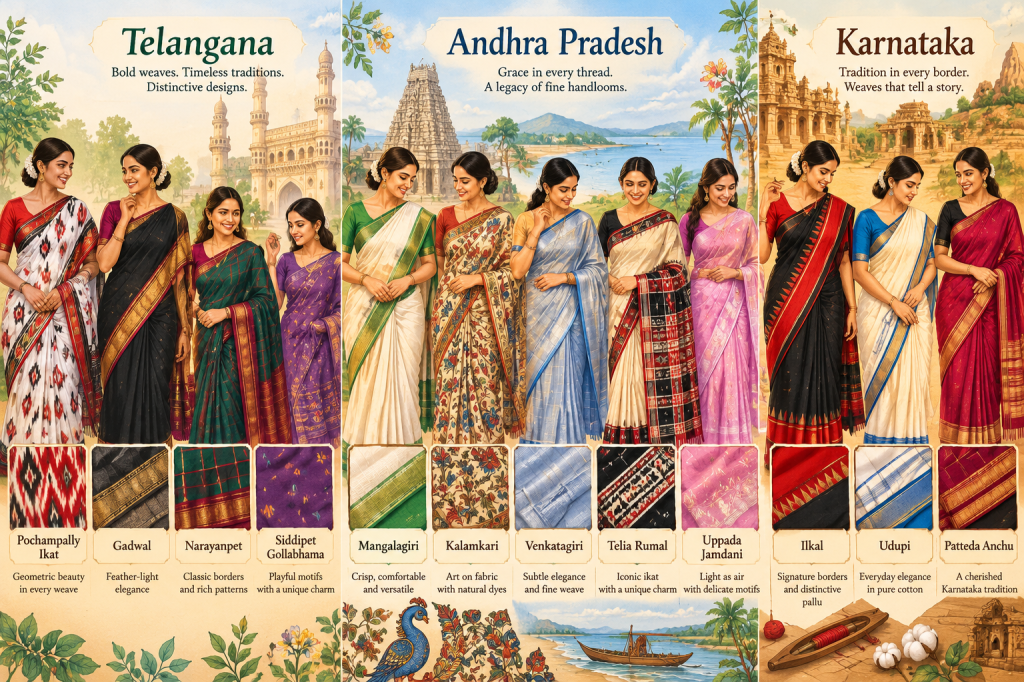
A journey through handloom traditions, regional artistry, and the stories woven into everyday elegance
Introduction: Three States, Countless Ways to Weave a Story
A cotton saree can be many things at once: a companion for a warm afternoon, a bright note in a festival wardrobe, a familiar garment worn to the market, a treasured gift, or a textile that carries the memory of a place. Across Telangana, Andhra Pradesh and Karnataka, cotton has been shaped by the hands, looms, design vocabularies and everyday needs of generations of makers. The resulting sarees are not one single style. They are a lively family of regional traditions, each with its own rhythm, palette, surface, border, pallu and way of bringing yarn together.
These names are more than labels on a shop tag. Each points to a community of practice: knowledge of yarn preparation, an understanding of how colours interact, decisions about how a border should sit, and skills that are learned through observation, repetition and experience. A saree may look simple at first glance, yet its character can depend on the order in which threads are arranged, the way a motif is introduced, or the care taken to make two sections meet seamlessly. The most rewarding way to explore these textiles is to look slowly: at the selvedge, the body, the border, the pallu and the reverse side, as well as at the balance of colour and pattern.
This article concentrates on cotton and cotton-rich sarees, while acknowledging that many celebrated regional traditions also include silk and silk-cotton versions. A tradition may be famous today for its silk ceremonial sarees and still have a meaningful cotton history; another may be best known for cotton but offer blended or dressier interpretations. Textile names are therefore used with care. Not every saree from a named centre is made from the same fibre, and not every contemporary product reproduces every historic feature. The individual sections explain the signature traits without suggesting that one version is the only authentic expression.
There is no need to rank these sarees from best to least. Their appeal lies in their differences. One wearer may be drawn to the quiet order of a fine cotton body, another to the lively movement of ikat, and another to a strong border that frames the drape. A collector may look for a particular weaving technique, while someone building a practical wardrobe may care most about softness, weight, ease of maintenance and versatility. The same textile can satisfy more than one of these interests.
The following guide moves from place to place and technique to technique. It explains what makes each tradition recognisable, how cotton behaves within it, which design details deserve attention, how the saree can be styled today, and how to care for it thoughtfully. Along the way, it also explores Kasuti embroidery, Sandur Lambani embroidery, Guledgudda Khana and the wider customs that connect textiles with daily routines and special occasions. The central idea is simple: regional cotton sarees are living design traditions. They are beautiful to wear, fascinating to study and worth understanding beyond the first impression of colour.
Reading a Cotton Saree: Fibre, Structure and Design
Before looking at individual regions, it helps to understand a few terms that appear repeatedly in saree descriptions. The body is the main field of the saree. The border runs along one or both long edges, framing the body and helping establish the overall visual character. The pallu, also called pallav in some regions, is the decorative end that often becomes especially visible when the saree is draped over the shoulder. A selvedge is the finished edge formed during weaving. These parts may be plain, striped, checked, patterned, richly ornamented or deliberately contrasted.
The word “handloom” describes cloth woven on a hand-operated loom, but handloom fabrics are not all identical. Different looms, attachments, preparatory methods and weaving sequences make different effects possible. Some motifs are created by arranging coloured threads before weaving; others are introduced as the fabric is woven. Additional threads can create raised or extra patterns. A technique can be recognised by its result, but the result is inseparable from the process that produces it.
Warp and weft are the two basic systems of threads in woven cloth. The warp runs lengthwise on the loom, while the weft crosses it from side to side. In ikat, sections of yarn are tied or otherwise protected from dye before the yarn is coloured. When the ties are removed, undyed areas remain. The yarn is then arranged and woven so that the pre-planned colour areas form a design. In double ikat, both warp and weft are resist-dyed in a coordinated way, requiring careful planning because the pattern must align as the two systems of threads interlace. The slight feathering at an ikat edge is not necessarily a flaw; it can be a visual clue to the resist-dye process.
Borders can be visually dramatic, but they also provide a way to compare regional styles. A narrow, restrained border may keep attention on the body; a wide contrasting border can create a bold frame. Temple-inspired shapes, checks, stripes, diamonds, florals, birds and geometric grids recur across Indian textiles, but the way they are arranged differs from place to place. Similar motifs do not mean that two sarees are the same. Their proportions, technical construction, colour logic and regional histories all matter.
Cotton and silk-cotton are often discussed together, yet they feel and behave differently. A cotton body with a silk border may combine a comfortable field with a luminous frame. A pure cotton saree can be visually rich without any silk at all, using checks, stripes, colour blocks, extra-weft work or a carefully designed pallu. A blend may drape differently from a cotton-only fabric, so buyers should read the fibre description rather than infer the composition from the appearance.
A final point is worth remembering: “traditional” does not mean “unchanged.” Weaving centres have long absorbed influences from trade, neighbouring regions, changing materials and the needs of wearers. A present-day saree may retain a recognisable structure while experimenting with colour, scale or motif. The best descriptions distinguish enduring craft features from optional styling choices, and they avoid presenting every modern variation as either a perfect replica of the past or a departure from it.
Telangana: A State of Pattern, Colour and Loom Knowledge
Telangana’s textile traditions are especially rewarding for anyone who enjoys the relationship between geometry and colour. In Pochampally, coloured yarns are planned before weaving so that the design emerges from the meeting of warp and weft. In Gadwal, a cotton body may be joined to a silk border and pallu through a specialised interlocking technique. Narayanpet is known for its orderly checks and contrasting borders, while Siddipet Gollabhama is recognised for its distinctive human-figure motif. These traditions show how a shared material—cotton—can lead to very different visual languages.
The region’s sarees range from everyday-friendly cotton cloth to more elaborate cotton-silk and silk versions. Their uses also overlap: a saree with a clear geometric pattern can be worn to work or a family gathering, while a dressier border can make a familiar textile feel occasion-ready. Instead of treating everyday and festive sarees as completely separate categories, it is more useful to think of a spectrum shaped by fibre, density, colour, embellishment and personal style.
Telangana’s cotton sarees are also a useful reminder that visual complexity does not always require heavy ornament. A checked body, a measured border and a pallu with a few well-placed motifs can create a complete design. In ikat, the apparent softness of a line can be the result of a highly exacting process. In a fine cotton weave, the simplicity of the surface can make the quality of the yarn and the evenness of the cloth more noticeable. In a figure-motif saree, a small repeated image can become the signature of the whole textile.
A practical wardrobe can make room for more than one Telangana style. A lightweight cotton Narayanpet can work for routine wear; a Pochampally with a graphic design can become the focal point of an understated outfit; a Gadwal cotton-silk saree can bridge daytime and celebratory dressing; and a Gollabhama saree can appeal to someone who likes motifs with a recognisable local identity. The point is not to collect them all, but to notice how each solves the design challenge differently.
1. Pochampally Ikat: Geometry Planned in Yarn
Pochampally Ikat, associated with Bhoodan Pochampally and neighbouring weaving areas in Telangana, is among the most recognisable textile traditions of the region. Its appeal lies in patterns that seem to shift between crisp geometry and softly feathered colour. Checks, diamonds, zigzags, stripes and stylised floral or animal-inspired forms can appear within carefully organised grids. The design is not simply painted or printed onto the finished saree. It is planned through the colouring of yarn before the cloth is woven.
Pochampally is associated with cotton, silk and silk-cotton versions. This article’s focus is cotton, where the patterning can be enjoyed without the visual weight or sheen of a silk surface. Cotton allows geometric designs to feel lively and wearable. Depending on the yarn and weave density, the fabric may be crisp, soft, light or more substantial. A cotton Pochampally can be an excellent choice for someone who wants a strong design statement while still preferring the familiar feel of cotton.
A useful way to read a Pochampally saree is to start with the body. Is it dominated by a large diamond grid, a tight repeat, a series of stripes or a more open arrangement? Next, examine how the border relates to the body. It may echo the same colours, introduce a contrasting band or create a visual pause before the pallu. Finally, look at the pallu. Its scale and density can alter the mood of the saree: a compact pattern may feel neat and graphic, while a more expansive arrangement can make the end piece the main feature.
Pochampally’s familiar motifs include geometric arrangements and stylised references to flowers, parrots, elephants and other forms. The visual effect is often less about a literal picture than about rhythm. A motif repeats, turns, meets another shape and creates a larger pattern. This is one reason the sarees work so well with simple accessories: the textile already contains a strong visual structure. A plain blouse in a colour drawn from the border can make the pattern feel deliberate without competing with it.
For a contemporary wardrobe, cotton Pochampally can be styled in several directions. A small geometric design can be paired with a solid blouse and everyday jewellery for a polished workday look. A high-contrast saree can be allowed to lead, with a simple blouse and restrained accessories. If the saree has multiple colours, choose one of them for the blouse rather than introducing a new shade that fights the pattern. For a more relaxed appearance, a cotton blouse with a clean neckline can complement the handloom texture.
When choosing a cotton Pochampally, check the fibre label, the consistency of the weave, the finishing of the selvedges and whether the pattern aligns in a way consistent with the product description. Handwoven textiles can show small variations, and these should be understood in context rather than treated as automatic defects. A seller who can explain the weaving and dyeing process is often a more useful guide than a label relying only on broad words such as “ethnic,” “traditional” or “premium.”
Care should begin with the seller’s instructions, because dye methods and finishing vary. For many cotton handlooms, gentle washing separately at first, using mild detergent, avoiding harsh scrubbing and drying away from prolonged direct sunlight are sensible precautions. Do not assume that every colour is completely colourfast. Store the saree clean and fully dry, and avoid pressing a hot iron directly over delicate areas or any surface embellishment. Fold it along different lines from time to time to reduce long-term stress on the same creases.
Pochampally is a wonderful introduction to the idea that cotton need not mean plain. It can carry an intricate design system while remaining grounded in a practical fibre. Its geometry is both decorative and intellectual: a visible result of decisions made long before the finished saree is draped. For wearers who enjoy pattern, colour and the satisfaction of knowing how a design came into being, it is a particularly rewarding textile.
2. Gadwal: The Art of Joining Cotton and Silk
Gadwal sarees are associated with Gadwal and surrounding weaving areas in Telangana. The tradition is widely known for the way a cotton body can meet a contrasting silk border and pallu. The result balances a relatively light, comfortable field with a more lustrous frame. While Gadwal also includes silk and silk-cotton varieties, the cotton-body version is especially relevant to a discussion of breathable regional sarees.
A Gadwal saree can be visually striking even when its body is understated. The cotton field may be plain, checked or subtly patterned, while the border introduces a strong contrast. Temple-inspired shapes, geometric forms, floral details and zari accents are among the design vocabularies associated with the tradition. The pallu often provides the most elaborate area, creating a graceful transition from the simple body to the more decorative end. In a cotton-rich version, this contrast can feel especially balanced: the body remains easy to wear, while the border gives the saree a ceremonial finish.
The familiar description of a Gadwal as light enough to be folded compactly is a tribute to the fineness of some examples, not a universal test that every saree must pass. Weight depends on yarn, weave, border construction and the materials used. A contemporary Gadwal may differ from an older example in fibre composition or ornamentation, so it is wise to evaluate the individual piece rather than rely on a single anecdote.
For styling, a cotton-body Gadwal can be paired with a blouse that repeats the border colour, or with a contrasting solid blouse chosen from the saree’s palette. A blouse with a small woven motif can work if it does not compete with the pallu. Jewellery can be adjusted to the occasion: simple earrings for daytime, or more elaborate pieces when the saree is worn to a celebration. The saree’s own structure is already a strong design element, so the wearer does not need to add detail everywhere.
When buying, look closely at the join between body and border, the regularity of the weave, the quality of the pallu, and the clarity of the fibre description. Ask whether the body is cotton, silk-cotton or another blend, and whether the border and pallu use silk, art silk or zari. These details affect both appearance and care. The term “Gadwal” identifies a recognised regional tradition, but exact fibre combinations can differ, so a clear product description matters.
Gadwal’s appeal is the conversation between sections: cotton and silk, matte and sheen, simplicity and ornament. It shows how a regional identity can reside not only in motifs but also in the way a textile is constructed. The border is not an accessory added to the story; it is woven into the story itself.
3. Narayanpet: Checks, Colour and Everyday Grace
Narayanpet sarees come from the town and surrounding weaving areas of Narayanpet in Telangana. The tradition is often recognised by a checked body, confident colour combinations and borders or pallus carrying traditional designs. Cotton versions are particularly appealing for regular wear because they can be light, durable and visually lively without requiring heavy ornament.
Local accounts of Narayanpet’s weaving history include a tradition linking the region’s textile practices with travelling weavers associated with Maratha ruler Chhatrapati Shivaji. Such stories form part of the area’s remembered heritage, but should be described as local historical tradition rather than treated as a fully documented single origin story. What is clear from the textile itself is the way the checked surface, colour arrangement and border design have become recognisable features of Narayanpet sarees.
A practical feature noted in descriptions of Narayanpet weaving is the production of multiple sarees in a coordinated run on the loom. The district’s craft profile describes a process in which eight sarees can be made together. This kind of arrangement reflects the planning involved in preparing yarn and managing repeated patterns. It also helps explain why the craft should not be reduced to the finished object alone: the loom setup and the sequence of work are part of the tradition.
The saree’s character changes with scale. Smaller checks can read as almost textured from a distance and reveal their pattern as one comes closer. Larger checks create a more graphic appearance. The border also changes the mood: a narrow border may feel neat and versatile, while a broader or more ornamented border can give the saree a stronger occasion presence. When choosing one, think about how often you want to wear it and whether you prefer a subtle or high-contrast design.
Narayanpet is also a useful reminder that a cotton saree need not be completely plain to be versatile. A checked design can be a wardrobe staple, and the same saree can be styled differently through blouse choice, draping, jewellery and footwear. For a busy day, a simple blouse and comfortable sandals may be enough. For a family event, a blouse with a more formal sleeve or neckline and a little more jewellery can shift the look without changing the saree.
For care, follow the maker’s instructions. Gentle washing, avoiding aggressive wringing, and drying away from harsh sun help preserve colour and shape. If the saree includes zari or contrasting components, extra care may be needed. Store it only when fully dry. Folding along slightly different lines every few months can help reduce permanent crease marks, particularly if the saree is stored for long periods.
Narayanpet’s charm is its balance of pattern and ease. The checks are not merely decorative; they are a visual signature that gives the cloth a recognisable rhythm. For wearers who want a cotton saree with character, one that can move comfortably between routine and celebration, Narayanpet offers a strong and enduring option.
4. Siddipet Gollabhama: A Motif with a Local Signature
Siddipet Gollabhama sarees are associated with Siddipet in Telangana and are known for a distinctive human figure motif. “Gollabhama” is commonly understood in connection with a woman or milkmaid figure, and the motif gives the saree a recognisable identity. Rather than relying only on a geometric grid or a contrasting border, the design places a figurative element at the centre of its visual language.
Siddipet’s weaving tradition is part of Telangana’s wider handloom landscape, where local identities are expressed through a combination of technique, pattern and place. Gollabhama sarees have received Geographical Indication recognition, which helps distinguish the named product and its recognised regional association. As with all GI-labelled crafts, the designation is best understood as recognition of a product’s geographical and craft identity, not as a substitute for checking the material, construction and seller’s information.
The figure motif can be playful without being novelty-driven. It carries a sense of place and gives the saree an individual personality. For a wearer who prefers textiles with a story, Gollabhama offers a point of conversation: the motif can be noticed by someone who appreciates craft, yet the saree remains a garment first and foremost. The design can be worn with a simple blouse so that the figure remains the focus.
When styling a Gollabhama saree, a plain blouse is often a sensible starting point. If the body contains several colours, select one colour for the blouse and let the motif do the work. A small, carefully chosen accessory can complement the design, but a competing print may make the visual field feel crowded. For a contemporary interpretation, a solid blouse in a shade that appears only sparingly in the saree can create an elegant link between the body and the border.
A buyer should inspect how clearly the figure motif has been formed, how evenly the cloth is woven and whether the pattern matches the product description. Ask whether the saree is pure cotton or a blend, and whether any decorative sections require special care. The name Gollabhama should not be used as a loose synonym for any saree with a human figure; it refers to a particular regional tradition.
Siddipet Gollabhama sarees remind us that textile traditions can communicate identity through a single recurring shape. The figure becomes a signature, but its impact relies on the whole cloth: the spacing around it, the colours that frame it and the skill required to weave it repeatedly. It is a lovely example of how regional handloom design can be both recognisable and wearable.
Andhra Pradesh: Cotton, Colour and Surface Art
Andhra Pradesh’s textile traditions span fine cotton weaving, resist-dyed yarns, patterned fabrics and hand-painted or block-printed cotton. Mangalagiri is associated with a clean, fine cotton surface and distinctive borders. Kalamkari transforms cotton into a canvas for drawing, painting and printing. Venkatagiri is celebrated for fine fabrics and Jamdani-inspired patterning, while Telia Rumal demonstrates the depth of resist-dye knowledge in the region. Uppada Jamdani is especially famous for its fine silk sarees, but its design and weaving principles are part of the broader conversation about regional pattern-making.
The state’s textile map includes both inland weaving centres and coastal locations. Geography can influence the availability of materials, the movement of goods and the kinds of garments people have needed, but no textile should be explained through climate alone. Technique, patronage, community knowledge and changing consumer preferences also shape the cloth. In the case of cotton, practical comfort has often coexisted with a desire for refinement: a fine yarn, a crisp edge or a carefully designed border can make a simple fabric feel special.
Many contemporary wearers look for sarees that can be styled in more than one way. Fine cottons can be worn with understated jewellery, while an intricately patterned or painted cloth can be allowed to act as the outfit’s main visual feature. A solid blouse often works well with a busy surface. For a saree with a striking border, a blouse that echoes the border can give the outfit a clear frame. There is no universal rule, but considering the relationship between body, border and pallu helps avoid a look in which every element competes for attention.
As with Telangana and Karnataka, the name of a weaving centre should be understood as a reference to a recognised tradition rather than a guarantee that every item bearing the name has the same composition. Some centres make cotton, silk-cotton and silk versions; others are known for a technique that may be adapted to multiple products. Clear fibre information, honest description of process and knowledge of the maker are valuable signs when choosing a textile.
5. Mangalagiri: Fine Cotton and a Distinctive Border
Mangalagiri sarees and fabrics are associated with Mangalagiri in Andhra Pradesh. The tradition is widely appreciated for fine cotton, a relatively clean body and borders that can carry much of the design interest. The classic cotton character is often understated: rather than filling the entire surface with motifs, the weave allows the border and the quality of the fabric to make the impression.
A Mangalagiri cotton saree is especially versatile for people who enjoy a clean silhouette. A plain or lightly textured body provides room for the border to stand out. Depending on the colour combination, the saree can feel understated, bright, formal or relaxed. A solid blouse in a border colour is an easy styling choice; a contrasting blouse can add energy if the saree’s body is simple. For a workday, minimal jewellery can preserve the refined character of the cloth. For a family function, the same saree can be styled with a more decorative blouse and traditional accessories.
The border deserves close attention. It can be narrow or more pronounced, and its geometry may be the main signature of the piece. Look at the transition between the body and border, the consistency of the woven lines and the finish of the edges. If zari is present, examine whether it is woven into the design and ask about cleaning. The quality of a Mangalagiri saree is not measured only by how much decoration it contains; the regularity of the cotton weave and the clarity of the border are equally important.
When buying, confirm that the saree is cotton if that is your priority. Some products from the region may use other fibres or blends, and product names are sometimes used broadly in retail settings. Ask about the weave, the yarn and the border technique. A knowledgeable seller should be able to describe whether the design comes from extra warp, supplementary threads or another method. Look for a fabric that feels consistent with its stated construction and for a pallu and selvedge that are neatly finished.
Care for a fine cotton saree begins with gentle handling. Follow the specific washing guidance from the maker, especially if the border includes zari or contrasting yarns. If the saree is plain cotton with washable dyes, a mild detergent and careful washing may be suitable. Avoid harsh bleach, forceful wringing and prolonged direct sunlight. Iron at an appropriate cotton setting while the fabric is slightly damp if recommended, and store it only when completely dry.
Mangalagiri’s appeal lies in restraint. It shows that a saree can be memorable without a dense field of ornament. Fine cotton, a confident border and a well-balanced colour choice can create a look that is both easy to wear and distinctly regional. For anyone building a collection of practical handloom sarees, Mangalagiri is a particularly useful bridge between everyday simplicity and considered dressing.
6. Kalamkari: Cotton as a Canvas for Story and Pattern
Kalamkari is a broad textile-art tradition associated with Andhra Pradesh, especially the Srikalahasti and Machilipatnam traditions. The word is commonly linked to the use of a pen or brush to create designs, though the methods differ across centres. Kalamkari textiles may be hand-painted, block-printed or produced through a combination of processes. Cotton is an important base because it can take the preparation and colouring needed to develop the design.
Kalamkari sarees often carry a visual world of vines, flowers, leaves, birds, animals, decorative borders and narrative compositions. Depending on the tradition and design, imagery may draw on a range of cultural and literary sources. The motifs should be described respectfully and specifically, without assuming that every Kalamkari textile has a religious subject. Floral and botanical designs can be just as central to the art. The visual effect may be intricate and dense, or more open and contemporary.
The making process is layered. Cotton may be prepared so that it can receive colour; outlines and areas of colour are developed in stages; and the cloth may be washed or treated between steps according to the method being used. Traditional natural dyes are associated with many Kalamkari processes, though contemporary production can vary in materials and methods. A buyer should therefore ask whether a specific saree is hand-painted, block-printed or digitally printed, and whether the colours are natural, synthetic or mixed. These distinctions are not minor details: they describe how the textile came into being.
One of the pleasures of Kalamkari is the difference between seeing it from a distance and studying it up close. At a distance, the overall colour arrangement creates the first impression. Close up, the viewer notices the outline, the layering of colour, the small leaves or petals and the way the border is constructed. These details make it worth looking at the reverse side and the edges too, while remembering that the reverse alone cannot always establish authenticity.
When purchasing Kalamkari, ask clear questions about process. Is the design hand-drawn, block-printed or machine-printed? What is the base fabric? What dyes or pigments are used? Is the saree pre-washed, and what care instructions are recommended? A printed fabric may reproduce the look of Kalamkari without using the traditional processes, and that can be a legitimate design product if described honestly. The problem is not adaptation itself; it is unclear labelling that leaves the buyer unable to understand what they are purchasing.
Kalamkari expands the idea of what a cotton saree can be. It is not only woven structure but also an art surface, shaped by the patient work of drawing, printing and colouring. When worn, it brings an image-rich textile into everyday life. When studied, it reveals the relationship between material preparation, artistic skill and regional practice.
7. Venkatagiri: Fine Cotton and Delicate Patterning
Venkatagiri sarees, associated with Venkatagiri in Andhra Pradesh, have a long reputation for fine fabric and delicate patterning. The tradition includes cotton, silk-cotton and silk versions, and cotton remains important to understanding its broader textile identity. Historical accounts describe the patronage of local rulers and the weaving of fine cotton cloth, including garments such as turbans and dhotis, before saree-making became a prominent part of the tradition.
A fine cotton Venkatagiri can be appreciated for the relationship between the body and the motifs. The cloth may appear relatively plain from a distance, with small patterns becoming visible as the wearer moves or as the viewer comes closer. This subtlety is part of its appeal. Instead of relying on a strong geometric grid or a dramatic contrast, the saree may use spacing, fineness and carefully placed decoration to create elegance.
Venkatagiri sarees can suit both simple and formal styling depending on their fibre and design. A cotton version with restrained patterning may be worn for a daytime event or a gathering where comfort matters. A version with a more decorative border or zari details can feel more dressed up. A blouse that repeats a border colour usually works well, while a textured or lightly patterned blouse can complement a quieter body if the scale is kept in balance.
Inspect the weave for evenness, the clarity of the motifs, the finishing of the selvedges and the pallu. Fine cloth can be delicate, so it should feel consistent with the stated yarn and construction. A very light saree is not automatically better than a slightly firmer one; the preferred feel depends on the wearer’s draping habits and the occasion. The most important thing is that the product’s description matches its actual materials and method.
Care should reflect the fineness of the cloth. Follow the specific guidance from the weaver or seller, especially if zari or silk sections are present. Avoid rough washing, aggressive wringing and storage in a damp place. A clean, dry cotton saree should be folded with care and kept away from sharp jewellery or accessories that might catch fine threads. If the fabric is unusually delicate or includes special ornamentation, professional cleaning may be the safest choice.
Venkatagiri’s identity is built around refinement. It demonstrates that visual richness can be quiet rather than loud, and that the skill of a weaver may be expressed through tiny motifs, a light fabric and a well-judged border. For someone who prefers fine cotton and understated elegance, the tradition offers a beautiful alternative to heavier or more densely patterned sarees.
8. Telia Rumal: Resist-Dyed Cotton with a Distinctive Past
Telia Rumal is an important resist-dyed textile tradition associated with Andhra Pradesh, particularly the Chirala region. The name is commonly connected to tel, meaning oil, because oil treatment formed part of the traditional preparation of the yarn. Although the textile is widely known as a square cloth or rumal, the technique and design vocabulary are also relevant to the wider story of Andhra’s ikat traditions and the development of patterned cloth.
The traditional oil treatment is one of the features that gives Telia Rumal its name and identity. Historical descriptions explain that the yarn was treated through a sequence involving oil and other materials before dyeing, although exact processes may vary across accounts and contemporary practice. It is better to avoid assuming that every textile sold under the name today has been made with an identical recipe. Buyers interested in traditional processing can ask the maker how the yarn was prepared and which steps are used for the specific piece.
Telia Rumal designs often feature geometric arrangements and strong contrasts. The traditional colour vocabulary has included combinations such as red, black and white, while contemporary products may explore additional palettes. Repeated diamonds, squares and other compact forms can create a rhythmic surface. The design is structured rather than pictorial: it depends on the interaction of colour blocks and the alignment of the woven grid.
For wearers who appreciate the look of ikat, Telia Rumal-inspired patterns can offer a bold graphic option. If choosing a saree or garment made with the technique, let the geometric surface lead. A plain blouse in a colour drawn from the textile can make the pattern look intentional. If the design is strongly contrasted, jewellery and other accessories can be kept simple. The clean geometry can also work well with contemporary styling, including a minimalist blouse or a carefully chosen solid layer.
As with Pochampally, it is useful to distinguish yarn-resist ikat from printed imitations. A product may be “ikat print” or “ikat-inspired,” and that can still be visually appealing, but it is not the same process as resist-dyeing yarn before weaving. Ask whether the textile is double ikat, single ikat or a print, and whether it is cotton, silk or a blend. A clear answer is more helpful than a vague claim that a product is simply “traditional.”
Telia Rumal brings together process, geometry and history. Its story reminds us that the cotton textile traditions of Andhra Pradesh are connected through shared knowledge of dye, yarn and pattern, even when the finished objects have different uses. The visual result may be bold and compact, but behind it lies a sequence of careful decisions made before the loom begins to weave.
9. Uppada Jamdani: Fine Patterning and a Wider Textile Conversation
Uppada Jamdani is associated with Uppada and nearby weaving centres in Andhra Pradesh. The tradition is especially celebrated for fine silk sarees with delicate motifs, but it is worth including in a discussion of cotton because it illustrates the broader regional language of Jamdani-style patterning and the importance of extra-weft design. The distinction is essential: many classic Uppada Jamdani sarees are silk, so a cotton version should be identified specifically rather than assumed from the name.
Uppada’s celebrated sarees often feature floral, paisley and geometric motifs. The visual effect can be intricate without appearing heavy. The body may have a delicate pattern distributed across the surface, while the border and pallu establish the overall composition. In a cotton or cotton-rich interpretation, the same principles can be appreciated through the relationship between motif and ground, although the feel, drape and level of fineness will differ from a silk version.
It is important to be precise about materials. Official and craft descriptions of Uppada Jamdani frequently emphasise silk, and many signature products are pure silk with zari or supplementary threads. If the purpose is to buy a cotton saree, ask explicitly whether the product is cotton, cotton-silk or silk. A Jamdani-inspired cotton fabric may use related pattern ideas without being identical to a classic Uppada silk saree. Honest naming helps preserve the meaning of the tradition while allowing contemporary design to evolve.
Uppada-style patterning can be dressed up or down depending on the fabric and design. A cotton version with modest motifs may be suitable for daytime occasions, while a silk saree with more elaborate zari and patterning may be chosen for celebrations. The name alone does not determine the occasion; fibre, weight, surface detail and the wearer’s preferences all contribute. A cotton saree can be elegant without pretending to be silk, and a silk saree need not be described as cotton to make it relevant to a broader wardrobe.
When purchasing, ask about the fibre, the weaving method, the use of supplementary weft and the nature of the border. If the product is presented as an authentic Uppada Jamdani, seek a clear explanation of the regional tradition and how the piece relates to it. A printed motif that resembles Jamdani should be labelled as a print or inspired design. These distinctions allow customers to value both traditional handwork and contemporary adaptations on their own terms.
Uppada Jamdani represents the beauty of a design that is built rather than applied. Even when discussing cotton, it offers a useful lesson: the character of a textile depends not only on what is depicted, but on how the motif is made part of the cloth. The distinction between fibre and technique is central to understanding the full range of Andhra Pradesh’s saree traditions.
Karnataka: Distinctive Borders, Cotton Comfort and Surface Craft
Karnataka’s textile heritage includes celebrated silk traditions, but cotton and cotton-rich sarees deserve equal attention for their versatility and regional character. Ilkal is one of the state’s best-known saree traditions, recognised for its bold colours, characteristic pallu and the way body and pallu are joined. Udupi cotton offers a different mood, often associated with a straightforward, comfortable fabric. Beyond sarees, Guledgudda Khana blouse cloth, Kasuti embroidery and Sandur Lambani embroidery demonstrate how the state’s textile identity extends into accessories, garment details and surface embellishment.
Karnataka’s regional textiles often make strong use of contrast. A body with stripes or checks can be framed by a broad border. A pallu may introduce a different colour and a dense arrangement of motifs. In other contexts, a more restrained cotton surface gives the cloth a practical, everyday quality. These choices show that a textile’s identity can arise from proportion as much as from decoration. A bold border can change the entire impression of a saree even when the body is simple.
Embroidery adds another dimension. Kasuti is a counted-thread embroidery tradition associated with Karnataka, known for motifs made through carefully planned stitches. Sandur Lambani embroidery, by contrast, is characterised by vibrant patchwork, appliqué, mirrors, beads, shells and a rich range of stitches. Neither craft should be casually treated as a generic embellishment. Each has its own community context, technical vocabulary and visual identity. They can complement cotton textiles, but the specific craft and its origin should be acknowledged.
For a modern wardrobe, Karnataka’s cotton and cotton-rich textiles can be styled in many ways. A classic Ilkal with a solid blouse can look graphic and confident. An Udupi cotton saree may work well with simple accessories for everyday use. A saree paired with a Khana blouse can create a coordinated regional look, while a small Kasuti detail can add handwork without overwhelming the fabric. Contemporary styling can be playful and personal while still respecting the identity of the craft.
The following sections explore Ilkal and Udupi cotton in detail, then look at embroidery and related fabrics. They show how Karnataka’s textile heritage is not one fixed style but an ecosystem of weaving, stitching, colour and use.
10. Ilkal: A Signature Join, a Bold Pallu and a Cotton-Silk Conversation
Ilkal sarees take their name from Ilkal, a town in Karnataka’s Bagalkot district. The tradition is widely associated with bold colour, distinctive borders and a striking pallu. Accounts commonly trace the weaving tradition back many centuries, while an official historical record cited in craft descriptions notes that Ilkal already had hundreds of looms in the nineteenth century. The precise beginnings of a craft are often difficult to date to a single moment, but the continuity of the weaving centre is clear.
Ilkal sarees can be made with cotton and silk combinations, and contemporary descriptions may include cotton or viscose in the body with art silk or pure silk in the pallu. For a cotton-focused wardrobe, the key is to check the exact fibre composition rather than assume all Ilkal sarees are pure cotton. The cotton body is valued for its familiar feel, while the more lustrous pallu can create a strong visual finish. Some versions are silk-rich, and those should be described as such.
The body commonly uses stripes, checks, rectangles, squares or a relatively plain field. The pallu often stands out through its colour and pattern, with traditional versions known for red tones and white designs. Temple-inspired forms, sometimes described as gopura-like, are part of the visual vocabulary. The borders are also associated with names such as Gomi, Paraspet and Gaadi in descriptions of Ilkal design. The details and proportions vary, but the overall effect often combines a confident border with a distinctive end panel.
Ilkal is also associated with Kasuti embroidery in some versions. Kasuti motifs may include architectural forms, animals, flowers and other familiar shapes, carefully stitched onto the fabric. The embroidery is a separate craft technique from the weaving itself, so it is useful to distinguish an Ilkal saree that includes Kasuti work from an Ilkal saree whose pattern is entirely woven. Both can be beautiful, but the description should make clear which techniques are present.
For styling, Ilkal’s strong pallu and border make a natural focal point. A plain blouse can allow the saree’s structure to stand out. A Guledgudda Khana blouse offers a traditional regional pairing, particularly when its geometric motifs relate to the saree’s colours. For a more contemporary look, a solid blouse in a colour taken from the pallu can create a clean contrast. Because the saree already has a defined visual frame, jewellery can be chosen according to the occasion rather than used to add more pattern.
When selecting an Ilkal, inspect the body-pallu join, the border’s consistency, the selvedge and the finish of the pallu. Check the fibre label, especially if you prefer cotton or need a particular care routine. Handwoven fabric may show small variations, but the construction should still feel coherent and the description should be clear. If the saree includes embroidery, ask whether the stitching is hand-done and how it should be maintained.
Care should reflect the blend of fibres. A cotton body combined with silk or art silk sections may need more careful treatment than a plain cotton saree. Follow the seller’s instructions and avoid strong detergents or rough wringing. If the saree has zari, embroidery or delicate joining details, professional cleaning may be recommended. Store it dry, folded carefully and away from sharp objects that can catch the threads.
Ilkal is a textile of confident structure. Its beauty comes from the way the body, border and pallu work together, and from the technical skill needed to join them. It is both a practical garment and a piece of regional engineering, where a distinctive construction method becomes a visual signature.
11. Udupi Cotton: Coastal Ease and Understated Versatility
Udupi cotton sarees are associated with the coastal Karnataka textile landscape and are often appreciated for their comfortable cotton feel and relatively straightforward styling. Compared with sarees whose identity depends on elaborate patterning or a highly distinctive join, Udupi cotton can appeal through simplicity, texture and ease. Product details vary, and the term should not be used to imply that every saree sold under the name follows one identical specification.
The design language of a cotton saree can be quiet: a plain body, a simple stripe, a restrained border or a small repeated motif. Such details can be easy to overlook in photographs, yet they make a difference when the saree is draped. A border gives the edge a clear line; a stripe can lengthen the visual rhythm; a subtle colour contrast can make the saree look finished without making it busy. The absence of dense ornament is not a lack of design. It is a different design choice.
A versatile Udupi cotton saree can work across several parts of daily life. Pair it with a simple blouse and comfortable footwear for routine errands or work. For a family gathering, choose a blouse with a more defined sleeve, a complementary colour or a small handloom texture. A light stole or jacket may be used in a contemporary ensemble, but the saree itself often needs little additional decoration. Its value lies in how easily it can adapt to the wearer’s day.
Because the name may be used differently by different sellers, a clear description matters. Confirm whether the saree is made in Udupi or is a cotton saree inspired by the region. Ask about any dyeing or finishing treatment that affects washing. A trustworthy product description should tell you what is known rather than relying only on a regional name as a selling point.
For everyday care, follow the maker’s instructions. Cotton generally benefits from gentle washing, mild detergent and careful drying. Avoid leaving a damp saree folded for a long time, and do not use harsh bleach unless the manufacturer explicitly confirms that it is appropriate. Iron at a suitable setting, and store the saree in a dry, ventilated place. If it has contrasting borders or special finishing, take those details into account.
Udupi cotton represents the understated side of regional saree dressing. It can be the saree reached for on an ordinary morning, yet it still carries the texture and visual discipline of a woven textile. Its beauty is not dependent on being reserved for a grand occasion. It lies in the ease with which it can become part of a person’s everyday style.
12. Khun and Guledgudda Khana: The Blouse Fabric that Completes the Look
Khun, also written as khana in many contexts, is a traditional woven fabric associated with northern Karnataka, especially the Guledgudda area. It is best known as blouse cloth and is often paired with Ilkal sarees. Though it is not itself a saree, it deserves a place in a discussion of cotton handloom because it demonstrates how regional dress traditions rely on coordinated textiles. A saree’s visual identity can be strengthened by the fabric chosen for the blouse, and Khun offers a distinctive option.
The motifs are often created through extra threads or additional warp design, which can make them appear bold against the ground. Their scale is an important part of the effect. A small motif can complement a saree with broad stripes or a large pallu without competing with it. The blouse then becomes a bridge between the saree’s main body and its border, drawing together colours and patterns that might otherwise seem separate.
Pairing Khun with Ilkal is a classic regional combination, but the underlying styling principle can be used more broadly. A blouse fabric with a compact geometric pattern can balance a saree with larger motifs. Conversely, a plain blouse may be the better choice when the saree is already densely patterned. The goal is not to match every element exactly, but to create a relationship between scale, colour and texture.
When purchasing Khun, check the fibre content, width, texture and motif structure. Since it is commonly sold as blouse material, confirm how much fabric is included and whether the piece has been pre-washed or finished. If it contains silk, the care instructions may differ from those for cotton-only cloth. A small sample can help assess colour, hand feel and how the fabric behaves when folded.
Care should be guided by the blend and the finishing. Avoid assuming that a cotton-silk fabric can be washed like plain cotton. Follow the seller’s instructions, and take special care with any zari or supplementary threads. Store unused fabric clean and dry, and avoid placing it where sharp objects can snag the small motifs.
Khun is a reminder that a traditional outfit is often a conversation between pieces. The saree may be the main garment, but the blouse can bring in a second regional weave, a complementary texture or a carefully chosen contrast. Together, Ilkal and Khun form a visual pairing that is recognisably rooted in Karnataka’s textile heritage while leaving plenty of room for personal expression.
13. Kasuti Embroidery: Counted Stitches and Thoughtful Motifs
Kasuti is a traditional embroidery form associated with Karnataka. It is known for counted-thread work in which motifs are built through carefully planned stitches, often using the structure of the fabric as a guide. The craft is admired for its precision and for the way a relatively limited set of stitches can create intricate images and borders. It may appear on sarees and other textiles, including garments and household pieces.
The motifs associated with Kasuti can include temples, chariots, lamps, birds, animals, flowers and architectural details. The designs are often arranged with a strong sense of symmetry or repetition, but the final effect depends on the specific pattern. A small motif may sit near the border; a repeated design can form a band; or a larger arrangement can create a more elaborate composition. Because the stitching is counted, the geometry can feel both decorative and architectural.
Kasuti has a natural relationship with cotton textiles. Cotton provides a visible structure through which counted-thread embroidery can be planned, and the finished stitches can add detail without requiring heavy embellishment. When Kasuti appears on an Ilkal saree, the embroidery can complement the saree’s strong border and pallu. It is important, however, to distinguish the woven features of Ilkal from the embroidered features of Kasuti. One technique creates the cloth; the other adds stitched motifs to it.
For styling, a saree with Kasuti embroidery may need little else. If the embroidery is concentrated near the border, a simple blouse can allow it to stand out. If the saree has a strong woven pallu as well, choose accessories that complement rather than compete. A blouse in a colour already present in the saree can help create continuity. If the embroidery is subtle, a slightly more textured blouse may work, provided its design does not overwhelm the stitching.
When buying Kasuti work, ask whether the embroidery is hand-stitched and whether the design follows the counted-thread method associated with the craft. Machine embroidery can imitate the appearance of handwork, but the process and character differ. Look at the stitch consistency, the reverse side and the way the motif follows the fabric. No single sign is conclusive, but a seller who can explain the stitches and origin provides useful context.
Kasuti shows how embroidery can be both precise and expressive. Its motifs connect textile decoration with the visual world of Karnataka, while its counted-thread method gives the craft a distinctive discipline. On a cotton saree, it can add a layer of meaning and detail without obscuring the fabric itself.
14. Sandur Lambani Embroidery: Patchwork, Mirrors and a Colourful Textile Language
Sandur Lambani embroidery is a distinctive needlecraft associated with the Lambani community in and around Sandur in Karnataka’s Ballari region. It is recognised for its lively combination of patchwork, appliqué, colourful stitches and embellishments such as mirrors, beads, shells and small metal ornaments. The craft is traditionally associated with garments worn by Lambani women, and today its techniques also appear on accessories, home textiles and contemporary clothing.
The craft has a strong connection to community identity and traditional dress. Lambani clothing has historically included richly decorated skirts, blouses and veils, with embroidery and adornment playing a visible role. These textiles reflect inherited knowledge and personal skill, often learned through observation and practice within families and communities. The embroidery is therefore more than an attractive surface treatment: it is part of a living cultural expression.
Sandur Lambani embroidery is also a reminder that not every textile tradition is centred on the loom. Weaving creates the base cloth, but embroidery transforms it through cutting, joining, stitching and embellishment. The craft can be applied to cotton and other fabrics, and contemporary products may include bags, pouches, cushion covers, wall hangings, jackets, dupattas and saree-related accessories. When the embroidery appears on a saree, it should be described as an embellishment technique applied to the base fabric rather than confused with the method by which the cloth was woven.
The colours can be bold, but the craft can also be adapted to more restrained palettes in contemporary products. What matters is that the work retains the recognisable combination of stitching, patchwork and embellishment, and that its origin is acknowledged. A muted cushion cover and a brightly coloured traditional garment can both draw from the same craft language while serving different contexts. The adaptation should not erase the community whose skill gives the craft its identity.
When styling a saree with Lambani embroidery, consider where the embellishment is placed. If the saree has a heavily embroidered border or pallu, a plain blouse can help maintain balance. If the embroidery appears on a blouse or accessory, the saree itself may be simpler. Because mirrors, beads and metal pieces can be visually strong, it is not necessary to add multiple competing ornaments. A thoughtful selection lets the handwork remain visible.
Care needs particular attention because of the raised elements. Do not machine-wash a heavily embellished textile unless the maker explicitly confirms that it is safe. Gentle spot cleaning or professional care may be better. Store the piece in a way that prevents mirrors and beads from pressing hard against delicate cloth, and avoid folding directly over bulky embellishment when possible.
Sandur Lambani embroidery demonstrates the power of surface craft. It brings together cloth, thread, patchwork and reflective details to create a textile with unmistakable character. Its place in a guide to cotton sarees is a reminder that the beauty of a regional outfit can come from the relationship between a woven garment and the embroidery traditions that accompany it.
Other Karnataka Cotton Traditions Worth Knowing: Patteda Anchu and the Textile Neighbourhood
Although this guide concentrates on the ten requested saree traditions, Karnataka’s broader cotton landscape includes Patteda Anchu, a traditional cotton saree associated with areas such as Gajendragarh and other northern Karnataka weaving centres. It is often described through its checks and distinctive border, and it has been linked with everyday use as well as customary and devotional contexts. The name itself is commonly explained through the visual importance of the border and checked field.
While this guide concentrates on cotton and cotton-rich sarees, Karnataka’s textile landscape also includes the celebrated Molakalmuru silk tradition. Associated with Molakalmuru in Chitradurga district, these handwoven silk sarees are known for their fine texture, contrasting borders and pallu, and motifs such as the hamsa (swan), rudrakshi, peacock, lotus and mango. They received Geographical Indication recognition for their distinctive regional identity. Although the present article focuses on cotton, Molakalmuru stands as another expression of Karnataka’s long handloom heritage and the skill of its weaving communities.
Patteda Anchu’s appeal is different from the elaborate pallu of Ilkal or the fine motif work of some other sarees. It often relies on a sturdy cotton feel, a clear pattern and a recognisable colour palette. Such features can make the saree practical for repeated use. The fabric’s character comes from its structure and proportion rather than from heavy embellishment. It is a useful example of how regional cotton sarees have served everyday needs while maintaining a distinct identity.
Karnataka’s textile ecosystem includes related fabrics such as Guledgudda Khana, which complements Ilkal sarees, and a range of embroidery practices. These traditions illustrate that textiles do not exist in isolation. A saree, blouse cloth, embroidered accessory and household textile may share colours or motifs, and knowledge can move between them. The result is a broader regional design language rather than a set of unrelated products.
For someone exploring cotton sarees, Patteda Anchu can be an excellent reminder to look beyond high-profile names. A simple checked saree with a well-formed border may be every bit as interesting as a more ornate piece. Its strength lies in the clarity of the design and the connection between fabric, use and place.
How These Traditions Meet: Similar Motifs, Different Methods
Looking across Telangana, Andhra Pradesh and Karnataka, it is easy to notice repeated motifs: checks, diamonds, stripes, temple-inspired borders, flowers, birds and geometric grids. Such similarities are part of a wider Indian textile vocabulary. Yet a shared motif does not mean the same technique or history. A diamond in Pochampally may be formed through resist-dyed yarn; a small geometric figure in Khun may be created through extra threads; a motif in a Jamdani-style fabric may be introduced with supplementary weft; and a shape in Kalamkari may be painted or block-printed. The finished image may look related, but the process is different.
This distinction is central to appreciating craft. If a saree is described only by its appearance, the labour and knowledge behind it can disappear. Naming the process makes the textile more legible. “Ikat” tells the reader to think about resist-dyed yarn. “Jamdani” points towards motifs built into the weave. “Kalamkari” directs attention to drawing, painting or printing on cloth. “Kasuti” identifies a counted-thread embroidery tradition. “Tope Teni” draws attention to the distinctive joining of Ilkal’s body and pallu. Each term gives the viewer a way to understand how the textile became what it is.
A useful comparison begins with four questions. First, what is the fibre? Second, how is the design made—woven, resist-dyed, printed, painted or embroidered? Third, where is the design concentrated—in the body, border, pallu or surface embellishment? Fourth, what is the cloth’s intended character—light and easy, crisp and structured, richly decorated or fine and delicate? These questions are more informative than simply asking whether a saree is “traditional” or “modern.”
It is equally important to recognise the limits of broad labels. A saree named after a region may be made in cotton, silk, a blend or a contemporary adaptation. A design inspired by a traditional motif may be printed rather than handwoven. Some makers preserve older methods, while others adapt them to new materials and uses. Honest descriptions allow buyers to appreciate each version for what it is. Traditional handwork deserves clear recognition, and contemporary design can be valued without being inaccurately presented as the same process.
The result is a richer way of shopping and wearing. Someone who likes strong geometry may gravitate towards Pochampally or Narayanpet. Someone who values a distinctive border may prefer Mangalagiri or a cotton-body Gadwal. Someone who enjoys a strong pallu and structural detail may choose Ilkal. Someone who wants a textile with a painted image may seek Kalamkari. The best choice is the one that fits the wearer’s taste and use while respecting the craft’s name and construction.
Choosing a Cotton Saree: A Practical, Craft-Aware Guide
A thoughtful purchase begins with the occasion and the way you want the saree to feel. For everyday wear, consider weight, breathability, ease of washing and how the fabric behaves when folded and draped. For travel, a saree that is not too delicate and does not require elaborate care may be useful. For a celebration, a strong border, intricate pallu or distinctive motif can create a more dressed-up look while still allowing cotton to remain comfortable.
Next, look at the weave. Hold the saree up to the light if possible and examine the consistency of the cloth. A regular weave is generally desirable, but small variations can occur in handwoven textiles. The key is to distinguish the character of handmade production from actual finishing problems. Loose ends, damaged threads, a badly finished selvedge or a join that does not match the stated technique deserve attention. If the saree has a special construction, such as Ilkal’s Tope Teni or Gadwal’s interlocking join, ask the seller to explain how it is made.
Look at the border and pallu separately. These areas often reveal the most about the saree’s design. Are the motifs clear? Does the border sit evenly along the edge? Is the pallu finished neatly? Does the colour combination feel balanced? In a checked saree, inspect whether the checks are consistent. In ikat, remember that some feathering at the edges is a normal feature of resist-dyed yarn. In Jamdani-style work, notice whether the motifs appear integrated into the weave. In Kalamkari, ask whether the imagery is painted, block-printed or reproduced by another method.
Think about your existing wardrobe. A saree with several colours can be versatile if you already own blouses that match one or more of them. A plain saree may offer more options for statement blouses, while a highly patterned saree may be easiest to style with a simple solid blouse. The goal is not to build a perfect matching set, but to make the saree easy to wear in ways that suit you. A thoughtfully chosen blouse can change the mood of a saree without needing expensive additions.
A good purchase also involves asking about provenance. Where was the saree woven? Who made it, or which weaving cluster is associated with it? Is it handloom, powerloom, printed, hand-painted or a blend of methods? Does the seller provide information about the artisan group or cooperative? Not every small seller will have a detailed story for every product, but transparent answers help distinguish informed retail from vague marketing.
Price alone is not a reliable guide to quality. Handwork, fine yarn, complex dyeing, supplementary-weft motifs, special joining methods and time-intensive embroidery can affect cost, but price also reflects many other factors. Compare products with similar fibre content and techniques rather than assuming that the most expensive piece is always the best choice. If a saree is described as handmade or handwoven, ask what part of the process is carried out by hand.
Finally, choose a saree you will enjoy wearing. A textile can be historically important and still not suit your personal style; another may feel immediately right because of its colour, weight or drape. Respect for craft does not require buying every tradition. It means making informed choices, understanding what you are wearing and valuing the skill that turns yarn and cloth into a distinctive regional textile.
Styling Cotton Sarees for Today: From Workdays to Celebrations
Cotton sarees are remarkably adaptable because their visual character can be changed through the blouse, drape and accessories. A geometric Pochampally can look crisp with a plain blouse and minimal jewellery. A Narayanpet check can be made more formal with a blouse that repeats the border colour. A Mangalagiri saree can feel refined with a well-cut blouse and a small pair of earrings. An Ilkal’s pallu can be allowed to take centre stage, while a cotton-body Gadwal can be dressed up through its border and blouse.
For family gatherings, a cotton saree can feel special without needing heavy embellishment. A contrasting blouse, traditional earrings or a neat bracelet may be enough. A saree with a distinctive pallu, such as Ilkal, can look festive through the drape alone. A Kalamkari saree with an image-rich surface can be paired with a simple blouse and understated accessories so the textile’s artistry remains visible.
For travel, consider how the saree will pack and recover from folds. Cotton can crease, and some fine fabrics need careful handling. Fold the saree neatly, keep it away from damp items and carry a small cloth bag for storage if needed. If the saree has mirrors, beads, zari or delicate embroidery, pack it so the embellishments do not press against other objects. A simple cotton saree is often easier to manage than one with elaborate surface work.
The drape can also change how a saree reads. Showing more of the pallu highlights its design; arranging the border prominently creates a stronger frame. A neat, compact drape may suit a busy day, while a more open pallu can feel ceremonial. There is no single correct way to wear every regional saree, and personal comfort should guide the final choice. The textile’s traditional form can inspire the styling without restricting it.
Accessories need not be elaborate to feel considered. A colour drawn from the saree, a simple metal finish that complements its border, or a bag with a clean shape can complete the outfit. For textiles with strong embroidery or mirrors, avoid accessories that catch on the work. Footwear should suit the occasion and the length of the drape. The goal is to let the saree move naturally and to make the wearer feel at ease.
Cotton sarees can also be styled beyond conventional pairings. A Khun blouse with Ilkal creates a regional combination; a simple contemporary blouse can give a traditional weave a different mood; and a light jacket or carefully chosen accessory can introduce a modern layer. The most successful styling treats the saree as a living garment rather than a museum object. It respects the textile’s character while allowing the wearer to make it their own.
Caring for Handwoven Cotton: Keep the Weave Beautiful
Care is not one-size-fits-all. A plain cotton saree, a cotton-silk Gadwal, an Ilkal with a silk pallu, a Kalamkari textile and a saree with Lambani embellishment can require different treatment. The seller’s instructions should take priority because dyeing, finishing and fibre blends vary. The guidance below is general and should not replace specific care directions for a particular piece.
For washable cotton, use a mild detergent and cool or lukewarm water if advised. Avoid harsh bleach, aggressive stain removers and prolonged soaking. Do not scrub directly over woven motifs, embroidery or printed areas. Handle the saree gently, and avoid forceful wringing that can distort the weave or stress the selvedges. Rinse thoroughly according to the care instructions.
Drying matters. Keep the saree away from prolonged harsh sunlight, which can fade colours over time. Spread it carefully so the weight is distributed and the fabric does not stretch in one area. Do not store it while damp. Cotton can retain moisture, and a folded damp saree may develop odour or damage. Make sure it is fully dry before putting it away.
Storage can extend the life of a saree. Fold it neatly and keep it in a dry, clean space. Refold along different lines occasionally so the same crease does not remain under pressure for years. Avoid hanging a heavy saree for very long periods if the weight could pull on the fabric. Keep it away from sharp jewellery, hooks and rough surfaces that can catch the threads. For heavily embellished pieces, store them so the embellishments do not press into another delicate fold.
Stains should be handled cautiously. Do not rub vigorously, especially on a painted Kalamkari surface or a saree with contrasting dyes. Blot a fresh spill gently if appropriate, then consult the care instructions or a textile cleaner familiar with handloom fabrics. Home remedies that work on ordinary clothing may damage natural dyes, zari or special finishes. When in doubt, professional advice is safer than an improvised treatment.
Caring for a handloom saree is also a way of respecting the work invested in it. The aim is not to keep every saree untouched in a cupboard, but to wear it, clean it appropriately and store it well. A cotton saree that is used thoughtfully can remain part of a wardrobe for many years, gathering personal memories along with its regional story.
The Living Tradition: How Handloom Design Evolves
Regional handlooms remain meaningful because they are not frozen in one moment. Weavers respond to changes in yarn availability, colour preferences, garment use and design trends. A traditional border may appear in a new palette; a classic motif may be scaled up or down; a familiar cotton weave may be adapted into a stole or home textile. These developments show the continuing relevance of craft knowledge, provided that the name and technique are described accurately.
Textile traditions also evolve through the way people wear them. Cotton sarees once chosen primarily for everyday use may now be styled for events, travel or work. A border that was once associated with a particular type of garment can become a design feature for a new audience. Younger wearers may pair regional sarees with contemporary blouses or accessories. Such styling does not automatically dilute tradition. It can help a textile remain visible and relevant in wardrobes that are otherwise changing quickly.
Documentation, teaching and demonstration are important parts of this continuity. When a maker explains the difference between warp and weft, shows how an ikat pattern is planned or demonstrates a joining method, the viewer gains a deeper understanding of the finished product. Craft knowledge is easier to appreciate when it is visible. Museums, design schools, craft organisations, cooperatives, responsible retailers and artisan-led initiatives can all help connect the public with the people and techniques behind the textile.
The value of a handloom saree is not only its age or rarity. It may lie in the quality of the yarn, the ingenuity of the technique, the balance of its design or the pleasure it brings to the wearer. Some sarees are treasured as heirlooms; others are made to be used frequently. Both roles matter. A tradition stays alive when it can serve real people in real lives, not only when it is admired from a distance.
For consumers, the simplest way to support this living heritage is to ask informed questions, buy from transparent sellers and treat the textile with care. Learn the name of the weave and what makes it distinctive. Avoid assuming that a lower-priced imitation is the same as a handwoven original, but also avoid dismissing contemporary adaptations that are honestly described. Most of all, wear the saree. Regional craft is a form of design knowledge, and one of the best ways to keep that knowledge in circulation is to let it remain part of everyday life.
A Quick Field Guide to the Ten Featured Traditions
Pochampally Ikat — Look for a design formed through resist-dyed yarn, often with geometric grids, diamonds or stylised motifs. Cotton, silk and silk-cotton versions exist. Ask whether the pattern is yarn-dyed ikat or an ikat-style print.
Mangalagiri — Look for fine cotton and a clear, often restrained body with a distinctive border. Extra-warp border designs and zari accents may appear. Ask about yarn, border construction and washing requirements.
Kalamkari — Identify whether the cloth is hand-painted, block-printed or made by another process. Cotton can carry detailed botanical, figurative or narrative designs. Care depends on the dyes and finishing.
Siddipet Gollabhama — The distinctive human figure motif is the signature. Look at how the figure is integrated into the overall design and ask whether the saree is cotton or a blend.
Venkatagiri — Fine fabric and delicate patterning are central to its reputation. The tradition includes cotton and silk versions, with Jamdani-style motifs associated with some designs. Verify the actual fibre and weaving method.
Uppada Jamdani — Known especially for fine silk sarees and motifs woven through supplementary-weft methods. If seeking cotton, confirm the fibre and whether the product is a cotton interpretation or a Jamdani-inspired design.
Ilkal — The Tope Teni join between body and pallu is a defining feature, along with bold borders and a distinctive pallu. Cotton, cotton-silk and silk-rich versions exist. Check the composition and joining method.
This quick guide is a starting point, not a substitute for looking closely at a particular saree. Regional traditions contain variation, and individual makers may use different palettes or materials. The most accurate description combines the place, the fibre, the process and the design features actually present.
Conclusion: Wearing the Weave, Carrying the Story
Cotton sarees from Telangana, Andhra Pradesh and Karnataka show how much variety can grow from a familiar fibre. Pochampally transforms planned colour into geometry. Gadwal brings cotton and silk together through a distinctive join. Narayanpet turns checks and borders into an everyday signature. Siddipet Gollabhama gives a repeated figure a memorable place on the cloth. Mangalagiri demonstrates the elegance of fine cotton and a confident border. Kalamkari makes cotton a canvas for drawing and printing. Venkatagiri shows the appeal of delicate patterning. Telia Rumal reveals the technical richness of resist-dyed yarn. Uppada Jamdani illustrates how motifs can be woven into the fabric itself. Ilkal unites body and pallu through a characteristic technique, while Udupi cotton offers a more understated approach to wearing regional cloth.
The story does not end with the saree. Kasuti embroidery adds counted-thread precision; Sandur Lambani embroidery combines patchwork, stitching and reflective embellishments; and Guledgudda Khana brings a complementary woven texture to the blouse. Together, these practices show that a regional wardrobe can be an ecosystem of fabrics and techniques, each adding something different to the finished look.
To wear a handloom saree is to participate in a long conversation between material, skill and use. The conversation continues whenever a weaver adapts a palette, an embroiderer develops a motif, a seller explains a technique, or a wearer chooses a saree for an ordinary day. Tradition remains vivid not because it never changes, but because its knowledge can still be recognised, valued and used.
The next time you choose a cotton saree, pause for a moment before deciding by colour alone. Look at the border, trace the lines of the pattern, notice the pallu and ask how the design was made. Is it woven, resist-dyed, painted or embroidered? What is the fibre? Where does the textile come from? The answers can turn a purchase into an encounter with a place and its craft. And once you know the story, the saree becomes more than something beautiful to wear. It becomes a piece of living design heritage, carried forward one drape at a time.
Sources and Further Reading
The article synthesises the following source materials and related official craft references. Craft descriptions and product specifications can vary across sources and over time; readers should confirm current product details with the maker or seller.
- Ilkal sarees — Incredible India: https://www.incredibleindia.gov.in/en/karnataka/ilkal-sarees
- Ilkal sarees — India Handloom Brand, Ministry of Textiles: https://www.indiahandloombrand.gov.in/Members/product_details/1622
- Ilkal Sarees — Geographical Indications Registry: https://search.ipindia.gov.in/GIRPublicSearch/Application/Details/76
- Pochampally Ikat — Telangana Tourism: https://tourism.telangana.gov.in/page/arts-crafts
- Pochampally sari — Wikipedia (background reference): https://en.wikipedia.org/wiki/Pochampally_sari
- Gadwal saree — Telangana Tourism: https://tourism.telangana.gov.in/experience/culture-history
- Gadwal sari — Wikipedia (background reference): https://en.wikipedia.org/wiki/Gadwal_sari
- Narayanpet saree weaving — Gaatha: https://gaatha.org/Craft-of-India/handloom-weaving-narayanpet-saree/
- Narayanpet cotton handloom and silk sarees — Government of Telangana: https://narayanpet.telangana.gov.in/district-produce/cotton-handloom-and-silk-sarees/
- Siddipet Gollabama — Geographical Indications Registry: https://search.ipindia.gov.in/GIRPublicSearch/Application/Details/188
- Mangalagiri Sarees and Fabrics — GI compendium: https://handicrafts.nic.in/cmsUpload/20170506115215GI_BOOK_FINAL_ilovepdf_compressed.PDF
- Venkatagiri sarees — Government of Andhra Pradesh, Tirupati District: https://tirupati.ap.gov.in/detailed-information-about-the-odop-product/
- Srikalahasti Kalamkari — National Portal of India: https://www.india.gov.in/explore-india/odop/details/srikalahasthi-kalamkari
- Telia Rumal — JR’s Handlooms: https://jrshandlooms.com/telia-rumal-andhra-pradeshs-ikkat/
- Telia Rumal — Wikipedia (background reference): https://en.wikipedia.org/wiki/Telia_Rumal
- Uppada Jamdani Sarees — Geographical Indications Registry: https://search.ipindia.gov.in/GIRPublicSearch/Application/Details/122
- Kasuti — Wikipedia (background reference): https://en.wikipedia.org/wiki/Kasuti
- Sandur Lambani Embroidery — Ministry of Textiles handicrafts portal: https://handicrafts.nic.in/crafts/All_Crafts/Craft_Categories/Textile/Embroidery/Sandur_Lambani_Embroidery/Sandur_Lambani_EmbroideryWebPage.html
- Sandur Lambani Embroidery — Geographical Indications Registry: https://search.ipindia.gov.in/GIRPublicSearch/Application/Details/134
- Guledgudda Khana — India Handloom Brand: https://indiahandloombrand.gov.in/pages/downloadFile/guledgudd-khana.pdf
- Patteda Anchu — Outlook Traveller: https://www.outlooktraveller.com/experiences/shopping/patteda-anchu-karnatakas-handloom-heritage
- Udupi cotton saree — Prathama Srsti: https://www.prathamasrsti.in/udupi-cotton-saree
- Khun saree — Shankari Paithani: https://shankaripaithani.com/blogs/news/khun-saree-spectacular-addition-to-your-wardrobe
- Lambani embroidery — Sandur Kushala Kala Kendra: https://sandurkendra.org/pages/lambani-embroidery
- Traditional Indian Textiles — CBSE resource (Telia Rumal background): https://cbseacademic.nic.in/web_material/Curriculum/Vocational/2015/Traditional_India_Textile_and_Basic_Pattern_Dev_XII/CBSE_Traditional_Indian_Textiles%20_XII.pdf


Leave a Reply